![Stephanie Blythe [Photo by Ken Howard courtesy of The Metropolitan Opera]](http://www.operatoday.com/Blythe_Orfeo.png)
26 Jan 2009
Orfeo ed Euridice at the MET
I am an ardent fan of Stephanie Blythe, and if you revel in sheer sound, she will delight you, too.
English Touring Opera are delighted to announce a season of lyric monodramas to tour nationally from October to December. The season features music for solo singer and piano by Argento, Britten, Tippett and Shostakovich with a bold and inventive approach to making opera during social distancing.
This tenth of ten Live from London concerts was in fact a recorded live performance from California. It was no less enjoyable for that, and it was also uplifting to learn that this wasn’t in fact the ‘last’ LfL event that we will be able to enjoy, courtesy of VOCES8 and their fellow vocal ensembles (more below …).
Ever since Wigmore Hall announced their superb series of autumn concerts, all streamed live and available free of charge, I’d been looking forward to this song recital by Ian Bostridge and Imogen Cooper.
The Sixteen continues its exploration of Henry Purcell’s Welcome Songs for Charles II. As with Robert King’s pioneering Purcell series begun over thirty years ago for Hyperion, Harry Christophers is recording two Welcome Songs per disc.
Although Stile Antico’s programme article for their Live from London recital introduced their selection from the many treasures of the English Renaissance in the context of the theological debates and upheavals of the Tudor and Elizabethan years, their performance was more evocative of private chamber music than of public liturgy.
In February this year, Albanian soprano Ermonela Jaho made a highly lauded debut recital at Wigmore Hall - a concert which both celebrated Opera Rara’s 50th anniversary and honoured the career of the Italian soprano Rosina Storchio (1872-1945), the star of verismo who created the title roles in Leoncavallo’s La bohème and Zazà, Mascagni’s Lodoletta and Puccini’s Madama Butterfly.
Evidently, face masks don’t stifle appreciative “Bravo!”s. And, reducing audience numbers doesn’t lower the volume of such acclamations. For, the audience at Wigmore Hall gave soprano Elizabeth Llewellyn and pianist Simon Lepper a greatly deserved warm reception and hearty response following this lunchtime recital of late-Romantic song.
Collapsology. Or, perhaps we should use the French word ‘Collapsologie’ because this is a transdisciplinary idea pretty much advocated by a series of French theorists - and apparently, mostly French theorists. It in essence focuses on the imminent collapse of modern society and all its layers - a series of escalating crises on a global scale: environmental, economic, geopolitical, governmental; the list is extensive.
For this week’s Live from London vocal recital we moved from the home of VOCES8, St Anne and St Agnes in the City of London, to Kings Place, where The Sixteen - who have been associate artists at the venue for some time - presented a programme of music and words bound together by the theme of ‘reflection’.
'Such is your divine Disposation that both you excellently understand, and royally entertaine the Exercise of Musicke.’
Amongst an avalanche of new Mahler recordings appearing at the moment (Das Lied von der Erde seems to be the most favoured, with three) this 1991 Mahler Second from the 2nd Kassel MahlerFest is one of the more interesting releases.
‘And there was war in heaven: Michael and his angels fought against the dragon; and the dragon fought and his angels, And prevailed not; neither was their place found any more in heaven … that old serpent … Satan, which deceiveth the whole world: he was cast out into the earth, and his angels were cast out with him.’
If there is one myth, it seems believed by some people today, that probably needs shattering it is that post-war recordings or performances of Wagner operas were always of exceptional quality. This 1949 Hamburg Tristan und Isolde is one of those recordings - though quite who is to blame for its many problems takes quite some unearthing.
There was never any doubt that the fifth of the twelve Met Stars Live in Concert broadcasts was going to be a palpably intense and vivid event, as well as a musically stunning and theatrically enervating experience.
‘Love’ was the theme for this Live from London performance by Apollo5. Given the complexity and diversity of that human emotion, and Apollo5’s reputation for versatility and diverse repertoire, ranging from Renaissance choral music to jazz, from contemporary classical works to popular song, it was no surprise that their programme spanned 500 years and several musical styles.
The Academy of St Martin in the Fields have titled their autumn series of eight concerts - which are taking place at 5pm and 7.30pm on two Saturdays each month at their home venue in Trafalgar Square, and being filmed for streaming the following Thursday - ‘re:connect’.
The London Symphony Orchestra opened their Autumn 2020 season with a homage to Oliver Knussen, who died at the age of 66 in July 2018. The programme traced a national musical lineage through the twentieth century, from Britten to Knussen, on to Mark-Anthony Turnage, and entwining the LSO and Rattle too.
With the Live from London digital vocal festival entering the second half of the series, the festival’s host, VOCES8, returned to their home at St Annes and St Agnes in the City of London to present a sequence of ‘Choral Dances’ - vocal music inspired by dance, embracing diverse genres from the Renaissance madrigal to swing jazz.
Just a few unison string wriggles from the opening of Mozart’s overture to Le nozze di Figaro are enough to make any opera-lover perch on the edge of their seat, in excited anticipation of the drama in music to come, so there could be no other curtain-raiser for this Gala Concert at the Royal Opera House, the latest instalment from ‘their House’ to ‘our houses’.
"Before the ending of the day, creator of all things, we pray that, with your accustomed mercy, you may watch over us."
I am an ardent fan of Stephanie Blythe, and if you revel in sheer sound, she will delight you, too.
The voice emerges easily, and is of exceptional beauty from top to bottom, at any size you like, Wagnerian power in the very grandest houses, light and quick in coloratura filigree or lieder delicacy as called for. She is also a highly intelligent woman and an effective actress. Stout in a svelte age, she moves with assurance and dignity on stage, and she can cut up deliciously in comedies like Italiana in Algeri and Offenbach’s Grande Duchesse. She is always conscious of differences of style between Handel and Donizetti or Broadway and the avant-garde, and she suits her sound to the music on her plate, light or heavy, intellectual or humorous, baroque or grand operatic or modern. Sincerity and majesty — or, in comedy, irony — are her long suits: she creates a sublime Fricka or Handel’s morbid Cornelia or Poulenc’s Mère Marie or Puccini’s Zia Principessa and wicked Zita . One longs to hear her Amneris and Dalila and Isabella — roles she has won kudos for in other cities, but has never sung in New York — not to mention daydreams of what an Alceste or Fidès or Ortrud she would be.
All of this being so, and the glory of the many times she has thrilled me in the past, I am puzzled by her beautiful but superficial, unmoving performance as Gluck’s Orfeo at the Met. Every note was beautiful but none of it touched the heart, hers or mine — as David Daniels so unerringly did two years ago. Somehow Daniels found the trembling, uncertain, bewildered soul at the heart of this desperate lover, humanizing him, but Blythe makes Orpheus too formal, too rigid — an actor portraying grief because grief is expected of a widowed hero. Coupled with James Levine’s rather quick, unvarying tempi — a bit of a surprise considering his tendency to slow down in Wagner — this was an unemotional, unfeeling Orfeo.
In startling contrast, Danielle de Niese, whose pretty, tireless soprano sometimes leaves me cold, projected all the desperation and confusion of Euridice’s plight without distorting any of its usual beauty. (Heidi Grant Murphy, as Amor, was a cipher with bad technique.)
I should mention that, like many no doubt, I had been worried about Blythe’s appearance and movement in some version of the man-in-black (-with-pointless-guitar) costume worn by Daniels, but here she has been well-served (and has served herself well): she looked massive in a dignified and masculine way, like one of our turn-of-the-century presidents, she moves with the proper gravity. For an opera to be telecast, this sort of thing is important — but not all-important.
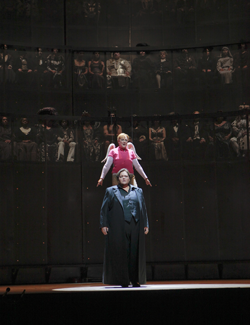 Stephanie Blythe as Orfeo and Heidi
Grant Murphy as Amor with chorus in background
Stephanie Blythe as Orfeo and Heidi
Grant Murphy as Amor with chorus in background
The myth of Orpheus is not a theatrical story — boy meets girl, boy
loses girl, boy has a chance to get her back but blows it. There is very
little for the girl to do, and hardly anything for anyone else: it is
practically a monodrama, though it has never (to my knowledge) been set to
music that way. To the ancients, it was a tale of death and mystical rebirth,
and if you joined the cult of the Orphic Mysteries, you could enter the
Members Only section after death — but that won’t do today: we
need a more universal message, like “Love conquers all,” even
though it clearly doesn’t. (Has anyone you loved come back from the
dead? Was that because you didn’t love them enough? Does anyone dead
come back? Mythologically, Eurydice never did.)
But as Orpheus was the mythic type of the musician, whenever opera remembers its classical roots (not that they have much to do with what opera turned into), Orpheus gets updated and some theatrical sense must be made of his quest. In Offenbach’s operetta (a send-up of Gluck), the two lovers have irreconcilable differences over his old-fashioned taste in music. In Sarah Ruhl’s recent play, Eurydice, the girl tricks Orpheus into looking back because she doesn’t want to rejoin him: she prefers cozy death to chancy life.
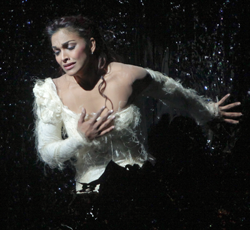 Danielle de Niese as Euridice
When Gluck and his librettist, Calzabigi, approached the subject, in a
self-consciously “reforming” mood, they started out by omitting
“boy meets girl, boy loses girl” — these events have
already occurred at curtain rise. They then expanded Orfeo’s quest to
the Underworld into several great solo, chorus and dance opportunities. Then
came their big alteration of the legend: instead of going so quietly that
Orfeo isn’t sure she’s there, begins to doubt the word of his
gods, and betrays his oath, this Euridice is a nag who never shuts up, and
Orfeo (who is barred, in this version, from telling her why he cannot turn to
look at her), is finally driven to violate his word. Euridice is lost and
Orfeo gets his most famous aria, “Che faro.” This is followed by
alteration two: The gods change their minds and give her back anyway. If you
have read the synopsis before you go in, this will undercut the tragic level
of what has gone before, but it does allow for extended dances of rejoicing
and a happy hymn to triumphant Love for us to hum going home.
I’ll admit I’ve never been entirely happy with any staging I’ve seen of Gluck’s opera (six and counting) — though from what I read, the current Viennese one sounds promising, austere and grand. The opera is so tightly focused on Orfeo’s feelings that there should be as little opportunity for wandering attention as possible, and I’ve been most pleased when, for example, the chorus were out of sight, in the orchestra pit, and dancers mimed their feelings. The Mark Morris staging at the Met seems mostly to be about Isaac Mizrahi’s costumes (creating far too much individuation precisely where it was not wanted), so that the rhythmic gestures of the corps de ballet miming grief and sympathy (and, in the finale, rejoicing), are distractingly individual, while the hundred historic “witnesses” of the chorus who look on at this (and who become without change of costume furies or whatever the libretto needs) seem a pointless extravagance.
We always knew Blythe could sing the music; she can sing anything. But the role does not play to her strengths, and I eagerly await her appearance in something that does.
John Yohalem