![Valerie Ogbonnaya (Silvia) [Photo by Richard Termine courtesy of Gotham Chamber Opera]](http://www.operatoday.com/Valerie_Ogbonnaya.png)
15 Mar 2009
Haydn’s L’Isola Disabitata by Gotham Chamber Opera
Had a misunderstanding with your truelove lately? Tough job straightening things out?
English Touring Opera are delighted to announce a season of lyric monodramas to tour nationally from October to December. The season features music for solo singer and piano by Argento, Britten, Tippett and Shostakovich with a bold and inventive approach to making opera during social distancing.
This tenth of ten Live from London concerts was in fact a recorded live performance from California. It was no less enjoyable for that, and it was also uplifting to learn that this wasn’t in fact the ‘last’ LfL event that we will be able to enjoy, courtesy of VOCES8 and their fellow vocal ensembles (more below …).
Ever since Wigmore Hall announced their superb series of autumn concerts, all streamed live and available free of charge, I’d been looking forward to this song recital by Ian Bostridge and Imogen Cooper.
The Sixteen continues its exploration of Henry Purcell’s Welcome Songs for Charles II. As with Robert King’s pioneering Purcell series begun over thirty years ago for Hyperion, Harry Christophers is recording two Welcome Songs per disc.
Although Stile Antico’s programme article for their Live from London recital introduced their selection from the many treasures of the English Renaissance in the context of the theological debates and upheavals of the Tudor and Elizabethan years, their performance was more evocative of private chamber music than of public liturgy.
In February this year, Albanian soprano Ermonela Jaho made a highly lauded debut recital at Wigmore Hall - a concert which both celebrated Opera Rara’s 50th anniversary and honoured the career of the Italian soprano Rosina Storchio (1872-1945), the star of verismo who created the title roles in Leoncavallo’s La bohème and Zazà, Mascagni’s Lodoletta and Puccini’s Madama Butterfly.
Evidently, face masks don’t stifle appreciative “Bravo!”s. And, reducing audience numbers doesn’t lower the volume of such acclamations. For, the audience at Wigmore Hall gave soprano Elizabeth Llewellyn and pianist Simon Lepper a greatly deserved warm reception and hearty response following this lunchtime recital of late-Romantic song.
Collapsology. Or, perhaps we should use the French word ‘Collapsologie’ because this is a transdisciplinary idea pretty much advocated by a series of French theorists - and apparently, mostly French theorists. It in essence focuses on the imminent collapse of modern society and all its layers - a series of escalating crises on a global scale: environmental, economic, geopolitical, governmental; the list is extensive.
For this week’s Live from London vocal recital we moved from the home of VOCES8, St Anne and St Agnes in the City of London, to Kings Place, where The Sixteen - who have been associate artists at the venue for some time - presented a programme of music and words bound together by the theme of ‘reflection’.
'Such is your divine Disposation that both you excellently understand, and royally entertaine the Exercise of Musicke.’
Amongst an avalanche of new Mahler recordings appearing at the moment (Das Lied von der Erde seems to be the most favoured, with three) this 1991 Mahler Second from the 2nd Kassel MahlerFest is one of the more interesting releases.
‘And there was war in heaven: Michael and his angels fought against the dragon; and the dragon fought and his angels, And prevailed not; neither was their place found any more in heaven … that old serpent … Satan, which deceiveth the whole world: he was cast out into the earth, and his angels were cast out with him.’
If there is one myth, it seems believed by some people today, that probably needs shattering it is that post-war recordings or performances of Wagner operas were always of exceptional quality. This 1949 Hamburg Tristan und Isolde is one of those recordings - though quite who is to blame for its many problems takes quite some unearthing.
There was never any doubt that the fifth of the twelve Met Stars Live in Concert broadcasts was going to be a palpably intense and vivid event, as well as a musically stunning and theatrically enervating experience.
‘Love’ was the theme for this Live from London performance by Apollo5. Given the complexity and diversity of that human emotion, and Apollo5’s reputation for versatility and diverse repertoire, ranging from Renaissance choral music to jazz, from contemporary classical works to popular song, it was no surprise that their programme spanned 500 years and several musical styles.
The Academy of St Martin in the Fields have titled their autumn series of eight concerts - which are taking place at 5pm and 7.30pm on two Saturdays each month at their home venue in Trafalgar Square, and being filmed for streaming the following Thursday - ‘re:connect’.
The London Symphony Orchestra opened their Autumn 2020 season with a homage to Oliver Knussen, who died at the age of 66 in July 2018. The programme traced a national musical lineage through the twentieth century, from Britten to Knussen, on to Mark-Anthony Turnage, and entwining the LSO and Rattle too.
With the Live from London digital vocal festival entering the second half of the series, the festival’s host, VOCES8, returned to their home at St Annes and St Agnes in the City of London to present a sequence of ‘Choral Dances’ - vocal music inspired by dance, embracing diverse genres from the Renaissance madrigal to swing jazz.
Just a few unison string wriggles from the opening of Mozart’s overture to Le nozze di Figaro are enough to make any opera-lover perch on the edge of their seat, in excited anticipation of the drama in music to come, so there could be no other curtain-raiser for this Gala Concert at the Royal Opera House, the latest instalment from ‘their House’ to ‘our houses’.
"Before the ending of the day, creator of all things, we pray that, with your accustomed mercy, you may watch over us."
Had a misunderstanding with your truelove lately? Tough job straightening things out?
Lovers, consider Gernando’s problem: He and his Costanza were visiting a desert island one day, thirteen years ago, when, without a word of warning, he vanished. Naturally she is peeved. When getting food and shelter (for herself and an infant sister, her only companion) have not distracted her, she has spent her spare time carving diatribes against the male sex in the rock. But he has a perfectly reasonable excuse — he was kidnapped by pirates! At last he has returned to the uninhabited island (“l’isola disabitata”) to see if she survives — she does! In sound health, good looks and a rather chic grass skirt! (Nothing like a healthy diet and lots of sleep to keep a diva limber.)
You can imagine what Mozart would have made of this absurd situation: He’d have gone wild, ten minutes at least of bitter reproaches, intricate descriptions (sung and orchestral) of his agonies, of her agonies, then joyous resolution as she gradually succumbs to his desperate pleas of enduring love…. Things would get completely out of hand, the duet would become a thing ungainly, unbalancing the brief exposition allowed by Metastasio’s libretto — but, by Thalia, it would be fun! It would be melodrama! In a Haydn opera, however, nothing is out of proportion and hardly anything is ever fun, or dramatic, or exciting. The singers are supposed to supply that, if they can, and the half-fledged cast of the Gotham Chamber Opera presentation are just not up to it, though they sound pleasant enough.
They probably trained on Mozart and Handel, and Mozart and Handel were men whose eyes lit up at the word “theatre” — they knew how to tell a story on the stage. It was in their blood somehow, and it passed right by Haydn. An opera to him might as well have been a string quartet with scenery. Hardly any of his operas were performed in urban centers in his lifetime — they were composed for the court theater at the country estate of Esterháza (a homey little 400-seat affair which today hosts a festival), and at Esterháza they remained. That meant they were not written for the great singers of the day, and also that the scores did not have to woo a popular audience — as Gluck did, or Mozart, or Paisiello, Martín y Soler, Salieri, Grétry. One learns things about opera construction if one’s listeners are paying customers, throwing tomatoes or simply not returning for more. Modern opera composers, mostly academics, suffer the same lack of apprenticeship that afflicted Haydn, with the same effect. Haydn knew it, too — when asked by a Prague producer for one of his opere buffe, he replied that none of his works for Esterháza was suitable for public presentation, and that he would be wary in any case of trying to compete on Mozart’s territory.
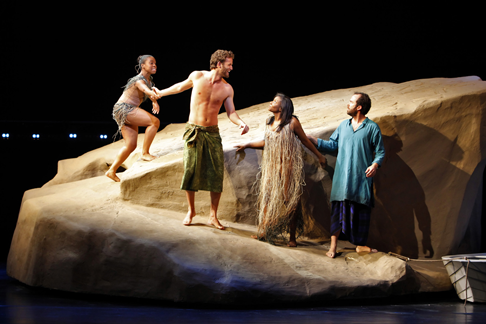 (Left to Right) Valerie Ogbonnaya, Tom Corbeil, Takesha Meshé Kizart and Vale Rideout
But back to L’Isola Disabitata, which has just been presented by Gotham Chamber Opera, with great fanfare, in a staging by Mark Morris. The piece was composed in 1779 (the year of Gluck’s Iphigénie en Tauride), shortly after a fire at Esterháza, and apparently the reconstruction budget permitted just one set, four characters, and no chorus. The opera is a succession of arias for four characters whose emotions are both predictable and shallow. There is one striking novelty, probably inspired by Gluck’s reforms: the singing is accompanied by orchestra throughout; there is no continuo to set off dialogue from arias. But Gluck knew how to build tension and how to bully his librettist into supplying the occasion for such tension. There is little tension in the score of L’Isola Disabitata. The opera concludes after a few predictable encounters with a vaudeville quartet in the French style: each character sings of what she or he has learned, to variants of a rondo melody, and they depart enlightened. The most famous such finale is that of Mozart’s Seraglio (1782), which states the moral clearly, but is enriched by the explosive intrusion (in an unsatisfied minor key) of the one character who has never changed and never will — to our thorough delight. Haydn would never have introduced something so tasteless, even in a farce. (He wrote several; none are performed very often.)
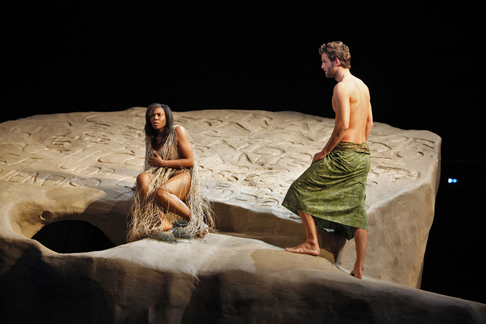 Takesha Meshé Kizart and Tom Corbeil
The GCO set was a revolving rock. One problem the cast may have had was in performing while maintaining balance on this thing, and the contortions involved in seeing or pretending not to see other characters, as called for by the script, surely did not help. The only obvious sign of Mark Morris influence came in hand-jive charades performed by each character in turn during the final quartet — this was charming, keeping our attention, heightening the individuality of Haydn’s generic characters, settling the plot happily.
The young, attractive performers may have left school a few years ago, but they all sounded like promising music students here. This is not a compliment: there was little that was “finished” about these performances and nothing that was deep. Perhaps, again, it is Haydn’s fault: Mozart gives you characters to play, with human quirks and expressions; so does Rossini; so does Paisiello. Haydn does not. It’s only play-acting, right? Why try to make these people real? (An apocryphal story has it that when Haydn attended the Vienna premiere of Don Giovanni, he realized how very out of his depth he was and gave up composing opera then and there. It may be true; Haydn had taste, judgment and good sense; he admired Mozart and would have grasped his achievement better than just about anyone else alive.)
For Takesha Meshé Kizart, the Costanza, company artistic director Neil Goren replaced the opening aria with one of Haydn’s many concert arias — that is, a piece written to suit the talents of an individual singer in the revival of a longer work written for someone else, a perfectly canonical practice. But the effect here was not good, as her performance was lackluster — only her second, rather more agitated aria seemed to wake her up, and her situation (thirteen years in solitary?) led us to expect rather more fireworks than she cared to offer. Her spousal unit, Vale Rideout, and his half-naked sidekick, Tom Corbeil, made pleasant, uninteresting sounds perhaps awkwardly placed due to their distance from the floor when singing. The only performer with much charm or distinction was the soubrette, Valerie Ogbonnaya, as Costanza’s naïve sister, a “Miranda” figure, whose innocence of the world (and of men) are intended to give us a thrill of contrast: she gave her character the light, fresh sound and airy coloratura proper to the dainty drama. The character is absurd, a sophisticated fantasy, but she sang and acted it as if it were something worth putting over.
I’m delighted at the notion of a chamber opera company in New York, and in the idea of exploring lesser-known crannies of the eighteenth century, but Haydn’s operas are not where his heart, or his genius, lay. With all possible good wishes for Gotham’s success in its downright heroic work in the current economic times, the company has made some weird repertory choices over the years; in the eighteenth century, for one thing, they would be better advised to examine composers like Paisiello and Grétry and Martín y Soler who knew how to write for the stage.
John Yohalem