Not until
Gounod’s Faust appeared, did Trovatore grudgingly yield
first place, but it didn’t go quietly. (Quietly? Trovatore?) At
the old Met at the turn of the century, before unions, Trovatore
sometimes appeared on double bills — the millionaires in the boxes might
depart for other entertainment, but the fans in the cheap seats hung on
screaming till the wee hours. The Marx Brothers didn’t have to
search for an opera to make fun of — they, and all their
audiences, knew Trovatore’s glorious absurdities from the
cradle: anvils, gypsies, long-lost kin, the stake! the poisoned ring! the
block! There were literally thousands of productions, despite a story that
tends to lurch around the war-torn Spanish landscape.
The conclusion one must draw is that it can’t be that
difficult to stage the thing. Caruso famously said all you needed was the four
greatest singers in the world, and that was when there were contenders for such
title. But you don’t really need top-flight Verdi giants (a good thing;
we no longer have them); you just need good singers who will hurl
themselves into the drama as if ready to die to reach that high note. Listen to
Emma Eames, a famously cold soprano, in her 1909 recording of the Act IV duet,
“Mira d’acerbe lagrime,” with baritone Emilio de Gogorza:
they seem to be aiming for a new speed record, but each grace note, each twirl
of a vocal figure, is perfectly produced, perfectly in place, perfectly
focused, and means what it should mean about passion and melodrama.
That’s how you sing Verdi.
The Met has staged Trovatore four times since the new house opened
in 1966, and the first three were variously atrocious, even when (to begin
with) they had the right singers. In 1969, there was the grotesque Attilio
Colonello production; in 1989, the Fabrizio Melano production, as handsome as
the Colonello was ugly, but with an absurd grandiosity: set among
imperial-sized columns on rollers, the gypsies encamped on a glossy ballroom
floor; in 2000, the notorious Graham Vick production where, in only the
evening’s most egregious folly, the tenor bursting through a
four-story-high crucifix in a convent wall had the audience laughing so hard it
stopped the show for ten minutes. The best Trovatore I’ve seen
under Met auspices in recent years was a 1998 concert in Prospect Park under
Marco Armiliato’s baton, with June Anderson and Larissa Diadkova singing
like goddesses.
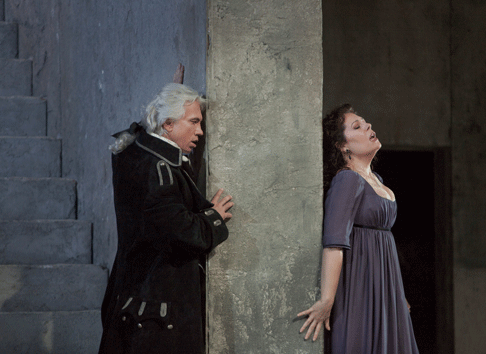 Dmitri Hvorostovsky as Count di Luna and Sondra Radvanovsky as Leonora
But we can’t have a grand opera house without a functional
Trovatore — it has been truly called the most operatic
of operas. So they had to try again, and fourth time is the charm — or
have we all become less demanding?
Set designer Charles Edwards has given us a turntable with a wall on it and
assorted dreary backdrops. The wall has a vertiginous staircase on one side, a
mélange of Spanish architectural elements from various eras on the other, all
cluttered together as, indeed, they often are in Spain. The costumes by
Brigitte Reifenstuel seem more or less nineteenth century (the opera is set in
1412), but I wish she had picked just one year: Leonora wears an unfortunate
Empire-waisted gown, Inez rather more Victorian garb, the Count di Luna a
frilly eighteenth-century officer’s uniform and Manrico a Romanian Gypsy
vest. There are various grilles for Manrico’s guerrillas to climb, most
athletically, in the convent scene — which one expects of guerrillas
— but how many Leonoras become crazed enough to climb them, too, on
hearing Manrico’s song in the turret scene? That may be a feature of
Sondra Radvanovsky’s view (expressed in an interview) of Leonora as a
teenager.
David McVicar, a director famous for his “Bollywood” version of
Handel’s Giulio Cesare, has made the old contraption work, and a
full house on March 10 was very happy and reluctant to depart — and no
one was giggling inappropriately, except perhaps Dolora Zajick as the crazed
Azucena and Kwangchul Youn, a tipsy Ferrando — I’ve always thought
of Ferrando as a grim retainer, telling ghost stories and nursing the family
grudge. There were, it seemed to me, far too many far too noisy camp followers
in Act III — they are nowadays inescapable in any soldiers’ camp
scene, but when I listened to the broadcast, I could understand every syllable
the soldiers were singing, and that’s very unusual (Met chorus master
Donald Palumbo is my hero, as I’ve said before, at Peter Grimes
and Satyagraha), but in the house one hardly noticed they were singing
at all because the girls were carrying on so. The staging of the convent scene,
the arrival of the guerrillas, the fight with the soldiers, the abduction of
Leonora as she is about to take holy orders, was a bit choppy — it always
is — but the opera’s end, confrontations, executions, revelations
that follow each other with startling speed, I have never seen staged or acted
more convincingly. This scene, if no other, should arouse shock and not
laughter, and McVicar’s cast pulled it off. Also pulling it off were the
bare-chested Gypsy blacksmiths, whose hammers mercifully hit the anvils on the
beat. I cringe for lazier revivals.
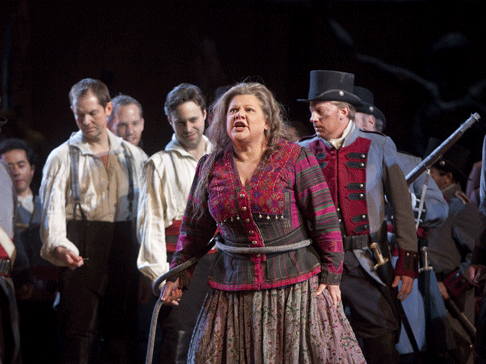 Dolora Zajick as Azucena
Marcelo Álvarez sang the troubadour, a modern, lost, existential hero like
Wagner’s Siegmund, who never learns the truth about his birth or anything
else important, but whose passions drive the story. Álvarez has an impressive
instrument, both graceful and sizable in mid-voice, but fading out in the upper
range — like many a fine Manrico (Tucker, Domingo), he lacks the ringing
top C that Verdi didn’t write anyway. He did not carry a harp or any
other instrument, which was puzzling since his offstage airs are sung to a
harp, and I found both these numbers a bit rushed and graceless, lacking
romantic atmosphere. Manrico should have an air of mystery, the alluring voice
in the darkness, the unknown knight who won that tournament, and fudging the
serenade punctures this mystery. On the whole he made a stalwart, passionate,
masculine figure, and it has been many years since any Met Manrico did such
justice to “Ah si, ben mio,” with every little curlicue elegantly
in place. This did not sound affected — it sounded seductive — a
warrior in love. Naturally the girl fell all over him.
The girl was Sondra Radvanovsky, currently, by default, the Met’s
leading Verdi soprano, a splendid Luisa Miller and an able Elena in Vespri
Siciliani (the toughest of all Verdi soprano roles). She has all the
technical devices necessary for Leonora, the floating pianissimo, acceptable
trills, volume whenever called for, and she is, moreover, a passionate actress
— but I would find her more convincing if she did less rolling about on
the floor. Leonora may be in her teens, but she’s a Spanish noblewoman in
her teens — she has dignity, she seriously considers becoming a nun; she
shouldn’t remind us of Carol Burnett or Gilda Radner, and
Radvanovsky’s jumping and climbing about often does. My real problem with
her, though, is the quality of her voice, exciting but not beautiful
— I miss the luster of Price, Arroyo, Caballé, Anderson, where the
ethereal floating tone seemed to explain how this devout girl has allowed love
to replace religious duty in her life. It is not a pretty or a sensuous voice;
I do not love the sheer sound of it. (I’m told it sounds less acid
upstairs.) But that she is a fine singing actress is beyond question.
Dmitri Hvorostovsky, for whom Verdi roles in a Met-sized house sometimes
seem too much, sang “Il balen” with superb, flawless line, total
control and long, flowing, high notes like chocolate ganache. If the Met
permitted encores, we’d all still be there, applauding or listening.
“Il balen” is one of Verdi’s great internal arias, a
character exploring his soul, and Counts who can put it over make us love them
despite the fact that they are contemplating rape and religious violation. It
was a noble performance — and it took a lot out of him, for he was way
off pitch during the agitated cabaletta that follows. The rest of the night he
was stern and on his mettle.
Dolora Zajick held down Azucena powerfully, lacking nothing obvious of the
mad Gypsy’s force of character, but she has never been a subtle actress
and I found her manic giggles out of place, her trills mere tuneless buzzing. A
little more active despair — especially in her great confrontation with
the Count and his army — would be in order. Some viewers found her
grotesque, but the character is grotesque, indeed half mad — the story
makes no sense if she’s played any other way. Rational people don’t
behave like characters in Il Trovatore. That’s why we love the
opera.
Gianandrea Noseda, in the pit, erred a bit on the side of bel canto —
Trovatore is not bel canto, it’s blood and thunder. He tempi lag
now and then as if to give the singers a hand (Emma Eames a hundred years ago
would not have needed it — but these are decadent times), but my only
real objection to his Trovatore is the perfunctory rush-through he
gave both of Manrico’s serenades. Manrico is the eponymous troubadour,
and these are his calling cards — they require the stillness and romance
of nights in the gardens of old Aragon.
But the Met has a solid Trovatore production — the first
since they tore the old house down — and one that can be inhabited by any
number of Verdi singers for years to come. I’m rather intrigued by the
second cast, coming up in April, which will include Marco Berti (a fine
Gabriele Adorno) as Manrico, Hasmik Papian (a noble Aida) as Leonora and Zeljko
Lucic (a great Macbeth and Germont) as the Count.
John Yohalem
![Marcelo Álvarez as Manrico [Photo by Ken Howard courtesy of The Metropolitan Opera]](http://www.operatoday.com/Alvarez_as_Manrico.gif)