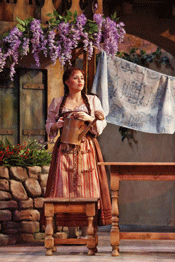
![Mara Bonde as Adina [Photo by Richard Termine courtesy of Sarasota Opera]](http://www.operatoday.com/Mara_Bonde_Adina.gif)
27 Mar 2009
In Sarasota the composer is king
In the world of opera it’s now the director who is the top banana.
English Touring Opera are delighted to announce a season of lyric monodramas to tour nationally from October to December. The season features music for solo singer and piano by Argento, Britten, Tippett and Shostakovich with a bold and inventive approach to making opera during social distancing.
This tenth of ten Live from London concerts was in fact a recorded live performance from California. It was no less enjoyable for that, and it was also uplifting to learn that this wasn’t in fact the ‘last’ LfL event that we will be able to enjoy, courtesy of VOCES8 and their fellow vocal ensembles (more below …).
Ever since Wigmore Hall announced their superb series of autumn concerts, all streamed live and available free of charge, I’d been looking forward to this song recital by Ian Bostridge and Imogen Cooper.
The Sixteen continues its exploration of Henry Purcell’s Welcome Songs for Charles II. As with Robert King’s pioneering Purcell series begun over thirty years ago for Hyperion, Harry Christophers is recording two Welcome Songs per disc.
Although Stile Antico’s programme article for their Live from London recital introduced their selection from the many treasures of the English Renaissance in the context of the theological debates and upheavals of the Tudor and Elizabethan years, their performance was more evocative of private chamber music than of public liturgy.
In February this year, Albanian soprano Ermonela Jaho made a highly lauded debut recital at Wigmore Hall - a concert which both celebrated Opera Rara’s 50th anniversary and honoured the career of the Italian soprano Rosina Storchio (1872-1945), the star of verismo who created the title roles in Leoncavallo’s La bohème and Zazà, Mascagni’s Lodoletta and Puccini’s Madama Butterfly.
Evidently, face masks don’t stifle appreciative “Bravo!”s. And, reducing audience numbers doesn’t lower the volume of such acclamations. For, the audience at Wigmore Hall gave soprano Elizabeth Llewellyn and pianist Simon Lepper a greatly deserved warm reception and hearty response following this lunchtime recital of late-Romantic song.
Collapsology. Or, perhaps we should use the French word ‘Collapsologie’ because this is a transdisciplinary idea pretty much advocated by a series of French theorists - and apparently, mostly French theorists. It in essence focuses on the imminent collapse of modern society and all its layers - a series of escalating crises on a global scale: environmental, economic, geopolitical, governmental; the list is extensive.
For this week’s Live from London vocal recital we moved from the home of VOCES8, St Anne and St Agnes in the City of London, to Kings Place, where The Sixteen - who have been associate artists at the venue for some time - presented a programme of music and words bound together by the theme of ‘reflection’.
'Such is your divine Disposation that both you excellently understand, and royally entertaine the Exercise of Musicke.’
Amongst an avalanche of new Mahler recordings appearing at the moment (Das Lied von der Erde seems to be the most favoured, with three) this 1991 Mahler Second from the 2nd Kassel MahlerFest is one of the more interesting releases.
‘And there was war in heaven: Michael and his angels fought against the dragon; and the dragon fought and his angels, And prevailed not; neither was their place found any more in heaven … that old serpent … Satan, which deceiveth the whole world: he was cast out into the earth, and his angels were cast out with him.’
If there is one myth, it seems believed by some people today, that probably needs shattering it is that post-war recordings or performances of Wagner operas were always of exceptional quality. This 1949 Hamburg Tristan und Isolde is one of those recordings - though quite who is to blame for its many problems takes quite some unearthing.
There was never any doubt that the fifth of the twelve Met Stars Live in Concert broadcasts was going to be a palpably intense and vivid event, as well as a musically stunning and theatrically enervating experience.
‘Love’ was the theme for this Live from London performance by Apollo5. Given the complexity and diversity of that human emotion, and Apollo5’s reputation for versatility and diverse repertoire, ranging from Renaissance choral music to jazz, from contemporary classical works to popular song, it was no surprise that their programme spanned 500 years and several musical styles.
The Academy of St Martin in the Fields have titled their autumn series of eight concerts - which are taking place at 5pm and 7.30pm on two Saturdays each month at their home venue in Trafalgar Square, and being filmed for streaming the following Thursday - ‘re:connect’.
The London Symphony Orchestra opened their Autumn 2020 season with a homage to Oliver Knussen, who died at the age of 66 in July 2018. The programme traced a national musical lineage through the twentieth century, from Britten to Knussen, on to Mark-Anthony Turnage, and entwining the LSO and Rattle too.
With the Live from London digital vocal festival entering the second half of the series, the festival’s host, VOCES8, returned to their home at St Annes and St Agnes in the City of London to present a sequence of ‘Choral Dances’ - vocal music inspired by dance, embracing diverse genres from the Renaissance madrigal to swing jazz.
Just a few unison string wriggles from the opening of Mozart’s overture to Le nozze di Figaro are enough to make any opera-lover perch on the edge of their seat, in excited anticipation of the drama in music to come, so there could be no other curtain-raiser for this Gala Concert at the Royal Opera House, the latest instalment from ‘their House’ to ‘our houses’.
"Before the ending of the day, creator of all things, we pray that, with your accustomed mercy, you may watch over us."
In the world of opera it’s now the director who is the top banana.
He moves Figaro into Trump Towers and has Giovanni — light headed after two centuries of champagne — shoot up on cocaine in the South Bronx. Caesar courts Cleopatra — or is it the other way around? — poolside at the Cairo Hilton. Elixir — cross bred with The Music Man — plays at the Iowa State fair. It’s fun now and then, but in the long run it’s opera that suffers from this mayhem and madness. And thus in the midst of all this it’s reassuring to know that there is an opera company where it’s still the composer who comes first: the Sarasota Opera that just wound up its 50th anniversary season on the Florida coast.
“Our mission is to produce outstanding opera true to the vision of the composer,” says Victor DeRenzi, SO artistic director for half its history. “Here each production is based on one approach: the view of the work that comes from the composer.” The result is opera as envisioned by those who created it; no one else gets in the way.
 Suzel : Catherine Cangiano
Those who have never attended one of the 500 performances that DeRenzi has conducted in Sarasota might find this the conservative credo of a man who looks back in history. But those who know the perfection and excitement of every opera staged at the SO relish the authenticity — and respect — that DeRenzi brings to SO productions.
In Sarasota it’s Verdi’s Verdi and Puccini’s Puccini that is on stage — not a flight of the imagination imposed upon their work by the Wunderkinder of Regieoper — director’s opera, the European import that currently prevails elsewhere. The major triumph of the 2009 season that ran for eight late-winter weeks in the intimate SO house that was handsomely rebuilt a year ago was Verdi’s Don Carlo. With it DeRenzi as conductor again confirmed his stature as a leading interpreter of this composer.
Don Carlo isn’t merely Verdi at his best, it is also the best of his operas based on a drama by Germany’s Friedrich Schiller. Here the Italian patriot underscores the parallels between the struggle for freedom in Inquisition-ridden Spain and the Italy of his own day.
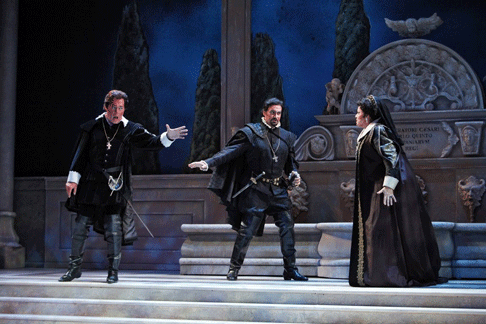 Eboli : Stella Zambalis; Don Carlos : Gustavo López Manzitti; Rodrigue : Marco Nisticò
Kevin Short was a deeply human Philippe II, unable to assert himself against the intolerance of a church chillingly represented by Jeffrey Tucker as the Grand Inquisitor. Panamanian Reyna Carguill was a full-blooded Elizabeth, beautifully balanced by the searing mezzo of Stella Zambalis as Eboli. And as Rodrigue Marco Nistico` was the very fiber from which revolutionaries are made.
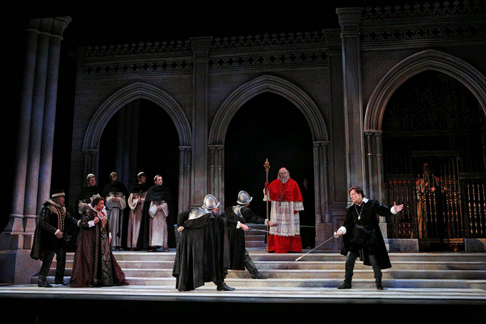 Elisabeth : Reyna Carguill; Don Carlos : Gustavo López Manzitti; Philippe : Kevin Short; Grand Inquisitor : Jeffrey Tucker
It was only Argentina’s Gustavo López Manzitti who in the title role failed to reach the level of passion of his colleagues. Stephanie Sundine directed this first North-American production of the four-act French version of the opera. Sets were by David P. Gordon, and Howard Tsvi Kaplan was responsible for lavish costumes that enhanced the realism of Verdi’s 16th-century Spaniards. Indeed, Kaplan who created costumes for all four operas of the SO season is a major asset of the company.
Each season Sarasota revives a work that has disappeared from the repertory, and the reaction to the first act of L’Amico Fritz, the 2009 “masterpiece,” was that works residing in oblivion are perhaps right where they belong. By the second act Mascagni’s 1891 score dispelled such doubts as vintage verismo warmed the heart. Swiss tenor Benjamin Warschawski and American soprano Catherine Cangiano were a winning lovers, while Heather Johnson earned high marks in the trouser role of Beppe. And although a rabbi seemed somewhat out of place in late 19th-century Alsace baritone Michael Corvino made him a winning figure. David Neely conducted; Michael Unger was stage director. Sets were by Michael Schweikardt.
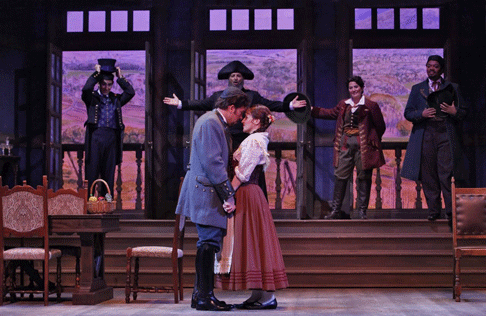 Suzel : Catherine Cangiano; Beppe : Heather Johnson; Fritz Kobus : Benjamin Warschawski; David : Michael Corvino
The popularity of Donizetti’s Elixir of Love easily leads to overplayed and exaggerated stagings. Happily, however, director Martha Collins kept everything under careful control to make the SO production unusually engaging. She was helped by an ideal cast led by youthful Mexico’s Edgar Ernesto Ramirez, a tenor who might well have the makings of a future Pavarotti.
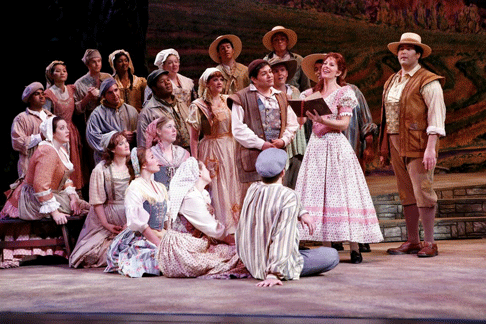 Adina : Mara Bonde; Nemorino : Edgar Ernesto Ramirez; Giannetta : Jo Ellen Miller
Michael Redding obviously relished the lover-boy image of soldier Belcore, and Stephen Eisenhard was a delight as an understated snake-oil salesman Dulcamara. As Adina Mara Bonde was all sugar and spice. John Mario Di Constanza conducted. Roger Hanna signed for sets.
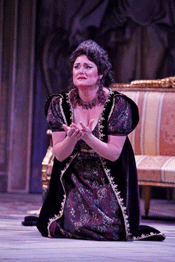 Floria Tosca : Kara Shay Thomson
One would search far today to find a better trio of singers than the three brought to Sarasota for Tosca, which opened the season on February 7. In her SO debut Kara Shay Thomson was a Floria Tosca even younger than the years of the established singer that Puccini’s heroine is. She sang the famous “Vissi d’arte” with tender and internalized emotion.
Rafael Dávila, a splendid Cavaradossi, is a native of Puerto Rico and yet another of the richly talented tenors now coming from Latin countries. Yet it was the Scarpia of Grant Youngblood that brought new dimensions to this staging. Long a signature role of the American baritone, Youngblood downplays the tyrant that Scarpia is to make the appeal of Tosca to him far more than a passing sexual fantasy. DeRenzi conducted; Sundine was the director.
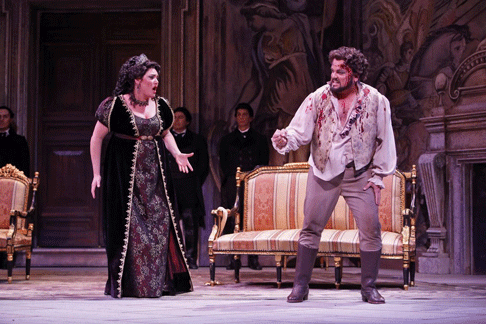 Floria Tosca : Kara Shay Thomson; Mario Cavaradossi : Rafael Dávila
Of special interest was the March 20 performance of opera choruses by the Sarasota Youth Opera, an ensemble open to kids from the third grade up. The thoroughly professional conduct of these 75 singers was as amazing as it was impressive. Lance Inouye, their major mentor, conducted the full SO orchestra for the event. This is the only such opera program in the United States.
Wes Blomster