![Katya Kabanova - English Touring Opera [Photo by Robert Workman]](http://www.operatoday.com/katya-180.gif)
24 Mar 2009
Katya Kabanova/The Magic Flute — English Touring Opera, Hackney Empire Theatre
English Touring Opera is 30 years old this year, and has never been more adventurous.
English Touring Opera are delighted to announce a season of lyric monodramas to tour nationally from October to December. The season features music for solo singer and piano by Argento, Britten, Tippett and Shostakovich with a bold and inventive approach to making opera during social distancing.
This tenth of ten Live from London concerts was in fact a recorded live performance from California. It was no less enjoyable for that, and it was also uplifting to learn that this wasn’t in fact the ‘last’ LfL event that we will be able to enjoy, courtesy of VOCES8 and their fellow vocal ensembles (more below …).
Ever since Wigmore Hall announced their superb series of autumn concerts, all streamed live and available free of charge, I’d been looking forward to this song recital by Ian Bostridge and Imogen Cooper.
The Sixteen continues its exploration of Henry Purcell’s Welcome Songs for Charles II. As with Robert King’s pioneering Purcell series begun over thirty years ago for Hyperion, Harry Christophers is recording two Welcome Songs per disc.
Although Stile Antico’s programme article for their Live from London recital introduced their selection from the many treasures of the English Renaissance in the context of the theological debates and upheavals of the Tudor and Elizabethan years, their performance was more evocative of private chamber music than of public liturgy.
In February this year, Albanian soprano Ermonela Jaho made a highly lauded debut recital at Wigmore Hall - a concert which both celebrated Opera Rara’s 50th anniversary and honoured the career of the Italian soprano Rosina Storchio (1872-1945), the star of verismo who created the title roles in Leoncavallo’s La bohème and Zazà, Mascagni’s Lodoletta and Puccini’s Madama Butterfly.
Evidently, face masks don’t stifle appreciative “Bravo!”s. And, reducing audience numbers doesn’t lower the volume of such acclamations. For, the audience at Wigmore Hall gave soprano Elizabeth Llewellyn and pianist Simon Lepper a greatly deserved warm reception and hearty response following this lunchtime recital of late-Romantic song.
Collapsology. Or, perhaps we should use the French word ‘Collapsologie’ because this is a transdisciplinary idea pretty much advocated by a series of French theorists - and apparently, mostly French theorists. It in essence focuses on the imminent collapse of modern society and all its layers - a series of escalating crises on a global scale: environmental, economic, geopolitical, governmental; the list is extensive.
For this week’s Live from London vocal recital we moved from the home of VOCES8, St Anne and St Agnes in the City of London, to Kings Place, where The Sixteen - who have been associate artists at the venue for some time - presented a programme of music and words bound together by the theme of ‘reflection’.
'Such is your divine Disposation that both you excellently understand, and royally entertaine the Exercise of Musicke.’
Amongst an avalanche of new Mahler recordings appearing at the moment (Das Lied von der Erde seems to be the most favoured, with three) this 1991 Mahler Second from the 2nd Kassel MahlerFest is one of the more interesting releases.
‘And there was war in heaven: Michael and his angels fought against the dragon; and the dragon fought and his angels, And prevailed not; neither was their place found any more in heaven … that old serpent … Satan, which deceiveth the whole world: he was cast out into the earth, and his angels were cast out with him.’
If there is one myth, it seems believed by some people today, that probably needs shattering it is that post-war recordings or performances of Wagner operas were always of exceptional quality. This 1949 Hamburg Tristan und Isolde is one of those recordings - though quite who is to blame for its many problems takes quite some unearthing.
There was never any doubt that the fifth of the twelve Met Stars Live in Concert broadcasts was going to be a palpably intense and vivid event, as well as a musically stunning and theatrically enervating experience.
‘Love’ was the theme for this Live from London performance by Apollo5. Given the complexity and diversity of that human emotion, and Apollo5’s reputation for versatility and diverse repertoire, ranging from Renaissance choral music to jazz, from contemporary classical works to popular song, it was no surprise that their programme spanned 500 years and several musical styles.
The Academy of St Martin in the Fields have titled their autumn series of eight concerts - which are taking place at 5pm and 7.30pm on two Saturdays each month at their home venue in Trafalgar Square, and being filmed for streaming the following Thursday - ‘re:connect’.
The London Symphony Orchestra opened their Autumn 2020 season with a homage to Oliver Knussen, who died at the age of 66 in July 2018. The programme traced a national musical lineage through the twentieth century, from Britten to Knussen, on to Mark-Anthony Turnage, and entwining the LSO and Rattle too.
With the Live from London digital vocal festival entering the second half of the series, the festival’s host, VOCES8, returned to their home at St Annes and St Agnes in the City of London to present a sequence of ‘Choral Dances’ - vocal music inspired by dance, embracing diverse genres from the Renaissance madrigal to swing jazz.
Just a few unison string wriggles from the opening of Mozart’s overture to Le nozze di Figaro are enough to make any opera-lover perch on the edge of their seat, in excited anticipation of the drama in music to come, so there could be no other curtain-raiser for this Gala Concert at the Royal Opera House, the latest instalment from ‘their House’ to ‘our houses’.
"Before the ending of the day, creator of all things, we pray that, with your accustomed mercy, you may watch over us."
English Touring Opera is 30 years old this year, and has never been more adventurous.
Later this year the company will be dispensing with the usual two- or three-opera tour format, as well as their now-regular opening venue of the Hackney Empire, in favour of a five-opera Handel festival at the Britten Theatre in this 250th anniversary year of the composer’s death.
For the spring tour, though, the format is largely the familiar one: an opera from the borderline of the standard repertoire paired with a popular hit that will guarantee consistent ticket revenues. As this is a major birthday for the company, there are a few concert performances of Norma thrown in for good measure — about which more in late April.
James Conway’s production of Katya Kabanova, with a set design by Adam Wiltshire, looks a little like a miniature version of Trevor Nunn’s 1994 production for Covent Garden, all grey colours and sloping wooden walkways. My only real complaint here would be that neither ETO’s production nor the orchestra made much of an attempt to evoke the Volga, whose presence is so central to the opera that it is virtually a character in its own right. As a minimum, Katya’s death plunge (a cramped and unconvincing affair) really needs sorting out before the tour goes much further.
In a fairly small space and with a reduced orchestra, the full lyrical power of Janacek’s scoring was never really going to be a possibility, though one could hardly have asked for better playing from the forces available. Conductor Michael Rosewell ensured that the the musical line was tautly controlled and powerfully driven, and paid detailed attention to the expressiveness of the more transparent and intimate moments.
But here the vocal performances made the greatest impression. The title role was compellingly and radiantly sung by soprano Linda Richardson, who managed to convey the essence of the lively spirit and physical beauty trapped behind the dowdy façade Katya has been forced to adopt. Mezzo Fiona Kimm was a truly despicable Kabanicha — and I mean that in the most complimentary sense. Like her Jezibaba in last autumn’s Rusalka, there was a grandeur to her stage presence which defied her petite stature; the physical contrast between her and Dikoy — the immensely tall and broad Welsh bass Sion Goronwy — made the nature of their relationship all the more telling. Colin Judson’s Tichon was a perfect portrait of a man who wouldn’t know how to stand up to his mother even if he wanted to.
Jane Harrington was an ideal Varvara, her voice and manner warm, lively and straightforward; together with Michael Bracegirdle’s Kudryash and Richard Roberts’s Boris, they made a vivacious trio of youngsters who served to highlight only too plainly how Katya’s own life might have been.
Onto the next night, and there was predictably a full house for The Magic Flute. When the curtain went up, it at first seemed that the production might be quite unconventional: Tamino’s serpent is a writhing chain of contemporary(ish) whores and playboys, his wilderness a human one. A clean-cut youth dressed smartly in a pale jacket, the prince (Mark Wilde) is an obvious outsider to the black and silver lace of the figures which dominate his nightmare world. There’s even some suggestion that Papageno (complete with fluttering birds borne by scurrying members of the chorus) might be a drug-induced hallucination, and Tamino is rightly unsure where vision ends and reality begins. The Queen of the Night makes her first appearance from the rear centre stage with an immense royal-blue train which fills the entire set; as she sings, it has rolling waves like a nocturnal sea. But as she turns to make her exit, the train disappears through a trapdoor leaving her clad in black; from then on, reality stabilises somewhat, and Tamino’s quest of self-discovery continues along more conventional lines.
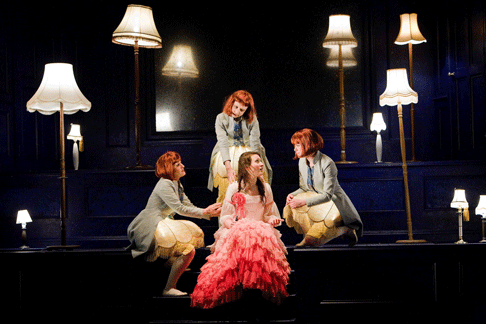 Scene from The Magic Flute [Photo by Robert Workman courtesy of English Touring Opera]
The production remains slightly surreal throughout, being set in an enclosed room with panelled walls painted a deep blue, several doors and trap-doors, and an aperture at the rear which is used for grand entrances and whenever a visual focal point is required. The guiding role of the three boys (here sung by women, as is practical for a touring production) is underlined by their surprising costumes, with skirts made of lit lamp-shades. There are a lot of lights and lamps in this dark-coloured staging, but these are often confusing to the adventurers rather than illuminating; at one point a forest of standard-lamps springs up around Papageno as he searches for his Papagena. The young American soprano Paula Sides was a passionate Pamina, her soprano richer and more complex than is often heard in this role. Other than a slight hardness under pressure at the top of her voice, she sounded truly glorious, with some beautifully controlled pianissimo singing towards the end of ‘Ach, ich fühl’s’. Also vocally impressive was Laure Meloy as the Queen of the Night, again with a fuller and more refulgent tone than many; however, although she cut an imposing and elegant figure, her body language conveyed little in the way of rage and fury. Andrew Slater’s Sarastro had physical presence aplenty, but vocally he lacked weight and authority. Daniel Grice’s Papageno had energy and good humour although his bright and forward baritone was rather monochrome and unvarying in volume.
A little more variety would have been welcome in other areas too. In the pit, Paul McGrath started the overture with such pointed deliberation that I feared it could be a long evening, but if anything he tended towards the other extreme; ‘In diesen heil’gen Hallen’ had a folk-tune feel to it, and if ‘Ach, ich fühl’s’ had been any faster it would have been one-in-a-bar. Generally his approach succeeded in maintaining momentum, but it sidelined the moments of grandeur, reflection and calm.
Singing in Jeremy Sams’s gently humorous English translation (well-known to London audiences from ENO’s popular production), the cast generally did an excellent job with the English text.
Ruth Elleson © 2009