08 Mar 2009
Korngold Thrills in Venice
It is not often that the team of stage director, set and costume designer get the biggest, most boisterously rowdy roar of approval at opera's end.
English Touring Opera are delighted to announce a season of lyric monodramas to tour nationally from October to December. The season features music for solo singer and piano by Argento, Britten, Tippett and Shostakovich with a bold and inventive approach to making opera during social distancing.
This tenth of ten Live from London concerts was in fact a recorded live performance from California. It was no less enjoyable for that, and it was also uplifting to learn that this wasn’t in fact the ‘last’ LfL event that we will be able to enjoy, courtesy of VOCES8 and their fellow vocal ensembles (more below …).
Ever since Wigmore Hall announced their superb series of autumn concerts, all streamed live and available free of charge, I’d been looking forward to this song recital by Ian Bostridge and Imogen Cooper.
The Sixteen continues its exploration of Henry Purcell’s Welcome Songs for Charles II. As with Robert King’s pioneering Purcell series begun over thirty years ago for Hyperion, Harry Christophers is recording two Welcome Songs per disc.
Although Stile Antico’s programme article for their Live from London recital introduced their selection from the many treasures of the English Renaissance in the context of the theological debates and upheavals of the Tudor and Elizabethan years, their performance was more evocative of private chamber music than of public liturgy.
In February this year, Albanian soprano Ermonela Jaho made a highly lauded debut recital at Wigmore Hall - a concert which both celebrated Opera Rara’s 50th anniversary and honoured the career of the Italian soprano Rosina Storchio (1872-1945), the star of verismo who created the title roles in Leoncavallo’s La bohème and Zazà, Mascagni’s Lodoletta and Puccini’s Madama Butterfly.
Evidently, face masks don’t stifle appreciative “Bravo!”s. And, reducing audience numbers doesn’t lower the volume of such acclamations. For, the audience at Wigmore Hall gave soprano Elizabeth Llewellyn and pianist Simon Lepper a greatly deserved warm reception and hearty response following this lunchtime recital of late-Romantic song.
Collapsology. Or, perhaps we should use the French word ‘Collapsologie’ because this is a transdisciplinary idea pretty much advocated by a series of French theorists - and apparently, mostly French theorists. It in essence focuses on the imminent collapse of modern society and all its layers - a series of escalating crises on a global scale: environmental, economic, geopolitical, governmental; the list is extensive.
For this week’s Live from London vocal recital we moved from the home of VOCES8, St Anne and St Agnes in the City of London, to Kings Place, where The Sixteen - who have been associate artists at the venue for some time - presented a programme of music and words bound together by the theme of ‘reflection’.
'Such is your divine Disposation that both you excellently understand, and royally entertaine the Exercise of Musicke.’
Amongst an avalanche of new Mahler recordings appearing at the moment (Das Lied von der Erde seems to be the most favoured, with three) this 1991 Mahler Second from the 2nd Kassel MahlerFest is one of the more interesting releases.
‘And there was war in heaven: Michael and his angels fought against the dragon; and the dragon fought and his angels, And prevailed not; neither was their place found any more in heaven … that old serpent … Satan, which deceiveth the whole world: he was cast out into the earth, and his angels were cast out with him.’
If there is one myth, it seems believed by some people today, that probably needs shattering it is that post-war recordings or performances of Wagner operas were always of exceptional quality. This 1949 Hamburg Tristan und Isolde is one of those recordings - though quite who is to blame for its many problems takes quite some unearthing.
There was never any doubt that the fifth of the twelve Met Stars Live in Concert broadcasts was going to be a palpably intense and vivid event, as well as a musically stunning and theatrically enervating experience.
‘Love’ was the theme for this Live from London performance by Apollo5. Given the complexity and diversity of that human emotion, and Apollo5’s reputation for versatility and diverse repertoire, ranging from Renaissance choral music to jazz, from contemporary classical works to popular song, it was no surprise that their programme spanned 500 years and several musical styles.
The Academy of St Martin in the Fields have titled their autumn series of eight concerts - which are taking place at 5pm and 7.30pm on two Saturdays each month at their home venue in Trafalgar Square, and being filmed for streaming the following Thursday - ‘re:connect’.
The London Symphony Orchestra opened their Autumn 2020 season with a homage to Oliver Knussen, who died at the age of 66 in July 2018. The programme traced a national musical lineage through the twentieth century, from Britten to Knussen, on to Mark-Anthony Turnage, and entwining the LSO and Rattle too.
With the Live from London digital vocal festival entering the second half of the series, the festival’s host, VOCES8, returned to their home at St Annes and St Agnes in the City of London to present a sequence of ‘Choral Dances’ - vocal music inspired by dance, embracing diverse genres from the Renaissance madrigal to swing jazz.
Just a few unison string wriggles from the opening of Mozart’s overture to Le nozze di Figaro are enough to make any opera-lover perch on the edge of their seat, in excited anticipation of the drama in music to come, so there could be no other curtain-raiser for this Gala Concert at the Royal Opera House, the latest instalment from ‘their House’ to ‘our houses’.
"Before the ending of the day, creator of all things, we pray that, with your accustomed mercy, you may watch over us."
It is not often that the team of stage director, set and costume designer get the biggest, most boisterously rowdy roar of approval at opera's end.
But then, La Fenice’s extraordinary Die Tote Stadt was helmed on all three counts by the venerable triple threat Pier Luigi Pizzi in another of his masterful displays of how to perfectly showcase and (gasp) serve the work at hand. At this point in his long and illustrious career, Signor Pizzi is deservedly a veritable national treasure.
His atmospheric setting consisted largely of two angled black platforms mid-stage, headed by a door on each side, dipping from the wings, and coming to rest one on top of the other center stage, serving as the wherewithal for the entrances and exits in the “realistic” scenes.
This rather shallow space was dressed with two black-draped tables, sporting vases stuffed profusions of white flowers. Stacks of plump, over-sized black pillows were strewn on the floor, perfect for lounging. The stage right table also bore the all-important silver box-cum-reliquary containing the dead wife’s braid of hair. A full-length black and white oil painting of the deceased Marie was propped on the stage right wall, flanked by large candlesticks, and complemented with a corresponding full length mirror stage left.
This whole elegant “prison” of Paul’s own creation, is framed by a mirrored proscenium, and backed by black drapes, but no ordinary backdrop was this. For the cloth was able to trim into fourths (making three vertical openings) and/or fly into the loft, revealing all or part of a fantasy land of water and set pieces that were perfectly calculated to suggest the various locales in our hero’s troubled mind.
This upstage nether world was slightly skewed by a giant tilted overhead mirror which reflected the pool of water and all that was in it from a disorienting perspective. The tourist postcard town of Bruges never looked like this! After Marietta’s first appearance in which she teased and left, the drapes then revealed her upstage as the dead Marie, clad in white, and subsequently outlined by a spectral white frame that tilted up at us out of the water, creating a living double for the oil painting. Chilling.
After Marie glided off, she soon came back in a taunting mood, clad in a devastatingly dazzling red gown, replete with long train and diaphanous capes that she trailed in the water as she twirled and flung red roses willy nilly, roses from an identical bouquet that had figured so prominently in Marietta’s first scene.
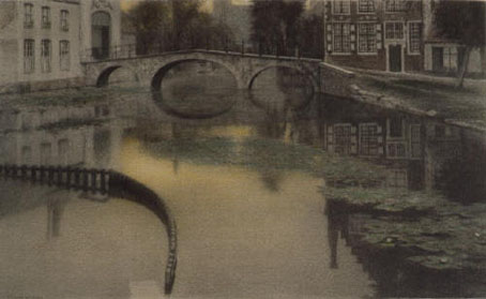 L’entrée du Béguinage by Fernand Khnopff (1904).
Act Two’s carnival featured a canal boat, a silvery denuded cypress tree, two rotating buildings, Bruges’ bell tower, and, well…truly gorgeous designer costumes, another of Pizzi’s masterful accomplishments. To name one, there was a knockout nudie black lace number that evoked the same peak-a-boo naughtiness that adorned Anita Morris in Nine. Marietta was resplendent in yet another star-worthy, drop dead sequined red dress.
The most creative costume design effect was arguably the white clad funeral procession, which began respectfully enough slogging through the water, and ended with a profane parody of a religious ceremony, with the celebrants revealed to be naked under their chasubles. Their frenzied religious-sexual fervor as they kicked and hurled water about, costumes akimbo, in a demented tarantella was powerful imagery indeed. (Vincenzo Raponi contributed the excellent lighting design, and Marco Berriel the free-wheeling choreography.)
Nor did Pizzi falter in his directorial accomplishment with a gifted cast of singers pulled from the front ranks of the world’s roster. Stefan Vinke, in the punishing role of Paul, experienced a bit of spreading at times, but he is also in command of stentorian high notes that are as thrilling as you are likely to hear today. Man, he slams them home!
True, he sometimes did not recover quickly from the effort, the voice getting brittle in mezzo forte mid-range passages, and there were a few rough releases. However, he gets all the notes and more in this killer part, and even manages some wonderful messa di voce effects. I do worry that he muscled up for the big outpourings — I have never seen anyone open his mouth that wide — no, never — provoking concern for just how relaxed his jaw might be. But Herr Vinke delivered the musical goods, and he is also a committed actor with an appealing “bear” look. He is singing Siegfried later in the season here, and it should hold no terrors for him.
Solveig Kringleborn as Marie/Marietta confirmed my wonderful previous impressions of her artistry with an assured impersonation that was beautiful, blond, sexy, fearless, and vibrantly sung. Mariettas Lied, the opera’s best known tune, was voiced with silvery tone and lovely limpid phrasing. Her full-throated, arching phrases also gave much pleasure and if her vibrato got a bit (but just a bit) generous in pressed lower passages, it was more womanly than off-putting.
The roles of Frank-Fritz were well-served by the very musical baritone Stephan Genz, even though the voice occasionally got a little croony and hooty as is the wont of some German baritones. It must be said his Pierrot’s Song (the other famous melody) was pleasantly taken. All of the featured ensemble solos were uniformly secure. Special mention must go to mezzo Christa Mayer, whose Brigitta was a piece of luxury casting that showcased a rich, full-bodied instrument that would be a pleasure to encounter as, say, the Nurse in “Die Frau Ohne Schatten.”
The orchestra regaled us with professional playing of the highest order, easily the best effort from the pit I have yet experienced at La Fenice. Under Maestro Eliahu Inbal, they embraced every demand of Korngold’s sprawling score, capable at will of being tender, passionate, delicate, agitated, percussive, melodic, and most important, sensitively supportive of the singers.
Still, for all the radiant musical accomplishments, it was Pier Luigi’s day. His sure hand was evident in so many ways: beautiful use of the levels to define character relationships, excellent variety of blocking using the entire space in a psychologically meaningful way, and the ability and willingness to simply serve the creators’ intentions. When Marietta taunted Paul with Marie’s braid and he strangled her with it, it was not only highly effective drama, it was also just as called for in the script.
The final image found Paul walking slowly out of his “prison” and into the fantasy world upstage, literally walking into a sea of possibilities. He had shed his demons at last.
This was stunning lyric theatre. Mr. Pizzi, we should be cheering you still.
James Sohre