La Sonnambula is a story of true love thwarted by jealousy then joyously restored, among peasants so unsophisticated they believe ghost stories but have never heard of sleepwalking. The urbane Milanese observed this with the proper degree of
condescension – it was quaint, but it wasn’t fluff; the feelings
are real; Bellini makes them so; the rest is up to the singers. Peasant society
as a place of seething, primal passions was the trope of later generations. Of
course, urban audiences enjoyed feeling superior to that, too.
Pastoral fantasy is long out of fashion, and it’s evidently something
Peter Gelb at the Met and director Mary Zimmerman are ashamed of –
sufficiently ashamed for Gelb to dismiss the opera’s plot publicly, and
for Zimmerman to ignore it in her staging, which is not so much post-modern as
a bunch of casual goofs on Sonnambula – there is no coherent
story line in it, because the characters must change personality drastically
from one moment to the next, alternately following Zimmerman’s
“concept” or singing Bellini’s opera – the two have
little in common, and no one onstage can be in just one or the other –
Zimmerman has seen to that.
She has set the piece in a rehearsal hall in Manhattan during the run up to
a performance of La Sonnambula – okay – starring a
self-important diva who chatters on a cell phone during her sortita
and is betrothed to the star tenor – okay – and the diva’s
jealous rival has become the sulky stage manager. But then real feelings leap
out of the music, and real words (Zimmerman knows no Italian, but there are
titles on the seat backs), and these modern figures cannot be using these 1831
words. They don’t make sense in 2009. Try to imagine an opera chorus in
contemporary New York who refuse to believe in sleepwalking – have they
never heard of Macbeth? Or a visiting star baritone (as
Bellini’s Count has become) who, instead of taking a luxury hotel room
for the night (hey, even during a blizzard, it’s a short cab or subway to
the Pierre), is forced to sack out on a cot in the rehearsal hall just so the
diva can turn up in his bed. (Why else would this happen?) Or any celebrity
tenor who, on finding his celebrity soprano untrue, marries his ex the very
next day. Move out and shack up, yes; but marry? Church bells and all?
It’s not just that all this is trivial or perverse – it’s
that puzzling over whether a singer (or the chorus) is sincere or playing the
play within the play at every single moment gets in the way of being able to
hear, and appreciate, the music-making.
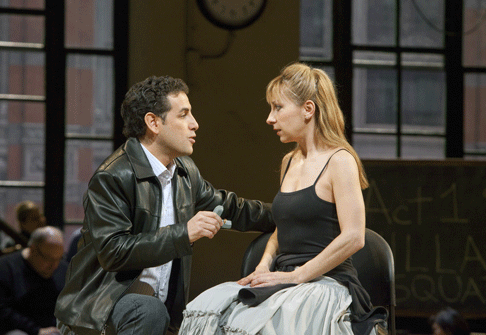 Juan Diego Flórez as Elvino and Natalie Dessay as Amina
I do understand why the chorus, at the end of Act I, rhythmically tear up
their scores and toss them about like confetti, while spinning the heroine
around on her bed: Mary Zimmerman does not know, understand, accept that music
has a place in opera; she does not believe it is important or interesting; she
wants to distract us with some activity or other so we won’t be bothered
by all that stuff being played and sung – you know – the music? The
reason the rest of us go to the opera, and wanted to revive this delicate piece
in the first place? Yes, the woman who slew the sextet in Lucia is at it again.
She doesn’t like opera, and it sure don’t like her.
Now you can see how this all came about, in a brain-storming session with
much laughter and, perhaps, alcohol: Amina sleepwalks across a mill-race? How
about a Manhattan ledge in a snowstorm? (laughter) And theater people are all
superstitious, right? So they believe there’s a rehearsal hall ghost.
(laughter) And turn jealous Lisa into an irritable stage manager. Brilliant!
And Elvino into a star tenor (like Florez) whose romance with the diva is the
talk of the tabloids (like Gheorghiu or Netrebko). Genius! But it’s not;
it just makes us uncertain who is singing any phrase at any particular time. It
takes away much and adds nothing. This is not updating – it’s frat
house or SNL skit. (I’m surprised the Count isn’t in drag.)
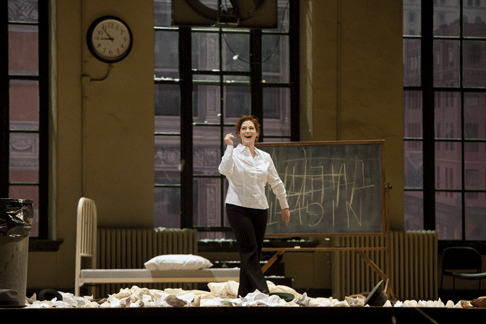 Jennifer Black as Lisa
The thing is, this cast could have put the piece over as written. Whenever
Juan Diego lets loose with his soaring high notes, he is not merely a joy to
hear, he is expressing real feeling – not the feeling of whoever,
whatever, he is supposed to be playing in this “concept,” but the
feeling Bellini bestowed on the character of Elvino. And when Natalie Dessay,
alone in a spotlight on a plank over the orchestra pit, sings the dreamy,
endlessly unreeling melody of Amina’s climactic sleepwalk (the melody
Chopin asked to have played to him while he was dying), she holds the house
silent and breathless on the thread of her voice. In short – they could
have played this thing straight, and it would have been great theater, and
we’d have been able to enjoy the rest of it, too.
Yes, Sonnambula, relic of a forgotten genre, the pathetic opera
semiseria, is a problem to present nowadays. But there are ways to present
Sonnambula that do not oblige you to disbelieve in the characters, to
doubt the meaning of every word they sing. The problem is not their words or
actions, but our attitude, and a great director would realize we are the ones
who must be transformed, brought into the proper frame of mind. When Luchino
Visconti directed Maria Callas in La Sonnambula, he staged the piece
in the manner of a “peasant” ballet like Giselle,
costumes, gestures, movements stylized to lure the viewer into the acceptance
of convention we bring to romantic dance. It was a triumph, for Visconti, for
Callas’s virtuosic singing and acting, and for Bellini – whose
operas no longer had to blush on the modern stage.
If you ignored the stage antics, if you were lucky enough to be stuck at
home, you could derive a great deal of pleasure from listening to this
Sonnambula. Florez’s voice has expanded to handle the exquisite
bel canto phrases, and though he can be a trifle nasal, he shows no sign of
strain as he inhabits the too-trusting, too-bitter, repentant Elvino. His
brilliant B-flat fills the huge house. His leap to head voice (perfectly
acceptable in Bellini’s time, deplored nowadays) is not only well
executed, he maneuvers it into an expression of dramatic despair. Michele
Pertusi makes a suavely supercilious Count – pity he doesn’t get to
reprise his cabaletta, one of my favorite tunes. Jennifer Black, the flirty
Lisa, acts vividly and sings her little arias with charm if perhaps too dark a
sound – I suspect and hope there is Verdi in her future. Evelino Pidò is
eminently the first thing one wants in a bel canto conductor: supportive of the
singers. Bellini is not a man to cover a voice – on the contrary, he
notoriously exposes it, often with only the lightest film of orchestral
accompaniment. There’s no place to hide if you are singing Bellini.
Natalie Dessay sings the long and arduous role of Amina very prettily, aside
from a few squally high notes, and phrases the great “Ah, non
credea” languorously, as if, well, asleep and dreaming – but
holding the whole house breathless to her every tone. Her sleepwalk on a ledge
does not quite come over – she can never just do something; she
has to futz with it, as she did with Lucia’s mad scene. This is a sleep
walk, not a sleep mambo. I liked her acting as Amina and I was amused
by her acting as a diva, but it was a pity she did both in the same performance
– it was impossible to believe they were the same woman. One of them was
just a performance, but which?
On March 11, even she seemed unsure – she blew her cue for the final
cabaletta twice, though she managed to “work it into” the
performance so that those attending for the first time thought she’d done
it on purpose. Perhaps she did. There’s no earthly way to tell which of
her jokes were to be laughed at and which not, and it was frustrating to have
to spend so much time working that out. The last Sonnambula I saw,
Ruth Ann Swenson’s in an unstaged concert by Opera Orchestra of New York
at Carnegie Hall, was not only more beautifully sung, it was far closer to the
dramatic truth of the piece.
John Yohalem
![Natalie Dessay as Amina [Photo by Ken Howard courtesy of The Metropolitan Opera]](http://www.operatoday.com/Dessay_Amina.gif)