19 Mar 2009
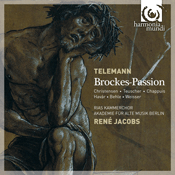
TELEMANN: Brockes-Passion
Heinrich Brockes’s famous poetic setting of the Passion, Der für die Sünden der Welt gemarterte und sterbende Jesus (1712), was one of the most significant devotional texts of its day in Germany.
English Touring Opera are delighted to announce a season of lyric monodramas to tour nationally from October to December. The season features music for solo singer and piano by Argento, Britten, Tippett and Shostakovich with a bold and inventive approach to making opera during social distancing.
This tenth of ten Live from London concerts was in fact a recorded live performance from California. It was no less enjoyable for that, and it was also uplifting to learn that this wasn’t in fact the ‘last’ LfL event that we will be able to enjoy, courtesy of VOCES8 and their fellow vocal ensembles (more below …).
Ever since Wigmore Hall announced their superb series of autumn concerts, all streamed live and available free of charge, I’d been looking forward to this song recital by Ian Bostridge and Imogen Cooper.
The Sixteen continues its exploration of Henry Purcell’s Welcome Songs for Charles II. As with Robert King’s pioneering Purcell series begun over thirty years ago for Hyperion, Harry Christophers is recording two Welcome Songs per disc.
Although Stile Antico’s programme article for their Live from London recital introduced their selection from the many treasures of the English Renaissance in the context of the theological debates and upheavals of the Tudor and Elizabethan years, their performance was more evocative of private chamber music than of public liturgy.
In February this year, Albanian soprano Ermonela Jaho made a highly lauded debut recital at Wigmore Hall - a concert which both celebrated Opera Rara’s 50th anniversary and honoured the career of the Italian soprano Rosina Storchio (1872-1945), the star of verismo who created the title roles in Leoncavallo’s La bohème and Zazà, Mascagni’s Lodoletta and Puccini’s Madama Butterfly.
Evidently, face masks don’t stifle appreciative “Bravo!”s. And, reducing audience numbers doesn’t lower the volume of such acclamations. For, the audience at Wigmore Hall gave soprano Elizabeth Llewellyn and pianist Simon Lepper a greatly deserved warm reception and hearty response following this lunchtime recital of late-Romantic song.
Collapsology. Or, perhaps we should use the French word ‘Collapsologie’ because this is a transdisciplinary idea pretty much advocated by a series of French theorists - and apparently, mostly French theorists. It in essence focuses on the imminent collapse of modern society and all its layers - a series of escalating crises on a global scale: environmental, economic, geopolitical, governmental; the list is extensive.
For this week’s Live from London vocal recital we moved from the home of VOCES8, St Anne and St Agnes in the City of London, to Kings Place, where The Sixteen - who have been associate artists at the venue for some time - presented a programme of music and words bound together by the theme of ‘reflection’.
'Such is your divine Disposation that both you excellently understand, and royally entertaine the Exercise of Musicke.’
Amongst an avalanche of new Mahler recordings appearing at the moment (Das Lied von der Erde seems to be the most favoured, with three) this 1991 Mahler Second from the 2nd Kassel MahlerFest is one of the more interesting releases.
‘And there was war in heaven: Michael and his angels fought against the dragon; and the dragon fought and his angels, And prevailed not; neither was their place found any more in heaven … that old serpent … Satan, which deceiveth the whole world: he was cast out into the earth, and his angels were cast out with him.’
If there is one myth, it seems believed by some people today, that probably needs shattering it is that post-war recordings or performances of Wagner operas were always of exceptional quality. This 1949 Hamburg Tristan und Isolde is one of those recordings - though quite who is to blame for its many problems takes quite some unearthing.
There was never any doubt that the fifth of the twelve Met Stars Live in Concert broadcasts was going to be a palpably intense and vivid event, as well as a musically stunning and theatrically enervating experience.
‘Love’ was the theme for this Live from London performance by Apollo5. Given the complexity and diversity of that human emotion, and Apollo5’s reputation for versatility and diverse repertoire, ranging from Renaissance choral music to jazz, from contemporary classical works to popular song, it was no surprise that their programme spanned 500 years and several musical styles.
The Academy of St Martin in the Fields have titled their autumn series of eight concerts - which are taking place at 5pm and 7.30pm on two Saturdays each month at their home venue in Trafalgar Square, and being filmed for streaming the following Thursday - ‘re:connect’.
The London Symphony Orchestra opened their Autumn 2020 season with a homage to Oliver Knussen, who died at the age of 66 in July 2018. The programme traced a national musical lineage through the twentieth century, from Britten to Knussen, on to Mark-Anthony Turnage, and entwining the LSO and Rattle too.
With the Live from London digital vocal festival entering the second half of the series, the festival’s host, VOCES8, returned to their home at St Annes and St Agnes in the City of London to present a sequence of ‘Choral Dances’ - vocal music inspired by dance, embracing diverse genres from the Renaissance madrigal to swing jazz.
Just a few unison string wriggles from the opening of Mozart’s overture to Le nozze di Figaro are enough to make any opera-lover perch on the edge of their seat, in excited anticipation of the drama in music to come, so there could be no other curtain-raiser for this Gala Concert at the Royal Opera House, the latest instalment from ‘their House’ to ‘our houses’.
"Before the ending of the day, creator of all things, we pray that, with your accustomed mercy, you may watch over us."
Heinrich Brockes’s famous poetic setting of the Passion, Der für die Sünden der Welt gemarterte und sterbende Jesus (1712), was one of the most significant devotional texts of its day in Germany.
A so-called “passion oratorio,” Brockes’s text is a fully versified account of the Passion of Jesus, harmonized from the various Gospel accounts. The perhaps more familiar model from Bach’s two passions is that of the “oratorio passion,” where a single Biblical account is preserved verbatim, with modern poetry and chorales interposed in the form of arias and choral or congregational song. If less familiar in our day, nevertheless Brockes’s text in its own time achieved great visibility through its frequent publication as a devotional text and in musical settings by Keiser (1712), Telemann (1716), Handel (1716), Mattheson (1718), Stölzel (1725), and Fasch (1723). Portions of the poem also appear in Bach’s St. John Passion.
Brockes was a native of Hamburg and from 1720 an active member of the government. Telemann also had a long association with Hamburg as Kantor and Music Director, appointments that began in 1721 and likely reveal the influence of the poet. Several years ealier (1716), Telemann had given performances of his setting of the Brockes Passion in Frankfort, where he was then municipal music director and chapel master at the Barfüsserkirche; these performances were repeated in Hamburg from 1718-1720. Thus, in at least a professional capacity, Telemann and Brockes would have been well known to each other. In Hamburg the requirements for new Passion settings would see Telemann compose over forty liturgical passions, a prolific response to a common Kantorial need. But the setting of the Brockes Passion has gained a significance and prominence beyond its sibling works. Consequently, this excellent new recording by René Jacobs and his forces is an especially welcome one.
Jacobs has shaped his reading of Telemann’s colorful score with a compelling dramatic sense. Somewhat surprisingly, the absence of prose in the libretto does not impede the dynamism and forward motion of the narrative, and the arias themselves are frequently short and rarely da capo. Occasionally units cohere to create something akin to a “cantata-as-scene.” For instance, early in the oratorio, Jesus pleads for mercy in a lyric aria (“Mein Vater! Schau, wie ich mich quäle”), followed by his recounting of the torments he bears in an accompanied recitative; this is then followed by a return of the aria music to a second stanza of text, reminiscent of structural patterns found in cantatas. We may tarry a bit in the “cantata,” but more typical is a sense of dramatic impulsion, animated by strong, vivid, and quick contrasts. For instance, following Peter’s denial, the penitent disciple sings of his regret in lamentative tones, which turn menacing with the text’s turn to Satan’s laugh. Similarly strong contrasts are found throughout the oratorio, including in the unusual attention given to Judas’s tortured resolution to hang himself, immediately followed by the Daughter of Zion’s pastoral reflection on God’s grace.
Brockes’s text imagery is drawn with a bold pen. Here, in an aria sung by a Faithful Soul, you get both an example of the vivid nature of the language and the characteristic dynamic of contrast:
His [Jesus’s] bloodstained back resembles Heaven
Adorned with countless rainbows,
Like signs of pure grace,
Which, where the guilty flood of our sins runs dry,
Shows us the radiant sun of his dear love
In the streams of his blood.
The vividness of Brockes’s language is well served by Telemann’s colorful approach to the score. Obbligato instrumental lines for oboe, flutes, recorders, and various strings are frequent, often dramatically symbolic, and challenging. Moreover, the orchestra is also given special effects, such as the haunting piercing of Jesus’s flesh in the sound of ponticello string bowing. Certainly one of the more impressive aspects of the recording is the brilliant playing of the orchestral players of Akademie für Alte Musik Berlin, with oboist Xenia Löffler offering particularly expressive performances. For their part, the solo singers uniformly embrace dramatic flexibility and fluency of idiom, and do so with compelling expertise—qualities that remind, as well, of the distinctive singing career of Jacobs himself.
Our deep attachment to Bach’s Passions may blind us to the broader contexts in which these beloved works arose. Telemann’s setting of the Brockes Passion is a masterful example of the riches that await our moving beyond the seasonally familiar; Jacobs’s performance is a most gratifying way to begin that journey.
Steven Plank