Recently in Reviews
English Touring Opera are delighted to announce a season of lyric monodramas to tour nationally from October to December. The season features music for solo singer and piano by Argento, Britten, Tippett and Shostakovich with a bold and inventive approach to making opera during social distancing.
This tenth of ten Live from London concerts was in fact a recorded live performance from California. It was no less enjoyable for that, and it was also uplifting to learn that this wasn’t in fact the ‘last’ LfL event that we will be able to enjoy, courtesy of VOCES8 and their fellow vocal ensembles (more below …).
Ever since Wigmore Hall announced their superb series of autumn concerts, all streamed live and available free of charge, I’d been looking forward to this song recital by Ian Bostridge and Imogen Cooper.
The Sixteen continues its exploration of Henry Purcell’s Welcome Songs for Charles II. As with Robert King’s pioneering Purcell series begun over thirty years ago for Hyperion, Harry Christophers is recording two Welcome Songs per disc.
Although Stile Antico’s programme article for their Live from London recital introduced their selection from the many treasures of the English Renaissance in the context of the theological debates and upheavals of the Tudor and Elizabethan years, their performance was more evocative of private chamber music than of public liturgy.
In February this year, Albanian soprano Ermonela Jaho made a highly lauded debut recital at Wigmore Hall - a concert which both celebrated Opera Rara’s 50th anniversary and honoured the career of the Italian soprano Rosina Storchio (1872-1945), the star of verismo who created the title roles in Leoncavallo’s La bohème and Zazà, Mascagni’s Lodoletta and Puccini’s Madama Butterfly.
Evidently, face masks don’t stifle appreciative “Bravo!”s. And, reducing audience numbers doesn’t lower the volume of such acclamations. For, the audience at Wigmore Hall gave soprano Elizabeth Llewellyn and pianist Simon Lepper a greatly deserved warm reception and hearty response following this lunchtime recital of late-Romantic song.
Collapsology. Or, perhaps we should use the French word ‘Collapsologie’ because this is a transdisciplinary idea pretty much advocated by a series of French theorists - and apparently, mostly French theorists. It in essence focuses on the imminent collapse of modern society and all its layers - a series of escalating crises on a global scale: environmental, economic, geopolitical, governmental; the list is extensive.
For this week’s Live from London vocal recital we moved from the home of VOCES8, St Anne and St Agnes in the City of London, to Kings Place, where The Sixteen - who have been associate artists at the venue for some time - presented a programme of music and words bound together by the theme of ‘reflection’.
'Such is your divine Disposation that both you excellently understand, and royally entertaine the Exercise of Musicke.’
Amongst an avalanche of new Mahler recordings appearing at the moment (Das Lied von der Erde seems to be the most favoured, with three) this 1991 Mahler Second from the 2nd Kassel MahlerFest is one of the more interesting releases.
‘And there was war in heaven: Michael and his angels fought against the dragon; and the dragon fought and his angels, And prevailed not; neither was their place found any more in heaven … that old serpent … Satan, which deceiveth the whole world: he was cast out into the earth, and his angels were cast out with him.’
If there is one myth, it seems believed by some people today, that probably needs shattering it is that post-war recordings or performances of Wagner operas were always of exceptional quality. This 1949 Hamburg Tristan und Isolde is one of those recordings - though quite who is to blame for its many problems takes quite some unearthing.
There was never any doubt that the fifth of the twelve Met Stars Live in Concert broadcasts was going to be a palpably intense and vivid event, as well as a musically stunning and theatrically enervating experience.
‘Love’ was the theme for this Live from London performance by Apollo5. Given the complexity and diversity of that human emotion, and Apollo5’s reputation for versatility and diverse repertoire, ranging from Renaissance choral music to jazz, from contemporary classical works to popular song, it was no surprise that their programme spanned 500 years and several musical styles.
The Academy of St Martin in the Fields have titled their autumn series of eight concerts - which are taking place at 5pm and 7.30pm on two Saturdays each month at their home venue in Trafalgar Square, and being filmed for streaming the following Thursday - ‘re:connect’.
The London Symphony Orchestra opened their Autumn 2020 season with a homage to Oliver Knussen, who died at the age of 66 in July 2018. The programme traced a national musical lineage through the twentieth century, from Britten to Knussen, on to Mark-Anthony Turnage, and entwining the LSO and Rattle too.
With the Live from London digital vocal festival entering the second half of the series, the festival’s host, VOCES8, returned to their home at St Annes and St Agnes in the City of London to present a sequence of ‘Choral Dances’ - vocal music inspired by dance, embracing diverse genres from the Renaissance madrigal to swing jazz.
Just a few unison string wriggles from the opening of Mozart’s overture to Le nozze di Figaro are enough to make any opera-lover perch on the edge of their seat, in excited anticipation of the drama in music to come, so there could be no other curtain-raiser for this Gala Concert at the Royal Opera House, the latest instalment from ‘their House’ to ‘our houses’.
"Before the ending of the day, creator of all things, we pray that, with your accustomed mercy, you may watch over us."
Reviews
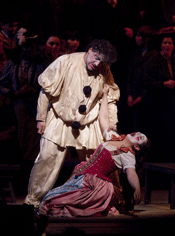
07 Apr 2009
Cavalleria Rusticana and I Pagliacci at the MET
The current revival of Cav and Pag at the Met went off like clockwork, with all the comfort and reliability that implies for a repertory house and all the success these tried and true verismo stalwarts merit.
No one was under par but there were very few surprises, few thrills or
chills. But each opera did conceal one surprise — one shock — one
small but significant vocal revelation — that made the evening other than
ordinary fare.
The spotlight on the curtain just before it rose on Franco
Zeffirelli’s almost too-accurate Sicilian mountain village drew from us
soft gasps of alarm, but it was just an announcement that José Cura, though
suffering from a cold, would be singing both leading tenor roles in any case.
(Domingo, his mentor, used to make such announcements all the time in the
’70s.) In the event, his opening serenade did indeed sound labored
— but when was the last time you heard any tenor, even in the pink of
health, sing that aria of sated love with an easy, leggiero line? For the rest
of the night he was fine, a bit gruff — as he usually is — and with
no ringing at the top, which some might miss. It’s a perfectly decent way
to put these parts over. Gigli fans will mourn, but he’s been dead a long
time.
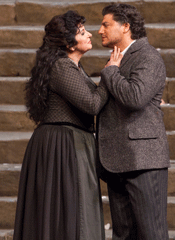 Ildikó Komlósi as Santuzza and José Cura as Canio in Mascagni’s Cavalleria Rusticana.
I was interested in the ladies of the evening. Ildikó Komlósi sang the most
mellow-sounding Herodias of my experience last fall — no
eldritch screamer but a chic, handsome hostess having trouble controlling her
adolescent daughter — and I wondered how that enjoyable take on Strauss
would translate to Mascagni’s tormented peasant. Komlósi is a fine
actress, and hurled herself about the story and the stage, but her essentially
lyric instrument (though she also sings Amneris and Eboli, which call for
power) did not at first warm to its task, to the expression of desperation
— Santuzza is always on the verge of hysteria, she says nothing calmly,
she opens her mouth and her whole anguished life is in her utterances.
Komlósi’s beautiful voice and Germanic (okay, Hungarian) vibrato are
pleasing, but she did not become intense until the duets with Cura and Alberto
Mastromarino’s dry, not very threatening Alfio pushed her to forget
herself and go wild. Santuzza has tripped up many experienced singers; I did
not feel she had it quite down, but she is a voice and an artist of
interest.
No part is too small for Jane Bunnell to make it interesting — on such
character performers do repertory companies rely, and her dignified Mamma Lucia
was a pleasure. But then out came Lola, a youngster from the Met’s
Lindemann Young Artists’s Program, one Ginger Costa Jackson, tall, slim,
very pretty, a bit too whorish about the sashay (an error made by too many
Lolas — she’s a respectable wife in a prudish small town, and no
one but Santuzza suspects she’s anything else), but — the voice! No
light mezzo here (as one is used to), but a deep, penetrating, perfectly
produced contralto with exciting colors. She would make quite an effect in a
range of Handel roles, trouser or otherwise.
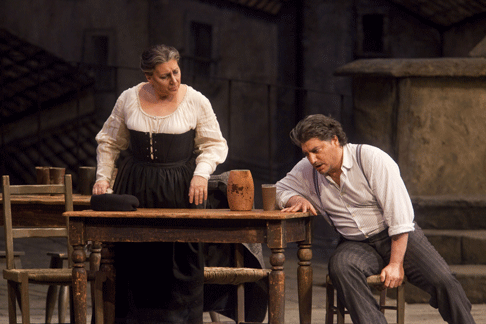 Jane Bunnell as Mamma Lucia and José Cura as Canio in Mascagni’s Cavalleria Rusticana.
The lady in Pagliacci — there’s only one, remember
— was Nuccia Focile, a charming soubrette in the past (an adorable
Despina in Cosí fan tutte), who sang a mediocre Nedda, the voice
unsupported, the coloratura imprecise in both “Stridono lassu” and
the play-within-the-play. The only time she rose to the demands of this
curious, death-defying figure was during her impassioned love duet with Silvio
— and here was the evening’s second surprise: Christopher Maltman.
This striking and sexy British baritone, a noted lieder singer as well as a
Billy Budd and a specialist in Mozart roles, filled the house with an easy,
dark, focused, thrilling baritone and was an equally thrilling actor. Too, he
sang with the most perfect Italian enunciation of the night. This is a voice
with star quality and a rare musical intelligence, a singer one is eager to
hear again in a dozen roles or in recital. Beside him, Cura and Mastromarino,
the evening’s Canio and Tonio, sounded effective but ordinary —
they wrung no sobs from me.
Pietro Rizzo had a firm hand on the dramatic flow of the evening in the pit;
the resonant celli seemed especially to flower, and I clearly heard echoes of
Wagner in Pagliacci, whenever Tonio was conniving. The Zeffirelli
staging with all its animals and all its children and all its gradual dawn and
sunset lighting changes and all its clowning extras gives audiences a notion of
what grand opera used to be about, and why young directors have been so eager
to change it. A ringing Canio, a gutsy Santuzza and a real Nedda would make it
for me.
John Yohalem