The result is a
production that is both entertaining and respectful of the score and text, with
a uniformly high level of singing as well as dramatic commitment. The Lyric
Opera Orchestra is led by Sir Andrew Davis, who elicits crisp playing with, at
times, broad strokes to suggest the forthcoming dramatic urgency,
complications, and eventual resolutions.
Already during the overture to this production the traditional concept of a
dramatic frame is used to highlight perspectives on the forthcoming action. As
will be revealed during the opening numbers of the first act, Konstanze and her
attendant Blonde have been captured at sea and are now held at the court of the
Pasha Selim. For the present production, through the course of the spirited
overture, the figure of an elderly man is seen picking up roses strewn on the
ground; further, he seems to be caught deep in silent contemplation, perhaps
musing on events of the past. As the overture draws to a suggestive close, the
lighting dims on this figure so that he is obscured, shortly before a trap door
in the center of the stage opens. The audience has been effectively transported
into the reverie of the now aged Pasha, as he recalls his attempts in the past
to force the affections of the captive Konstanze. Indeed out of the trap door
now climbs Belmonte, the nobleman who, in the recollection of the Pasha, has
come in search of his beloved Konstanze. In the leading tenor role of Belmonte
Matthew Polenzani has found an ideal match for his vocal talents. The urgency
of his emotional quest becomes immediately apparent as he climbs up onto the
stage and begins “Hier soll ich dich denn sehen” [“Here I
hope to finally see you”]. In this first aria Polenzani demonstrates the
effect of his elegant vocal line, a requisite in Mozart’s extended arias
composed for tenor in the Entführung. The seemingly endless flow of
“Bringe mich ans Ziel” [“Help me to reach the goal”],
sung here by Polenzani with admirable legato as he gazes at a
miniature portrait of Konstanze, underscores Belmonte’s commitment to
finding and saving his beloved. Of course all manner of obstacles will present
themselves, such as the immediately following exchange with Osmin, lead servant
of the Pasha. Belmonte persists in asking if he has truly come upon the palace,
while Osmsin seems distracted by amorous determination with women from the
harem. In the role of Osmin Andrea Silvestrelli projects an appropriate
gruffness while negotiating the vocal line with considerable variety. In the
first part of his duet with Belmonte Silvestrelli’s sonorous bass
emphasizes Osmin’s self-absorption while ignoring the visitor’s
queries. When Belmonte mentions the name of his squire Pedrillo, who was
captured along with Konstanze and her maid Blonde, Osmin’s attention is
quickly riveted to the immediate situation at court. He unleashes a spirited
attack on intruders, in which he declares full awareness of their villainy.
This diatribe is sung with comic lyricism by Silvestrelli, only losing some of
the syllables in the fastest passagework. As Pedrillo enters for a happy
reunion with his master Belmonte, the two hatch a plan to introduce the
nobleman as an architect offering his services to the Pasha. In the role of
Pedrillo the tenor Steve Davislim poses an ideal foil to his love-lorn and
anxious master. From this point to the close of the first act Davislim
encourages and cajoles, at once weaving between the threats of Osmin and the
dignified grandeur of the Pasha. In his extensive parts performed in dialogue
during these scenes Davislim’s idiomatic command of German adds to the
effectiveness of his character’s portrayal.
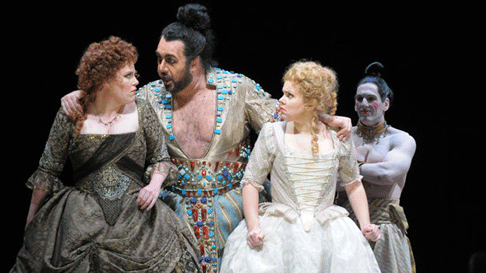 (l-r) Erin Wall (Konstanze), Andrea Silvestrelli (Osmin), Aleksandra Kurzak (Blonde)
Once Belmonte learns from his squire that Konstanze has survived and has
remained faithful, he sings the well-known aria “O wie ängstlich, o wie
feurig” [“O how anxious, o with what passion!”] in order to
describe the feelings pulsing from his heart. Polenzani’s carefully
projected legato and soft notes support a convincing interpretation
with dramatic spirit. At first, he touches his cheek to emphasize a line
(“Es glüht mir die Wange” [“My cheek is glowing”]),
before he intones “feurig” (“fiery”) with decided
conviction, repeating and varying the aria’s fist line. Once he and
Pedrillo leave the stage, Konstanze enters in the company of the Pasha. In her
response to her captor’s urging that she submit to his affections,
Konstanze protests that she still loves Belmonte. In her aria “Ach, ich
liebte” (“Ah, but I loved”) Erin Wall in the soprano role of
Konstanze confirms her reputation as a fine Mozart singer. In this first aria
Ms. Wall maintains firm control of the vocal line with notable decoration while
investing great feeling in her intonation of the text. In this sense, she and
Polenzani are well-balanced vocally as the lovers awaiting reunion beyond
daunting obstacles. Konstanze is now granted only one day further by the Pasha
in order to yield to his demands.
The final scene of Act I demonstrates not only the importance of ensemble in
Mozart’s Entführung but also the success of Lyric Opera’s
new production at rendering both drama and music in scenes involving groups.
Once Pedrillo introduces Belmonte to the Pasha as an aspiring architect, a door
lifts at the stage center symbolizing the entrance to the palace garden. Osmin
stands guard and refuses admission to the two intruders as he sees them. During
the following trio sung by the male principals, the slaves and members of the
harem move about the stage with ballet-like effect, the door as symbol
remaining a goal thoughout the weaving movements. As the act concludes,
Belmonte and his squire escape into the garden while the moving chorus prevents
Osmin from stopping them at the door.
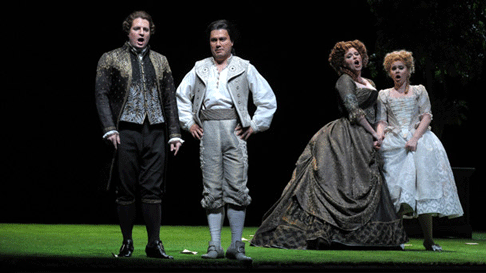 Matthew Polenzani (Belmonte), Steve Davislim (Pedrillo), Erin Wall (Konstanze), Aleksandra Kurzak (Blonde)
At the start of Act II the comic scene between Blonde and Osmin sets the
tone for their encounters during the remainder of the opera. Osmin’s
commands to Blonde that she should immediately love him are met with indignant
reminders that European women are not accustomed to such treatment. As
Alexandra Kurzak in the role of Blonde reminds her pursuer with the words
“Denen begegnet man ganz anders” [“One treats such women
quite differently”], she begins her aria ‘Durch Zärtlichkeit und
Schmeicheln” [“With tenderness an flattery”] on a note of
superiority. Ms. Kurzak had been unable to sing the first performance because
of illness and was making her debut during the performance reviewed. Her
impeccable diction and sprightly acting fit the character of Blonde admirably,
while the line and vocal command shown here and in later arias and ensembles
demonstrate the work of an accomplished Mozart singer. In the following
extended scena Konstanze sings at first of her suffering and
subsequently declares her intention to remain faithful to her lover until
death. Ms. Wall performs this two-part scene with exemplary focus on the text,
her repetitions of “Traurigkeit” [“Sadness”] in the
first part addressed to Blonde being invested with a genuine communication of
feeling. The staging at this point draws on poses and techniques reminiscent of
eighteenth-century practice, with a simplicity underscoring the effective
acting of the principals. After comparing her life to a “rose
blighted” that “withers away,” Konstanze again faces the
Pasha who reminds her that the deadline has arrived. Her response, the aria
“Martern aller Arten” [“Torments of all kinds”] as the
second number in this extended scene, is sung by Ms. Wall with dramatic flair
and a confident, firm use of coloratura decoration. The well-deserved ovation
given the performance of this vocal showpiece of the opera was a comment not
only on the exquisite singing but also on the use of voice as an instrument in
acting. During the aria a shallow revolving platform at the stage center kept
the Pasha and Konstanze at a measured distance from each other; the rotating
structure is used again later in the act when Pedrillo outwits Osmin and
praises the power of wine.
The remaining scenes of the second act give rise to the hope of escape.
Pedrillo appears in numbers together with his Blonde and with his master
Belmonte. Both Davislim and Kurzak excel vocally in their solo reactions to
plans hatched to free Konstanze. Ms. Kurzak introduces well-placed
appogiaturas and dwells significantly on the word “Herzen”
[“heart”]. Davislim uses his upper register to great effect
especially when he sings forte on the phrases “Es sei
gewagt” [“Let us dare the deed”] and “zum
Streite” [“to the fight!”]. His comic scene with Osmin, the
latter falling into a drunken stupor despite his protests, shows a firm sense
of timing and stage gestures. After Belmonte’s re-entry the two couples
are finally united. The quartet “Es lebe die Liebe” [“May
love last forever”] brings to a close a series of alternating accusations
and reconciliations, here supported by vigorous and tasteful orchestral
playing.
At the start of the final act Polenzani delivers a memorable account of
Belmonte’s final aria, “Ich baue ganz auf Deine Stärke”
[“I build totally on the reliance of your strength”]. The use of
pianissimo and extended notes, as seen in the performance of earlier
arias, achieves a highpoint in the execution of this piece. As the men prepare
to abduct Konstanze from the garden, while Pedrillo sings a vocal
accompaniment, each character is trapped individually by the Pasha’s
servants until the squire himself is caught as the last. The Pasha is at first
surprised to learn of this deception at court, then indignant when he realizes
that his trust in the alleged architect has been compromised. The duet
performed by Wall and Polenzani as they swear to die together in love
[“Mit dem/der Geliebten zu sterben”] features a lyrical and
dramatic expression of their devotion that naturally follows from their earlier
characterizations in this production. The Pasha relents when he admits to Osmin
that one cannot force love, and that it is preferable to be remembered for
one’s generosity. As all are permitted to leave, the four principals sing
together with the chorus in praise of the Pasha’s enlightened rule. His
reverie thus comes to a happy and satisfying close.
Salvatore Calomino
![Matthew Polenzani as Belmonte, Erin Wall as Konstanze [Photo by Dan Rest/Lyric Opera of Chicago]](http://www.operatoday.com/abduction7.gif)