So they are going to enjoy it. At the end of Sunday’s matinee of the always weird and sometimes wonderful Freyer take on Die Walküre, the ovations grew into what seemed for once to be a true standing ovation which went on for quite a long time.
The best features and worst flaws of Freyer’s staging cannot be separated. His conception, for better and worse, sees Wagner’s narrative as a playground for theatrical invention, with the characters not much more than archetypes. Thus the major characters often spend much time behind stationary facades, in the form of flat representations of their costumes. On Sunday the heart of act one, the growing sense of identification between Siegfried and Sieglinde, long-lost siblings, could not beat with life while Plácido Domingo and Anja Kampe stayed on opposite ends of the ring/disc on which most of the action takes place. Narratively, Freyer sees these characters as trapped in their conventional identities until forced to move beyond their ordinary sense of self by circumstance. When Domingo and Kampe could finally emerge from behind their painted fronts and interact, some narrative blood finally started to flow. This same structure hobbled the action of Das Rheingold as well, but Freyer’s commitment to the conception is starting to pay off. After a slow start, the rest of the opera developed into a gripping affair.
Domingo and Kampe were made up as mirror image figures, half blue/black, half gray. Other productions may have tried to cast two singers with a passing resemblance (see Peter Hoffman and Jeannine Altmeyer in the Bayreuth/Chereau/Boulez films). Freyer uses his highly stylized costuming and make-up design to get to the heart of the characters, with no concern for naturalistic depiction.
Jackets play a big role in Freyer’s scheme as well, with Hunding’s enormous plush red number making him somehow comic and yet still insinuatingly dangerous. Another more somber jacket topped with a tilted hat stands in for Wotan as Wanderer at times, and at the end of act three, yet another jacket, metallic this time, descended and enveloped Brünnhilde as she stood in suspended animation, surrounded by Loge’s fire. As Freyer’s designs appear and reappear, in various transformations, he is building up a total world view that acknowledges the essential “otherness” of the story’s time and place, while keeping something recognizably human at the core.
That is underscored by the most surprising development in Freyer’s staging, the growth of his presentation of Wotan. The excellent singer Vitalij Kowaljow floundered in Das Rheingold, kept far too much of the time behind his costume facade and getting almost no chance to project the complexity of the character. On Sunday, he was finally free to move about, and as a result your reviewer finally felt that Wotan was on the stage, in all his misguided aspiration and egotistical fury. The marital combat with Michelle De Young’s formidable Fricka raged like the epic battle of wills that it is, and when Fricka exited, waving her weirdly elongated arms in triumph, Freyer allowed Kowaljow’s Wotan the un-godlike but understandable consolation of sinking down in dejection on the small platform in the center of the disc. Then as Wotan’s monologue ensued, with Linda Watson’s Brünnhilde listening, Freyer brought onto the now revolving disc the characters who populate Wotan’s tale. Wotan was truly at the center of the universe, and yet still a lost and troubled figure.
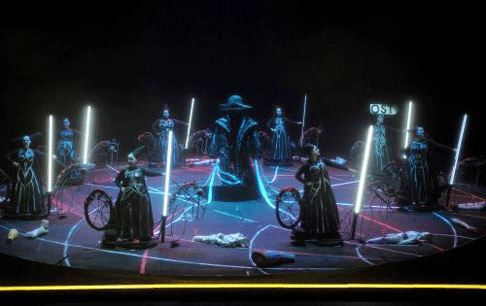 Counter Clockwise begining left: Erica Brookhyser (Waltraute), Susan Foster (Helmwige), Buffy Baggott (Siegrune), Ellie Dehn (Gerhilde), Jane Gilbert (Grimgerde), Margaret Thompson (Rossweisse), Ronnita Miller (Schwertleite), Melissa Citro (Ortlinde) [Photo by Monika Rittershaus courtesy of LA Opera]
Technically, however, Freyer’s staging has many a bug to work out. The revolving disc creaked far too much, and at other times odd bangs and whistles could be heard. Far too often stagehands in black have to run on stage to fix this or that, with attempted but unsuccessful discretion. And the smoke that pours out seemingly throughout the whole show surely added to the usual rounds of audience coughing, at least in orchestra seating. At some points the frequently employed lightsticks that characters wielded seemed to have their own minds about when they should be on or off.
It’s a fascinating production and a frustrating one. Your reviewer would prefer not to be frustrated, ultimately, but not at the loss of the fascination.
Musically, Los Angeles Opera put together a fine cast, stronger overall that what your reviewer has heard of the singing in the Metropolitan Opera’s current run of the cycle. Kowaljow’s Wotan has power and heft, although he seemed a bit tired by the end of act three. Linda Watson almost managed the treacherous opening battle cries for Brünnhilde, with only that final high note escaping her vocal grasp. After that, she was in control, and Freyer obviously loves this character, giving Watson many opportunities to present her wildness and devotion to her father. Michelle DeYoung repeated her fearsomely obstinate Fricka, and Eric Halfvarson sang a fierce Hunding. Surely he wants to take that red jacket home.
Anja Kampe continues to impress your reviewer as one of the very best sopranos around, although she doesn’t get as much publicity as some others. The voice is secure to just about the top of the range, as well as being as beautiful or forceful as necessary. Domingo has owned the role of Siegmund for sometime, and he is not ready to relinquish ownership. From first to last, he sounded magnificent. A fine gaggle of Valkyries energetically whooped it up astride their bicycle-frame steeds. Strange, isn’t it, in how so many so-called traditional productions, nary a horse is to be seen in this scene.
James Conlon led his forces from inside a covered pit, which created the occasional odd balance but always supported the singers. Some of the grander moments of the score didn’t quite have the accustomed impact, such as the sublime transition to Siegmund’s “Winterstürme” or the concluding Magic Fire music, where Conlon chose a slower tempo. Overall the playing was secure and evocative.
Time will tell if the financial gamble of this risky project will pay off for Los Angeles Opera, and even artistically, it can’t be called a total success. With two more epic chapters yet to unfold (both scheduled for next season), however, Freyer’s staging of Wagner’s Ring cycle may prove to be the foundation on which LAO builds a future audience responsive to challenge and excited by innovation.
Chris Mullins
![Vitalij Kowaljow (Wotan), Linda Watson (Brunnhilde) [Photo by Monika Rittershaus courtesy of LA Opera]](http://www.operatoday.com/lrg-327-walk__re_stage_261.gif)