There are plenty of die-hard Handelians in London, a
lesser number (we may presume) of passionate Purcellians, and undoubtedly
droves of those devoted to the dance — so one can only imagine the glee
with which this project was seized upon in the board rooms of Covent Garden.
With Dido running to just sixty minutes and Acis to ninety,
together they made up a most satisfying sandwich of English baroque music at
its most melodious.
Royal Ballet choreographer Wayne McGregor had already shown his work with
Dido & Aeneas at La Scala in 2006, so it was only the direction
and dance elements for Acis & Galatea that were actually new on
the 31st March, and he had a starry cast of singers to work on both
productions, as well as his colleagues from the Ballet. In the event there were
disappointments as well as delights on the vocal front, and not a little
puzzlement regarding the dance.
In Purcell’s Dido, Connolly’s technical assurance,
(this role’s tessitura seems to suit ideally) and her total psychological
immersion in the role gained from her recent performances and recording, should
have enabled her to delineate every nuance of the doomed Queen’s journey
from delight in her new love to the final, cathartic acceptance of his
betrayal. However, an announced indisposition (a throat infection) prevented
her from fully realising the role in a way that might have been expected. She
struggled to colour and project in the first Acts, and only managed to give us
a glimpse of what might have been in the final, celebrated “When I am
laid in earth…” A full recovery in time for the succeeding dates
is to be sincerely wished.
Lucas Meacham, baritone, as the perfidious Aeneas, managed to convey some of
the vacillating aspects of his character, but his effortful singing and lack of
period style was noticeable. In stark and welcome contrast was the stylish,
agile soprano of Lucy Crowe who gave us a youthfully-blooming and bell-like
Belinda which promises much for the later classical repertoire as well as
further major Handelian roles. This dramatically rather ambiguous
character’s music was delivered with intelligence. The lesser roles were
again variable: Sara Fulgoni mangled the vowels of the Sorceress to a degree
that really isn’t on with Purcell at this venue (she sang in the La Scala
production where one assumes it wasn’t noticed so much) and didn’t
convince as the evil manipulator of the whole drama. Her young witches Eri
Nakamura and Pumeza Matshikiza sang brightly with better diction, but were
costumed as if just off a London catwalk. Far too nice. Young English
countertenor Iestyn Davies was a welcome newcomer to ROH, singing his twelve
bars as the Spirit from off-stage somewhere, but with clean attack, good
full-throated projection and clear diction. Anita Watson sang the one aria of
the Second Woman and Ji-Min Park the Sailor’s; the latter with
commendable style and tone. Throughout, the Chorus was excellent in both
diction and ensemble and their essential role in this drama was not only
underlined but showcased in an entirely proper way.
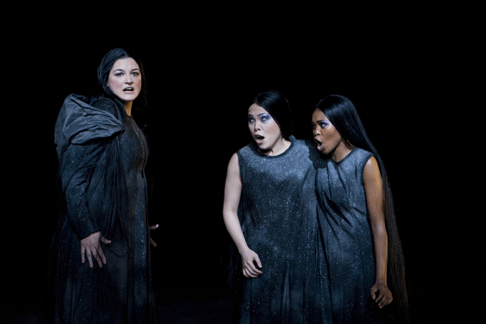 Sara Fulgoni as Sorceress & Eri Nakamura as First Witch & Pumeza Matshikiza as Second Witch
Seeing the added choreography for the first time neither added nor
particularly detracted from the whole — the dancers seemed to be
colouring-in the musical interludes and choruses rather than saying anything
very much new about the drama. The classical, spare set worked well and gave
all performers room to move and lighting filled in the nuances of the drama.
Less convincing were the choreographic elements of Wayne McGregor’s
handling of Handel’s Acis. McGregor has, he says, tried to not
just mirror the action of this pastoral masque, (or serenata), but to try to
access the “meanings” of the drama through the use of dance-imagery
— his famously angular patterns trying to elucidate the tensions between
the “present” reality of the drama and a more fragile emotional
reality. Each singer had either a single or couple of dancers (in as-naked
body-stockings) as their alter-egos and it was necessary to accept this extra
dimension to the operatic experience if one was to gain such insight. This
writer couldn’t, but others may.
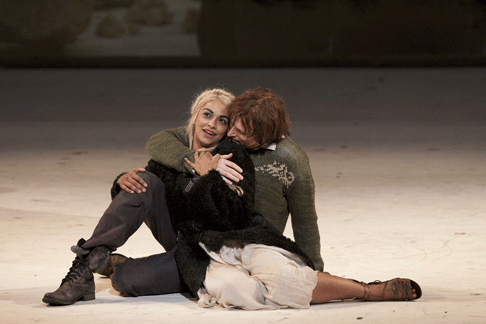 Danielle de Niese as Galatea & Charles Workman as Acis
It was good to see Charles Workman back on an English stage in the title
role. His Handel, up to now, has been limited to just four roles as he’s
been in demand on the continent for his Rossini and Mozart, but on this showing
we might expect to see more of him here. Acis lies high in the lyrical
tenor’s range, and Workman was indeed working hard from time to time, but
his elegance of phrasing and good line in such deceptively difficult arias as
“Love in her eyes sits playing…” was a delight. Even more
noticeable, and welcome, was his ability to combine Handelian style with plenty
of vocal power; his full and ringing tone was a highlight of the whole
evening’s double bill and he also received the only spontaneous post-aria
applause after a sterling “Love sounds th’alarm”. Matching
him in the style stakes, if not the dynamics, was the veteran period performer
Paul Agnew who wove lovely phrases around Damon’s bewitchingly melodic
lines.
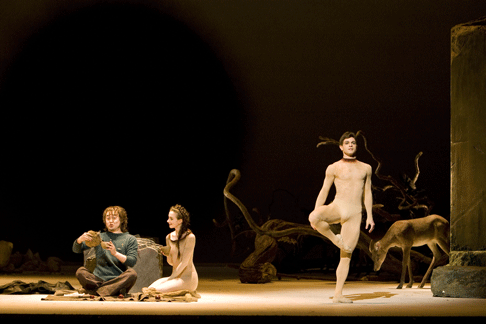 Ji-Min Park as Coridon, Lauren Cuthbertson as Galatea and Paul Kay as Coridon
Workman’s fellow American, the glamorous Danielle de Niese, has built
up a considerable (would it be churlish to suggest mainly male?) following in
Handel in recent years. But Galatea is no Cleopatra, and de Niese was called
upon to realise a very different heroine here. Curiously decked out in black
and white, with a bright red scarf and peroxide blonde wig with plaits, she
looked like a particularly exotic Heidi and occasionally acted like one. Her
soprano is well schooled and flexible and in her middle range she approaches a
really beautiful tone. Her carefully prepared trills and ornaments were
beautifully placed and “As when the dove….” was prettily
sung, but a hardness creeps in when she goes high above the staff. This can
reduce the impact of such delicate and affecting arias as “Heart, the
seat of soft delight” which is a shame as this is what this role is all
about.
Another throat-sufferer pre-announced was bass Matthew Rose as the giant
Polyphemus, who made his entrances along a curious but clever
“Giant’s Causeway” of mock-basaltic rocks. His singing was
not too badly affected and was rounded and smooth without any bark or growl.
Whether McGregor’s direction of him worked is debateable. He seemed
strangely awkward at times — and was required to walk off stage rather
tamely after a perfunctory killing of the noble Acis with a very small rock.
Ji-Min Park again sang — this time the one aria of Coridon — and
again showed a pleasing tone and style.
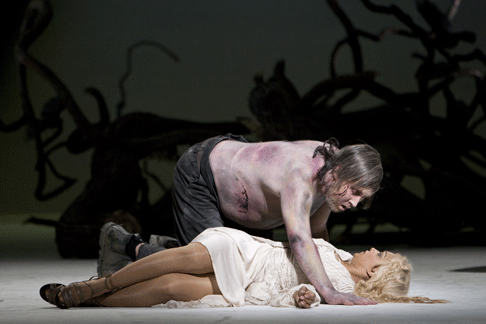 Matthew Rose as Polyphemus & Danielle de Niese as Galatea
Also repeating success, and if anything surpassing themselves, was the Royal
Opera Extra Chorus who had more acting to do and who sang with assurance and
relish. The Orchestra of the Age of Enlightenment under veteran Christopher
Hogwood presided at each “opera” — and after some initial
intonation variations they settled down to give a polished reading of both,
with Anthony Robson’s oboe particularly expressive and stylish. This
wasn’t a cutting-edge period performance, but then neither were the
productions. What Covent Garden’s first night full house certainly got
was value for money — whether it’s the way forward for such baroque
gems is another matter.
Sue Loder © 2009
![Lucas Meachem as Aeneas & Sarah Connolly as Dido [Photo by Bill Cooper courtesy of The Royal Opera House]](http://www.operatoday.com/Dido_Aeneas_ROH_2009_01.gif)