Subscribe to
Opera Today

Receive articles and news via RSS feeds or email subscription.


twitter_logo[1].gif


UCP_9780226043425.gif

Recently in Reviews

Baltimore Premieres Camelot Requiem

In May of 2013, the Spire Series at the First Presbyterian Church in Baltimore, Maryland, observed the fiftieth anniversary of the death of President John F. Kennedy by presenting a work dealing with the 1963 assassination.

Domingo Conducts Holdridge’s New Opera Dulce Rosa

Dulce Rosa, a brand new opera, had its world premiere Friday night, May 17, 2013 at the Broad Stage in Santa Monica, California. It was produced by Los Angeles Opera, but staged in the smaller theater.

Verdi’s Falstaff at Glyndebourne

Richard Jones’ 2009 production of Verdi’s Falstaff translates the action from the first Elizabethan age to the start of the second.

Gareth John, Wigmore Hall

Baritone Gareth John is rapidly accumulating a war-chest of honours. Winner of the 2013 Kathleen Ferrier Award, he recently won the Royal Academy of Music Patrons’ Award and was presented the Silver Medal by the Worshipful Company of Musicians.

La bohème at ENO

This second revival of Jonathan Miller’s La bohème was the first time I had caught the production.

Rolando Villazón: Verdi (International Opera Stars Series 2013)

It’s Verdi’s bicentenary year and Rolando Villazón has two new CDs to plug — titled somewhat confusingly, ‘Villazón: Verdi’ and ‘Villazón’s Verdi’, the latter a ‘personal selection’ of favourite numbers performed by stars of the past and present.

Brahms Third in San Francisco

Nicola Luisotti and the San Francisco Opera Orchestra climbed out of the War Memorial pit, braved the wind whipped bay and held spellbound an audience at Cal Performances’ Zellerbach Auditorium at UC Berkeley.

Ariane et Barbe-Bleue on Blu-Ray

Paul Dukas’ Ariane et Barbe-Bleue, first heard in 1907, once seemed important. Arturo Toscanini conducted the Met premiere in 1911 with Farrar and later arranged some of its music for a 1947 recording with his NBC Symphony.

Glyndebourne: Ariadne auf Naxos

Utterly mad but absolutely right — Richard Strauss’s Ariadne auf Naxos started the Glyndebourne 2013 season with an explosion. Strauss could hardly have made his intentions more clear. Ariadne auf Naxos is not “about” Greek myth so much as a satire on art and the way art is made.

Wozzeck at ENO

“Man is an abyss. It makes one dizzy to look into it.” So utters Georg Büchner’s Woyzeck, repeating what was also a recurring motif in the playwright’s own letters.

Mulhouse: Rare Britten Well Done

National Opera Company of the Rhine has marked this year’s Benjamin Britten celebration with a remarkably compelling, often gripping new production of the seldom-seen Owen Wingrave.

Frankfurt's Intriguing Idomeneo

Once upon a time, Frankfurt Opera had the baddest ass reputation in Germany as “the” cutting edge producer of must-see opera.

Rigoletto at Lyric Opera of Chicago

Productions of Giuseppe Verdi’s Rigoletto can serve as a vehicle for individual singers to make a strong impression and become afterward associated with specific roles in the opera.

Britten Sinfonia with Ian Bostridge

Just in case we were not aware that the evening’s programme was ‘themed’, the Britten Sinfonia designed a visual accompaniment to their musical exploration of night, sleep and dreams.

Aida, Manitoba Opera

Poor Aida! She never seems to have anything go her way.

Superlative singing: Don Carlo, Royal Opera House

Is it possible to upstage Jonas Kaufmann? Kaufmann was brilliant in this Verdi Don Carlo at the Royal Opera House, London, but the rest of the cast was so good that he was but first among equals. Don Carlo is a vehicle for stars, but this time the stars were everyone on stage and in the pit. Even the solo arias, glorious as they are, grow organically out of perfect ensemble. This was a performance that brought out the true beauty of Verdi's music.

Sarah Connolly: French Song at Wigmore Hall

The big names were absent: Duparc, D’Indy, Debussy, Ravel … and while Fauré, Chausson, Roussel and several members of Les Six put in an appearance, in less than familiar guises, this survey of French song of the early 20th century and interwar years deliberately took us on a journey through infrequently travelled terrain.

Rare restoration: Handel’s Esther 1720

Composed between 1718 and 1720, Handel’s Esther is sometimes described as the ‘first English Oratorio’, but is in fact a hybrid form, mixing elements of oratorio, masque, pastoral and opera.

The Damnation of Faust, London

Hector Berlioz's légende dramatique, La Damnation de Faust, exists somewhere between cantata and opera. Berlioz's flexible attitude to dramatic form made the piece unworkable on the stages of early 19th century Paris and his music is so vivid that you wonder whether the piece needs staging at all.

Elizabeth Connell Memorial Concert, St John's Smith Square

St. John’s Smith Square was the site of Elizabeth Connell’s final London concert, intended as a farewell to London on her moving to Australia. It was rendered ultimately final by her unexpected death.

OPERA TODAY ARCHIVES »

Reviews

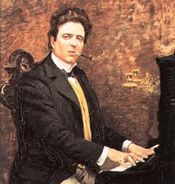
Pietro Mascagni
26 Apr 2009

Il Piccolo Marat

Try to imagine the scenario: You’re an opera company, giving concert performances of neglected, indeed forgotten, hundred-year-old scores (no sets, no costumes, at least you don’t have those headaches), and you give young singers a chance to do their stuff once a year before a paying New York crowd actually eager to hear music they do not know, and you’ve lit on a genuine obscurity, even in the ranks of the obscure; Mascagni’s penultimate stage work, a huge success at the premiere (as his operas usually were), utterly forgotten nowadays (as, but for Cavalleria Rusticana and, on rare occasion, L’Amico Fritz, they pretty much are), and it’s never been performed in North America ever.

Pietro Mascagni: Il Piccolo Marat

Il Piccolo Marat: Richard Crawley; L’Orco: Brian Jauhiainen; Mariella: Paula Delligatti; Il Carpentiere: Daniel Ihn-Kyu Lee; Il Soldato: Joshua Benaim; Una voce basso: Alfred Barclift; Una voce tenore: Hugo Vera. Teatro Gratticielo Orchestra, conducted by David Wroe. Teatro Gratticielo at Avery Fisher Hall, April 13.


Recordings of ancient performances exist, though, and everyone is really excited to hear it, with its blood-and-skullduggery-defeated-by-true-love French Revolutionary plot, and you gather your forces, and rehearse to a fare-thee-well, and then it happens: the lead tenor in the big title role withdraws due to a death in the family. Okay, hardly the first time that’s happened, there’s still two weeks, you can dig up another tenor, and you do. But then the baritone in the impossibly evil villain’s part (and in verismo opera, it’s the villain who makes the machine run, more than almost anything else), falls ill and cannot sing, and you have mere days to find a baritone capable of learning a long role, to say nothing of performing it Monday night. And you find one, and he can handle Scarpia, so he can probably handle this. And then, the day of the performance, the third male lead, another baritone, has to pull out … and there is no time for anyone to learn this thing now, and no one on earth knows it … but a young singer of no less than three other small roles says he’s been following the sick man’s music and he could give it the old Bastille try. And you give it to him, and smile when the audience shows up, and out of the corner of your mind, the sole corner that remains sane, you vow to rip the soprano’s head off if she so much as murmurs of her rampaging case of bubonic plague, but no, she is a lamb, she is in excellent health and ready to rock, and by all the Muses (but especially Thalia, comedy), the show goes on.

Would you have a stroke? Would you retire? Would you call Mel Brooks or Blake Edwards and try to get them to option this backstage screenplay, far too unlikely to occur in real life? Or maybe a skit on SNL?

And would the show go on?

On April 13, at Avery Fisher Hall, the show – Teatro Gratticielo’s concert performance of Mascagni’s Il Piccolo Marat – went on, and was greeted, at evening’s end, with a standing ovation.

The world premiere, in 1921, took fifty curtain calls. Why, then, did Marat become so rare? I’m told the Grove Dictionary of the Opera blames its failure to hold audiences on its Fascist librettist. This does not make sense when reading (and following) the libretto, which is as passionate a hymn to freedom from tyranny as Fidelio or Tosca. Too, there is a rather beautiful love duet, a melodious lullaby that recalls the peaceful Easter music of Cavalleria Rusticana, and a tense climax that lures the audience into the emotions of the three “good” characters as, desperately, they assault the unkillable Ogre (English for Orco, the character’s nickname – so that’s where Tolkien found the word!).

As is customary in verismo, a school that matured as the bourgeoisie seized political power and its echo in the arts from aristocratic predecessors, the chorus is a main character in this opera, easily swayed and ruthless in its bloodthirsty support of hero or villain by turns. The Cantori New York and the Long Island University Chorus howled gloriously under the direction of Mark Shapiro; we were right at home, ringside to mob rule.

As is also the rule in operas about the French Revolution (think Andrea Chenier or Madame Sans-Gêne), there were innumerable small parts – which proved convenient when one singer of three of them, Daniel Ihn-Kyu Lee, earned a needed promotion to the almost-lead role of the gentle Carpenter, not too sensitive to design death ships but queasy when the Ogre wants him to build them. Joshua Benaim was worthy and forthright as a Soldier sent to investigate the Ogre – a by no means easy role, designed for a Pertile or Del Monaco sound, to give heroic voice to the Revolution during the opera’s early scenes, when the title character, the Piccolo Marat, must conceal his real feelings to win the Ogre’s confidence. Alfred Barclift and Hugo Vera showed promise onstage playing offstage voices. (Versatility is the name of this game.)

Richard Crawley, in the title role, effectively concealed his noble self and warmed up the while in order to sing a passionate duet with Paula Delligatti, as Mariella, the Ogre’s unhappy niece, and then burst out like a Cavaradossi “Vittoria” when the time came. Brian Jauhiainen was less overwhelming as the monstrous Ogre. Neither gentleman indicated, however, by any hesitancy or misstep, how recently they had first encountered this music: these were trim, professional performances and we were all very grateful to have them. Delligatti has an expressive spinto, perhaps less than ideal to the explosions of a Butterfly or Tosca but probably ideal for Liú or Maddalena. Her lullaby, perhaps the opera’s only excerptable number (another reason for the work’s obscurity), was serene and charming.

Conductor David Wroe, who perhaps rehearsed with the singers who cancelled, rather bashed his way through the score. It’s a large score, all right, and the music should be loud, but not holding back in a hall as orchestrally focused as Fisher is a disservice to the singers, who were often inaudible at the opera’s high points.

John Yohalem
Send to a friend

Send a link to this article to a friend with an optional message.

Friend's Email Address: (required)

Your Email Address: (required)

Message (optional):