![Petra Lang as Ortrud [Photo by Clive Barda courtesy of The Royal Opera]](http://www.operatoday.com/LOHENGRIN-090424_0482.gif)
29 Apr 2009
Lohengrin at The Royal Opera, London
I first saw this production in Manchester in 1981: I loved it then and love it now, despite the present hero’s un-Heldentenor qualities when compared to the glorious Peter Hoffman of yore.
English Touring Opera are delighted to announce a season of lyric monodramas to tour nationally from October to December. The season features music for solo singer and piano by Argento, Britten, Tippett and Shostakovich with a bold and inventive approach to making opera during social distancing.
This tenth of ten Live from London concerts was in fact a recorded live performance from California. It was no less enjoyable for that, and it was also uplifting to learn that this wasn’t in fact the ‘last’ LfL event that we will be able to enjoy, courtesy of VOCES8 and their fellow vocal ensembles (more below …).
Ever since Wigmore Hall announced their superb series of autumn concerts, all streamed live and available free of charge, I’d been looking forward to this song recital by Ian Bostridge and Imogen Cooper.
Although Stile Antico’s programme article for their Live from London recital introduced their selection from the many treasures of the English Renaissance in the context of the theological debates and upheavals of the Tudor and Elizabethan years, their performance was more evocative of private chamber music than of public liturgy.
Evidently, face masks don’t stifle appreciative “Bravo!”s. And, reducing audience numbers doesn’t lower the volume of such acclamations. For, the audience at Wigmore Hall gave soprano Elizabeth Llewellyn and pianist Simon Lepper a greatly deserved warm reception and hearty response following this lunchtime recital of late-Romantic song.
For this week’s Live from London vocal recital we moved from the home of VOCES8, St Anne and St Agnes in the City of London, to Kings Place, where The Sixteen - who have been associate artists at the venue for some time - presented a programme of music and words bound together by the theme of ‘reflection’.
'Such is your divine Disposation that both you excellently understand, and royally entertaine the Exercise of Musicke.’
‘And there was war in heaven: Michael and his angels fought against the dragon; and the dragon fought and his angels, And prevailed not; neither was their place found any more in heaven … that old serpent … Satan, which deceiveth the whole world: he was cast out into the earth, and his angels were cast out with him.’
There was never any doubt that the fifth of the twelve Met Stars Live in Concert broadcasts was going to be a palpably intense and vivid event, as well as a musically stunning and theatrically enervating experience.
‘Love’ was the theme for this Live from London performance by Apollo5. Given the complexity and diversity of that human emotion, and Apollo5’s reputation for versatility and diverse repertoire, ranging from Renaissance choral music to jazz, from contemporary classical works to popular song, it was no surprise that their programme spanned 500 years and several musical styles.
The Academy of St Martin in the Fields have titled their autumn series of eight concerts - which are taking place at 5pm and 7.30pm on two Saturdays each month at their home venue in Trafalgar Square, and being filmed for streaming the following Thursday - ‘re:connect’.
The London Symphony Orchestra opened their Autumn 2020 season with a homage to Oliver Knussen, who died at the age of 66 in July 2018. The programme traced a national musical lineage through the twentieth century, from Britten to Knussen, on to Mark-Anthony Turnage, and entwining the LSO and Rattle too.
With the Live from London digital vocal festival entering the second half of the series, the festival’s host, VOCES8, returned to their home at St Annes and St Agnes in the City of London to present a sequence of ‘Choral Dances’ - vocal music inspired by dance, embracing diverse genres from the Renaissance madrigal to swing jazz.
Just a few unison string wriggles from the opening of Mozart’s overture to Le nozze di Figaro are enough to make any opera-lover perch on the edge of their seat, in excited anticipation of the drama in music to come, so there could be no other curtain-raiser for this Gala Concert at the Royal Opera House, the latest instalment from ‘their House’ to ‘our houses’.
"Before the ending of the day, creator of all things, we pray that, with your accustomed mercy, you may watch over us."
The doors at The Metropolitan Opera will not open to live audiences until 2021 at the earliest, and the likelihood of normal operatic life resuming in cities around the world looks but a distant dream at present. But, while we may not be invited from our homes into the opera house for some time yet, with its free daily screenings of past productions and its pay-per-view Met Stars Live in Concert series, the Met continues to bring opera into our homes.
Music-making at this year’s Grange Festival Opera may have fallen silent in June and July, but the country house and extensive grounds of The Grange provided an ideal setting for a weekend of twelve specially conceived ‘promenade’ performances encompassing music and dance.
There’s a “slide of harmony” and “all the bones leave your body at that moment and you collapse to the floor, it’s so extraordinary.”
“Music for a while, shall all your cares beguile.”
The hum of bees rising from myriad scented blooms; gentle strains of birdsong; the cheerful chatter of picnickers beside a still lake; decorous thwacks of leather on willow; song and music floating through the warm evening air.
I first saw this production in Manchester in 1981: I loved it then and love it now, despite the present hero’s un-Heldentenor qualities when compared to the glorious Peter Hoffman of yore.
There were a lot of first-night nerves around, unsurprisingly given that King Heinrich, Telramund, Elsa and the Herald were all house debutants, but they all showed great star quality to match that of the more experienced Ortrud and Lohengrin. Semyon Bychkov elicited some of the most polished and exquisite playing from the ROH orchestra that I have heard in a long time; overall this was a wonderful evening, a shining example of what the Royal Opera House is all about.
The shimmering strings of the overture, so delicately shaped and daringly leisured in tempo, were somewhat compromised for many in the audience by the noisy actions of some latecomers, but the conductor sailed on as if surrounded by total silence. An aside, but what can be done about the appalling manners of some of the (supposedly) ‘great and good?’ It wasn’t just the noise—just to add insult to injury, as Lohengrin launched into ‘In fernen Land’ a man leaned over his wife to ask their friend, not exactly sotto voce, ‘So, where shall we eat after the show, then?’ Presumably these were amongst those like the bejewelled crinkly lady whom I heard complain loudly that she ‘got offered so many free tickets here that I just can’t fit it all in.’
The production is now 32 years old, yet it still looks fresh and logical for the work, with those prostrate nuns and gilt-encrusted icons reminiscent not so much of tenth century Brabant but ‘Old Mother Russia,’ and the muted colour tones of white and grey subtly contrasted with the splashes of red and gold. Some might consider the presentation of the swan as a projected motif underwhelming, but to me it was just right, with the Knight’s entrance via the trapdoor still producing a frisson—and let’s face it, this solution avoids any possibility of having to enquire ‘Wann fährt der nächste Schwann?’
More than any other of Wagner’s operas, ‘Lohengrin’ is all about the singing, and here this production excels. Johan Botha does not possess the ideally heroic stage presence for the title part, nor would he be accurately described as a Heldentenor, yet his singing is always expressive, finely phrased and sensitively shaped. Lohengrin is a rarity amongst Wagner’s major tenor roles in that his music is far more often marked to be sung mezzo-forte rather than forte, and Botha offers a hero more in the lyrical mould of a Slezak than a belter, and his characterization is all the better for it. ‘Mein Lieber Schwann’ was achingly poignant, reminding me of Rosvaenge’s recording of it, and ‘In fernen Land’ was as affecting as it should be, the gentle pressure on ‘Taube’ and the heroic strength of ‘Sein Ritter ich’ parts of a seamlessly dramatic whole.
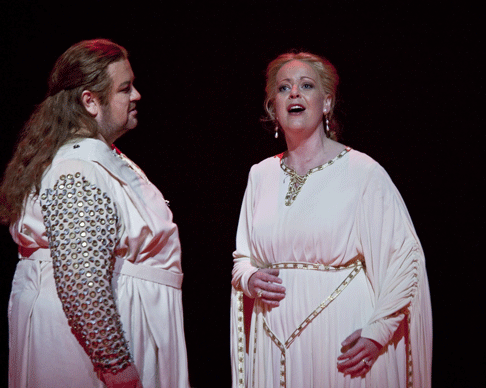 Johan Botha as Lohengrin and Edith Haller as Elsa
His Elsa was the beautiful South-Tyrol soprano Edith Haller, in a house debut performance which revealed a sweet, bell-like purity of tone, with the capacity to melt one’s heart in phrases like ‘Es gibt ein Glück, das ohne Reu’—‘Einsam in trüben Tagen’ was also a model of clarity and touching sweetness. At present, however, her voice is ‘merely’ lovely and crystalline, lacking in some colour and variety, and she found the last act a challenge in parts. Nevertheless, a notable debut from a soprano whom we will look forward to hearing in many other rôles.
Petra Lang’s Ortrud is a known quantity, yet she never ceases to surprise with the vehemence and commitment of her acting and the commanding quality of her singing. You half expect her to utter remarks like ‘Come, you spirits that tend on mortal thoughts. Unsex me here!’ as she launches into one of her tirades, and I can’t recall having experienced quite so marked a shiver down the spine by anyone else’s singing of the phrase ‘der Rache süsse Wonne’ or quite so definite a frisson during her ‘Entweitert Götter.’ Her husband was the fascinating baritone Gerd Grochowski, who looks a bit too noble for the weak Telramund, but whose singing, firmly in the Fischer-Dieskau mould, was supple and expressive. Indeed, there were times when one felt more sympathy for him than one probably should.
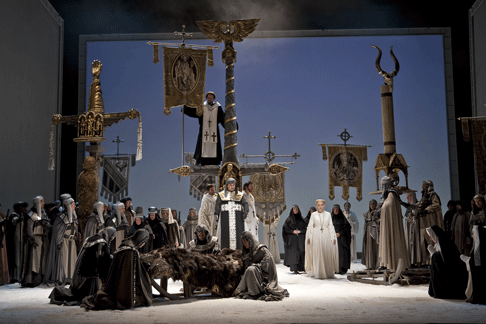 Scene from Lohengrin
Two more house debutants gave impressive performances of the rôles of Heinrich I and the Herald. This was the first time I’ve heard the Korean bass Kwangchul Youn, whose sound may lack a little in volume but whose expressiveness and dignity were a joy—he may have missed a little of the king’s grandeur here and there, but he more than made up for it with the Prayer, with genuinely noble heft at ‘weil unsere Weisheit Einfalt ist.’ I look forward to hearing his Commendatore and Méphistophélès. Boaz Daniel’s Herald was another noble assumption, his proclamations of ‘Nun höret Mich’ true clarion calls.
The Chorus sounded a little underpowered at the beginning, but rose to great heights at ‘Wie fasst uns selig süsses Grauen!’ and ‘Wir steh’n zu dir.’ They were matched by orchestral playing of real majesty, the strings and trumpets especially covering themselves in glory. It’s now three years since Semyon Bychkov conducted here, and I hope it won’t be that long again before we experience his blend of absolute control and sympathetic support for singers.
A great evening—and mercifully delivered uncut, with further performances on May 3rd (matinee), 5th, 8th, 11th, 14th and 16th. It is an almost full house for each night, but there are a sprinkling of seats to be had as well as Day tickets—if you haven’t booked yet, you are strongly advised to do so now, to experience a ‘Lohengrin’ which comes as near to expressing what Wagner called ‘one of man’s earliest poetic ideals’ as I can imagine.
Melanie Eskenazi