![Eva-Maria Westbroek as Katerina Lvovna Ismailova [Photo courtesy of Opéra national de Paris]](http://www.operatoday.com/Lady_macbeth_Paris.gif)
06 Apr 2009
Paris: As Good As It Gets
I cursed myself for not having turned on the television sooner.
English Touring Opera are delighted to announce a season of lyric monodramas to tour nationally from October to December. The season features music for solo singer and piano by Argento, Britten, Tippett and Shostakovich with a bold and inventive approach to making opera during social distancing.
This tenth of ten Live from London concerts was in fact a recorded live performance from California. It was no less enjoyable for that, and it was also uplifting to learn that this wasn’t in fact the ‘last’ LfL event that we will be able to enjoy, courtesy of VOCES8 and their fellow vocal ensembles (more below …).
Ever since Wigmore Hall announced their superb series of autumn concerts, all streamed live and available free of charge, I’d been looking forward to this song recital by Ian Bostridge and Imogen Cooper.
The Sixteen continues its exploration of Henry Purcell’s Welcome Songs for Charles II. As with Robert King’s pioneering Purcell series begun over thirty years ago for Hyperion, Harry Christophers is recording two Welcome Songs per disc.
Although Stile Antico’s programme article for their Live from London recital introduced their selection from the many treasures of the English Renaissance in the context of the theological debates and upheavals of the Tudor and Elizabethan years, their performance was more evocative of private chamber music than of public liturgy.
In February this year, Albanian soprano Ermonela Jaho made a highly lauded debut recital at Wigmore Hall - a concert which both celebrated Opera Rara’s 50th anniversary and honoured the career of the Italian soprano Rosina Storchio (1872-1945), the star of verismo who created the title roles in Leoncavallo’s La bohème and Zazà, Mascagni’s Lodoletta and Puccini’s Madama Butterfly.
Evidently, face masks don’t stifle appreciative “Bravo!”s. And, reducing audience numbers doesn’t lower the volume of such acclamations. For, the audience at Wigmore Hall gave soprano Elizabeth Llewellyn and pianist Simon Lepper a greatly deserved warm reception and hearty response following this lunchtime recital of late-Romantic song.
Collapsology. Or, perhaps we should use the French word ‘Collapsologie’ because this is a transdisciplinary idea pretty much advocated by a series of French theorists - and apparently, mostly French theorists. It in essence focuses on the imminent collapse of modern society and all its layers - a series of escalating crises on a global scale: environmental, economic, geopolitical, governmental; the list is extensive.
For this week’s Live from London vocal recital we moved from the home of VOCES8, St Anne and St Agnes in the City of London, to Kings Place, where The Sixteen - who have been associate artists at the venue for some time - presented a programme of music and words bound together by the theme of ‘reflection’.
'Such is your divine Disposation that both you excellently understand, and royally entertaine the Exercise of Musicke.’
Amongst an avalanche of new Mahler recordings appearing at the moment (Das Lied von der Erde seems to be the most favoured, with three) this 1991 Mahler Second from the 2nd Kassel MahlerFest is one of the more interesting releases.
‘And there was war in heaven: Michael and his angels fought against the dragon; and the dragon fought and his angels, And prevailed not; neither was their place found any more in heaven … that old serpent … Satan, which deceiveth the whole world: he was cast out into the earth, and his angels were cast out with him.’
If there is one myth, it seems believed by some people today, that probably needs shattering it is that post-war recordings or performances of Wagner operas were always of exceptional quality. This 1949 Hamburg Tristan und Isolde is one of those recordings - though quite who is to blame for its many problems takes quite some unearthing.
There was never any doubt that the fifth of the twelve Met Stars Live in Concert broadcasts was going to be a palpably intense and vivid event, as well as a musically stunning and theatrically enervating experience.
‘Love’ was the theme for this Live from London performance by Apollo5. Given the complexity and diversity of that human emotion, and Apollo5’s reputation for versatility and diverse repertoire, ranging from Renaissance choral music to jazz, from contemporary classical works to popular song, it was no surprise that their programme spanned 500 years and several musical styles.
The Academy of St Martin in the Fields have titled their autumn series of eight concerts - which are taking place at 5pm and 7.30pm on two Saturdays each month at their home venue in Trafalgar Square, and being filmed for streaming the following Thursday - ‘re:connect’.
The London Symphony Orchestra opened their Autumn 2020 season with a homage to Oliver Knussen, who died at the age of 66 in July 2018. The programme traced a national musical lineage through the twentieth century, from Britten to Knussen, on to Mark-Anthony Turnage, and entwining the LSO and Rattle too.
With the Live from London digital vocal festival entering the second half of the series, the festival’s host, VOCES8, returned to their home at St Annes and St Agnes in the City of London to present a sequence of ‘Choral Dances’ - vocal music inspired by dance, embracing diverse genres from the Renaissance madrigal to swing jazz.
Just a few unison string wriggles from the opening of Mozart’s overture to Le nozze di Figaro are enough to make any opera-lover perch on the edge of their seat, in excited anticipation of the drama in music to come, so there could be no other curtain-raiser for this Gala Concert at the Royal Opera House, the latest instalment from ‘their House’ to ‘our houses’.
"Before the ending of the day, creator of all things, we pray that, with your accustomed mercy, you may watch over us."
I cursed myself for not having turned on the television sooner.
I found myself tuning in way late to the sort of intense, committed, brilliantly sung operatic performance that had me urgently asking “Who is this woman?” And “what is this stunning production?”
Well, the soprano was Eva-Maria Westbroek, and the work was Lady Macbeth of Mtsensk in what seemed to have perhaps been a definitive staging by the adventurous Netherlands National Opera. Damn, to have missed it, although it is out on DVD. What must it have been like “live,” I was thinking.
And lo, the equally adventurous Paris Opera brought this very same mounting to the Bastille recently, with…the luminous Eva-Maria Westbroek in one of the finest performances I have yet seen. Having experienced her wonderful account of the Frau Empress last year, plus the bit of the televised Lady, I was already in her camp of admirers. But nothing prepared me for the visceral impact of her total immersion into the complex layers of Shostakovitch’s troubled heroine Katerina.
Clad most of the evening only in a satiny silver slip, our diva un-self-consciously threw herself into every dramatic (and usually, sexual) situation like a hungry tigress playing with her food. It does not hurt that she is a striking blond, and that she has a dramatic voice of substance, steely beauty, unerring technique, and stamina. The ear-splitting cheers that rained down on her at curtain call seemed inadequate praise for the definitive musical and dramatic journey with which she gifted us. So loud, so fierce, and so prolonged was the rejoicing that Ms. Westbroek was visibly moved by her reception. It was one of those rare bonding moments that only happen in live theatre when true artistic greatness and the audience’s deep desire to experience it collide. Ya shouldda been there.
Our diva was not alone in her accomplishment, oh no. Holding his own as Sergei, Michael König offered a securely sung performance of brutal power. Vladimir Vaneev had orotund sound to spare as Boris, and the dispiriting husband Zinovy was well served by Ludovit Ludha. The excellent Carole Wilson dominated the stage in her featured moment as Aksinya, fearlessly stripped down by her assailants and put on full display in no more than skimpy panties. Her dramatic commitment almost upstaged the fact that she sang very well indeed, and doubled in the role of the Female Prisoner to good effect.
Valentin Jar’s Schoolmaster, Alexander Vassiliev’s Priest, and Nikita Storojev’s Chief of Police were all solidly voiced. Lani Poulson provided a memorable impersonation of the rival Sonietka, and special mention should be made of Alexander Kravets’ willfully malevolent characterization of the seedy Village Drunk, savoring his momentary importance at having exposed the murder.
The Paris Opera orchestra rose to the challenge of Shostakovitch’s often knotty score with a reading of incomparable fire and melting delicacy as required. Rarely has this fine band been heard to such advantage in a house noted for its variable acoustic. I don’t know what more maestro Hartmut Haenchen can do to get to be the Critic’s Darling or the Queen’s Delight, but based on this evening’s thrilling result (and every other Haenchen performance I have heard) he is way higher up in my conductors’ pantheon than other more highly publicized baton wavers. The all-important chorus, well-prepared by Winfried Maczewski. made solid contributions all evening. Superb.
Stage director Martin Kušej has devised a “concept” production that really cooks. Starting with a big glassed-in room that is Katerina’s symbolic prison, and ending with a nightmarish realistic prison that sinks into the bowels of the earth, set designer Martin Zehetgruber came up with one startlingly correct image after another. The pair of them departed from some specific script locations, true, but…they told the story with clarity, passion, and highly creative visual imagery. The look of that endless row of women’s shoes (Imelda Marcos would be proud) at opera’s start in that expansive, barren, glassed-in room, was so simple and so right. Heide Kastler’s appropriate costuming, and Reinhard Traub’s sensitive lighting were icing on the gateau. This was opera as good as it gets.
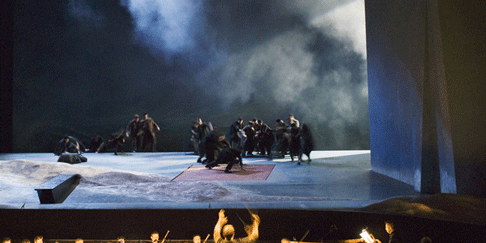 Scene from Idomeneo
The riches continued with a beautifully realized production of Idomeneo across town at the sumptuous, and more intimate Palais Garnier. This is a perfect sized house for such works, and conductor Thomas Hengelbrock got fine results from his pit musicians, leading with rhythmic drive, exceptional color, and communicating well the arc of the piece. I would be remiss were I not to single out the superlatively inventive recitative accompaniment provided by Alessandro Pianu at the “clavecin,” a cogent dramatic partner to all that transpired on stage.
I was less taken with the physical production so let’s get that out of the way. Set designer Erich Wonder and director Luc Bondy have collaborated to present a framework idea of modern day refugees on a raked white sandy beach, almost a lunar landscape, that spilled over the pit to the audience box stage left. The built-in knolls allowed for variety of visual groupings, and it was dressed variously with a large bench, a pop-out black wall, rocks positioned diagonally, and most important, the omnipresent sea as backdrop.
The cast seemed to spend an awful lot of time regarding that omnipresent sea, although it was effective and, especially with the tsunami-like storm effect, beautifully lit by Dominique Brugière. Of course, Mr. Bondy has a well-deserved reputation for forging clearly defined characters, interactive relationships, and well motivated stage movement. His Idomeneo was largely successful.
Having Ilia initially bound to the bench by a really long rope attached to her boot was a meaningful visual which underscored her entrapment in an untenable emotional situation. The introduction of a switchblade as a prop was less sure, brandished as it was by Idamante who cuts Ilia’s rope, then sticks it in a dune (huh?), later to be plucked out by Idomeneo and stuck in another dune. There was a lovely picture of Ilia beginning “Zeffiretti lusinghieri” writing a letter, then discarding it and starting again, and then having the breeze gently blow the discarded letters across the sands. But then the effect went astray as beach trash joined the windy parade.
There was a rather odd pacing to the evening, as applause was generally discouraged. Then when it was called for, it didn’t materialize. At one point the chorus tromps on in two lines, surely meant to coincide with applause, but there was none. And there were some odd curtain drops, like the one that closed behind a soloist on the apron, then re-opened to reveal exactly the same set, except our hero had changed from black to red costume.
Overall, Rudy Sabounghi’s eclectic costumes were just fine. I quite liked Elettra’s “period’ black costume with farthingale, and her covering her face with a black veil, a device that is passed on to Ilia who wears the black veil later when she is further distanced from her happiness. And there was a well-judged moment of Idomeneo’s covering Idamante with a white scarf when he made to kill him, only to withdraw it as he later crowned him. But I have to say that overall, by evening’s end, we were seeing re-hashed situations, as though the usually estimable Mr. Bondy had simply run out of fresh ideas.
The singers could hardly have been bettered, starting with the meticulous Camilla Tilling as an unusually starchy Ilia. Ms. Tilling’s pointed, pure, lyric soprano is capable of great subtlety and flexibility. Surely she displayed the best vocal coloring and most emotionally rich recitatives I have heard in this role.
Parisian favorite Joyce DiDonato as Idamante was every bit the centerpiece that the show requires, assured at every moment, throbbing phrases balanced by haunting sotto voce expressions of despair and grief that were a model of their kind. Ms. DiDonato is well established here and received the evening’s largest ovation. This town loves her. And why shouldn’t they? Great.
Personally, I adore Mireille Delunsch. She has an unerring technique that is always in service to the piece at hand, witness her past successes as Iphigenie and Louise which I so relished. On this occasion, her Elettra started off just a little rough around the edges. She almost immediately gained in assurance, and knocked out her first great aria with as much vibrant tone and musicality as ever, and she made truly wonderful contributions to the ensembles. If “Oreste, d’Ajace” was slightly less memorable than other versions I have encountered (Studer and Vaness among them) it was at least partly owing to the slack and uninventive staging. (See “Bondy ran out of ideas,” above.)
For as she sang this great showpiece, our director had the entire assembled cast simply turned upstage and stand stock still, as she sang to a rock. A Rock. As …altar? Therapist? At the end Mireille ran off stage to total silence. Imagine! This may be the first time in operatic history that a major soprano successfully sang a great aria, and got not one iota of applause.
Paul Groves showed off his awesome technique with as much variety of expression as you are likely to encounter from anyone in the title role. His tenor, always secure and reliable, has lost a little of the brilliant sheen of his younger days, and there is on occasion a slightly veiled top note when approach with a leaping phrase. But Mr. Ford is surely one of the best Idomeneo’s currently on world stages.
As Arbace, Johan Weigel deployed his lyric baritone with conviction; Ilya Bannik’s Voice of the Oracle of Neptune was decent, if not overly imposing; and the other four soloists were very finely sung indeed (Two Cretans: Yun-Jung Choi, Anna Wall; Two Trojans: Jason Bridges, Bartolomiej Misiuda). The hard-working chorus was once again well tutored by Winfried Maczewski.
So fine were the musical accomplishments, and so congenial were most of the technical elements, would it be impertinent to urge Bondy to do a re-Luc at staging the last fifth of the show?
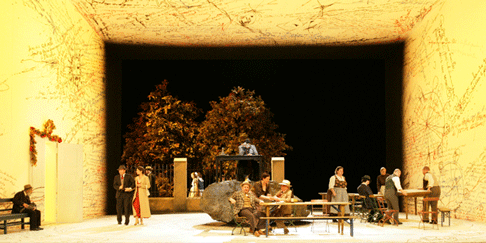 Scene from Werther
Rounding out my visit, curiosity was high, and the air was rife with “ will he or won’t he?” — or rather — “can he or can’t he?” anticipation as the recently beleaguered Rolando Villazon was scheduled to take on a series of performances of Werther at the Bastille. Recent cancellations and rampant rumors of Mr. Villazon’s vocal demise aside, the truth is that Rolando did indeed sing, and sang very nicely, merci-beaucoups-messiuers-dames.
It is true that he is alternating shows with baritone Ludovic Tézier, on this evening the wonderful Albert but spelling Villazon on other nights as a baritone Werther. And while our tenor got all the high notes, he didn’t spend any more time on them than necessary, or perhaps prudent. There was a collective relaxation in the house after he made it successfully through his first big scene, and a momentary tightening of the buttocks as he subsequently sang rather hoarsely through a slight frog.
But Rolando Villazon deployed his lyric tenor sensibly throughout, and seemed to have reined in his tendency to over-sing phrases that most singers toss away, saving up energy for the money moments. Perhaps his voice is a quarter-size too light to be ideal as Werther but he is such a complete stage animal that he was impossible to resist. The rumors of his demise are happily premature. Vocally and dramatically he was highly affecting.
Susan Graham was in fine form, full-voiced, intelligent, and with more specificity in her dramatic posturings than is sometimes the case for this fine technician. Her French was spot-on. Over the years, Susan has developed an esteemed reputation in the City of Lights and she did not disappoint her public. Adriana Kucerova was a treasurable Sophie, who not only had all the youthful delicacy required, but also had some real bite that she incorporated into select phrases, suggesting a voice of considerable substance.
The production, shared with the Bavarian State Opera, wore well on me. Indeed, since having reviewed it in Munich last year with Garanca and Giordano, I think my appreciation of the staging has even deepened. For the record, Juergen Rose was the successful director, and also did the colorfully creative sets and costumes. Kent Nagano led an impassioned reading of the score.
But the evening was really going to rise or fall on Mr. Villazon’s contribution, and happily, this revival of Werther became a minor triumph.
James Sohre