![Scene from Semyon Kotko [Photo courtesy of Mariinsky Theatre]](http://www.operatoday.com/Semyon_Kotko01.gif)
24 Apr 2009
Prokofiev’s Semën Kotko Lands in Sardinia
The Teatro Lirico di Cagliari is a sparkling comparatively new building in what used to be a blighted area near to the city center.
English Touring Opera are delighted to announce a season of lyric monodramas to tour nationally from October to December. The season features music for solo singer and piano by Argento, Britten, Tippett and Shostakovich with a bold and inventive approach to making opera during social distancing.
This tenth of ten Live from London concerts was in fact a recorded live performance from California. It was no less enjoyable for that, and it was also uplifting to learn that this wasn’t in fact the ‘last’ LfL event that we will be able to enjoy, courtesy of VOCES8 and their fellow vocal ensembles (more below …).
Ever since Wigmore Hall announced their superb series of autumn concerts, all streamed live and available free of charge, I’d been looking forward to this song recital by Ian Bostridge and Imogen Cooper.
The Sixteen continues its exploration of Henry Purcell’s Welcome Songs for Charles II. As with Robert King’s pioneering Purcell series begun over thirty years ago for Hyperion, Harry Christophers is recording two Welcome Songs per disc.
Although Stile Antico’s programme article for their Live from London recital introduced their selection from the many treasures of the English Renaissance in the context of the theological debates and upheavals of the Tudor and Elizabethan years, their performance was more evocative of private chamber music than of public liturgy.
In February this year, Albanian soprano Ermonela Jaho made a highly lauded debut recital at Wigmore Hall - a concert which both celebrated Opera Rara’s 50th anniversary and honoured the career of the Italian soprano Rosina Storchio (1872-1945), the star of verismo who created the title roles in Leoncavallo’s La bohème and Zazà, Mascagni’s Lodoletta and Puccini’s Madama Butterfly.
Evidently, face masks don’t stifle appreciative “Bravo!”s. And, reducing audience numbers doesn’t lower the volume of such acclamations. For, the audience at Wigmore Hall gave soprano Elizabeth Llewellyn and pianist Simon Lepper a greatly deserved warm reception and hearty response following this lunchtime recital of late-Romantic song.
Collapsology. Or, perhaps we should use the French word ‘Collapsologie’ because this is a transdisciplinary idea pretty much advocated by a series of French theorists - and apparently, mostly French theorists. It in essence focuses on the imminent collapse of modern society and all its layers - a series of escalating crises on a global scale: environmental, economic, geopolitical, governmental; the list is extensive.
For this week’s Live from London vocal recital we moved from the home of VOCES8, St Anne and St Agnes in the City of London, to Kings Place, where The Sixteen - who have been associate artists at the venue for some time - presented a programme of music and words bound together by the theme of ‘reflection’.
'Such is your divine Disposation that both you excellently understand, and royally entertaine the Exercise of Musicke.’
Amongst an avalanche of new Mahler recordings appearing at the moment (Das Lied von der Erde seems to be the most favoured, with three) this 1991 Mahler Second from the 2nd Kassel MahlerFest is one of the more interesting releases.
‘And there was war in heaven: Michael and his angels fought against the dragon; and the dragon fought and his angels, And prevailed not; neither was their place found any more in heaven … that old serpent … Satan, which deceiveth the whole world: he was cast out into the earth, and his angels were cast out with him.’
If there is one myth, it seems believed by some people today, that probably needs shattering it is that post-war recordings or performances of Wagner operas were always of exceptional quality. This 1949 Hamburg Tristan und Isolde is one of those recordings - though quite who is to blame for its many problems takes quite some unearthing.
There was never any doubt that the fifth of the twelve Met Stars Live in Concert broadcasts was going to be a palpably intense and vivid event, as well as a musically stunning and theatrically enervating experience.
‘Love’ was the theme for this Live from London performance by Apollo5. Given the complexity and diversity of that human emotion, and Apollo5’s reputation for versatility and diverse repertoire, ranging from Renaissance choral music to jazz, from contemporary classical works to popular song, it was no surprise that their programme spanned 500 years and several musical styles.
The Academy of St Martin in the Fields have titled their autumn series of eight concerts - which are taking place at 5pm and 7.30pm on two Saturdays each month at their home venue in Trafalgar Square, and being filmed for streaming the following Thursday - ‘re:connect’.
The London Symphony Orchestra opened their Autumn 2020 season with a homage to Oliver Knussen, who died at the age of 66 in July 2018. The programme traced a national musical lineage through the twentieth century, from Britten to Knussen, on to Mark-Anthony Turnage, and entwining the LSO and Rattle too.
With the Live from London digital vocal festival entering the second half of the series, the festival’s host, VOCES8, returned to their home at St Annes and St Agnes in the City of London to present a sequence of ‘Choral Dances’ - vocal music inspired by dance, embracing diverse genres from the Renaissance madrigal to swing jazz.
Just a few unison string wriggles from the opening of Mozart’s overture to Le nozze di Figaro are enough to make any opera-lover perch on the edge of their seat, in excited anticipation of the drama in music to come, so there could be no other curtain-raiser for this Gala Concert at the Royal Opera House, the latest instalment from ‘their House’ to ‘our houses’.
"Before the ending of the day, creator of all things, we pray that, with your accustomed mercy, you may watch over us."
The Teatro Lirico di Cagliari is a sparkling comparatively new building in what used to be a blighted area near to the city center.
It is the only proper opera house of Sardinia. Inaugurated slightly more than ten years ago, it has met the challenge of giving new life to the Sardinian capital’s musical life. Near to the theatre are a glittering modern hotel, a Church, a well-tended park and middle-class and upper middle-class housing developments. Opera is a wide, wild world that easily coexists with the “miracles” of urban planning and zoning regulations.
It is difficult to attract interest to an albeit elegant theatre in remote Sardinia. For the last ten years, the Cagliari Teatro Lirico has had a simple recipe: standard repertory (viz. Rigoletto, Bohème, Lucia) for most of the season but breaking news for the inauguration: an opera never previously performed in Italy (better still if seldom seen in the rest of the world) for a major opening to be scheduled in the Spring — not in December or January like in other Italian Opera Houses. The season’s inauguration coincides with the “Sant’Efision celebrations”, a local event that is nearly a national holiday (April 25th “Liberation Day” after the collapse of Nazism in Northern Italy). Thus, opera lovers flying to Cagliari can enjoy a little vacation and the late April sun on the lovely white sand beaches surrounding the town.
This year Semën Kotko [Semyon Kotko] by Sergey Prokofiev was chosen for the 2009 April event in a joint production with St Petersburg’s Mariinsky Theatre. Until the mid-70s, Semën was little performed even in Russia. The opera was composed when Prokofiev, having returned to the Soviet Union after 17 years abroad, made an earnest attempt to develop a good relationship if not with Stalin himself, at least with his top bureaucracy. The plot is based on the then successful novel by Valentin Katayev — the star of popular Soviet writers. It deals with a brave young Bolshevik fighting in post-World War I Ukraine with horrid reactionary, stupid but sadistic Germans; the happy end is the arrival of the Red Army when all our “good folks” are about to be executed. Whilst the score was being composed, the brilliant stage director who had commissioned it, Vsevolod Meyerhold, fell out of Stalin’s favors and subsequently executed by firing squad. During rehearsal, the Russians and the Germans entered into the Molotov–Ribbentrop Pact (the Treaty of Non-aggression between Germany and the USSR), which led to the partition of Poland. Thus, the libretto had to be changed: the cruel Germans were replaced by the Czarist White Army. A few weeks later, Nazi troops invaded the USSR. Thus, a new change — to go back to the original libretto. In spite of all these efforts, and of successful première at the Moscow Stanislavsky Opera Theatre, the officialdom’s reaction was icy: the opera (and its author) were accused of “formalism”. Thus the patriotic music drama was withdrawn and was not staged until 1958 — not in the USSR or in any major western opera house, but in little Brno, Czechoslovakia. It appeared at the Bolshoi only in 1970
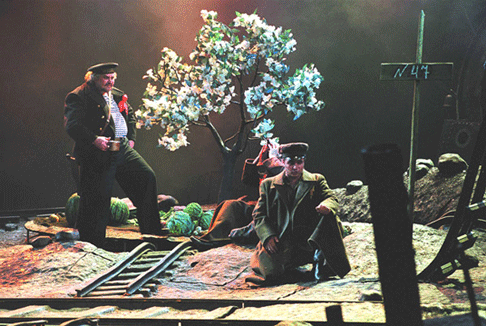 Scene from Semyon Kotko
The plot is puerile, but the score is intriguing. The vocal techniques range from pure speech (with rhythmic notation) to traditionally shaped melody, with every possible degree in between. There a Mussorgskian realism in the way voices overlap and different types of expressions are heard simultaneously. We are far away from Prokofiev’s nearly futuristic style, such as in The Love of Three Oranges or in The Gambler. The orchestration is rich. There is a strong, and apparently earnest, effort to follow “realistic socialism” aesthetics, which were incompatible with Prokofiev’s tendency toward innovation.
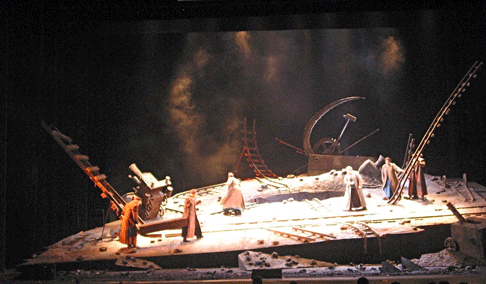 Scene from Act I
Does it work now? The Cagliari-Mariinsky production is, no doubt, an excellent effort: the stage direction is highly dramatic, acting is very good, a set of first-class tenors and basses (with a large gamut of varieties in their vocal specification), good conducting (Alexander Vedernikov), an intriguing stage set (Seymon Pastukh), and a stage direction (Yuri Alexandrov) that consists of 28 or so short scenes (post-World War I Ukraine looks like an immense garbage dump). In spite of these efforts, Semën Kotko fails because it is hampered by its inability to meet the demands of Bolshevist propaganda “despite [Prokofiev’s] best efforts . . . [to] bring it down to the level the Stalinist cultural establishment . . . required” [Richard Taruskin, Semyon Kotko, Grove Music Online ]. In light of the many attempts to please the powers-to-be and to experiment with a new mix of styles, it would have been well enough to have left this in the attic. Perhaps its principal significance is being a precursor to War and Peace, composed by Prokofiev a few years later.
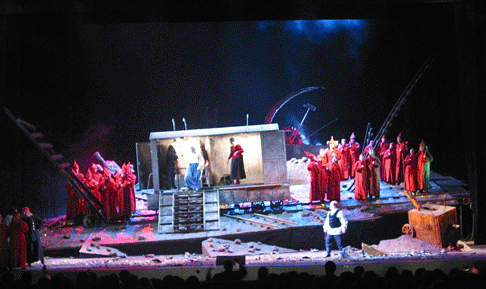 Scene from Act II
Nonetheless, a trip to Cagliari is worth for the marvelous voices, especially of the tenors, rarely heard in the West.
Giuseppe Pennisi