![Chris Lowrey (Alessandro) and Susanna Hurrell (Rossane [Photo by Chris Christodoulou]](http://www.operatoday.com/ChrisLowrey%26SusannaHurrell0.gif)
07 Apr 2009
Reasons to be Cheerful
London: Sue Loder reviews Alessandro and the Handel Singing Final
English Touring Opera are delighted to announce a season of lyric monodramas to tour nationally from October to December. The season features music for solo singer and piano by Argento, Britten, Tippett and Shostakovich with a bold and inventive approach to making opera during social distancing.
Conductor Oliver Zeffman has commissioned the very first opera for a socially distanced world, which is now available to watch exclusively on Apple Music. Eight Songs From Isolation has been written by eight leading composers, specifically for streaming - rather than live performance - and is the first opera written for a time when the performers were unable to meet in person.
Leading freelance musicians unite in Parliament Square to call for targeted support for colleagues in the arts and entertainment sector.
Duo Lewis Murphy (composer) and Laura Attridge (writer) have launched a charitable song project entitled Notes From Isolation. The resulting songs, featuring some of the UK's top singing talent, are being released online between August and October 2020 and can be enjoyed free of charge.
The Royal Opera House is thrilled to announce an exciting, wide-ranging new line-up for its autumn programme. For the first time, extraordinary performances will be accessible online for a global audience through livestreams and for socially distanced live audiences at our home in Covent Garden. In a global first, we present a new opera in hyper-reality, alongside repertory favourites from both artistic companies.
Some of the most famous and outstanding stars from the opera world are to take part in a very special evening from Wexford Festival Opera, including Aigul Akhmetshina, Joseph Calleja, Daniela Barcellona, Juan Diego Flórez, Igor Golovatenko, Ermonela Jaho, Sergey Romanovsky, and many more.
Following its successful launch in 2019, OperaStreaming streams nine operas on YouTube from the historic opera houses of Emilia-Romagna during the 2020-21 season, with fully-staged productions of Verdi's La traviata in October from Modena and Verdi'sOtello from Bologna in...
‘A brief history of song’ is the subtitle of the 2020 Oxford Lieder Festival (10th-17th October), which will present an ambitious, diverse and imaginative programme of 40 performances and events.
Bampton Classical Opera returns to the Baroque splendour of London’s St John’s Smith Square on November 6 with a concert performance of Gluck’s one-act opera The Crown, the first in the UK since 1987. The performance will also be filmed and available to watch on demand on the Bampton website from 9 November.
While many of us spent lockdown at home taking it a little easier, composer Andrew Synnott wrote an opera.
Owen Wingrave is part of the new Interim Season of 19 brand new events, all free to view online between September and December 2020.
The Arts Council has awarded innovative UK charity Music and Theatre For All (MTFA) a major new grant to develop three ambitious new projects in the wake of Covid 19.
English National Opera (ENO) will reopen the London Coliseum to socially distanced audiences on 6 and 7 November for special performances of Mozart’s Requiem. These will provide audiences with an opportunity to reflect upon and to commemorate the difficulties the nation has faced during the pandemic.
The Royal Opera House is proud to continue its curated #OurHouseToYourHouse programme into the autumn, bringing audiences the best of the ROH through a new series of Friday Premieres and cultural highlights.
After six months of closure, the Royal Opera House is thrilled to be opening its doors to the public as part of Open House London weekend, giving visitors a taste of one of the world’s most famous theatres for free.
The Academy of St Martin in the Fields is thrilled to announce re:connect - an eight concert series with live socially distanced audiences at its namesake church, St. Martin-in-the-Fields. The autumn concerts will take place at 5pm & 7:30pm on two Saturdays per month with guest artists including baritone Roderick Williams, soprano Carolyn Sampson and composer-conductor-pianist Ryan Wigglesworth performing a wide range of repertoire.
Music and poetry unite and collide across centuries, from the Medieval to the Enlightenment to the present day. This year, the Oxford Lieder Festival will present a thrilling and innovative programme comprising more than forty events streamed over eight days.
The English Concert with artistic director Harry Bicket is delighted to announce a series of concerts from 1-15 October 2020. The concerts take place in historic London venues with star soloists and will be performed and streamed live to a paying audience at 7pm GMT on each performance date. The programmes include first-class vocal and instrumental works from the two pillars of the English Baroque, covering different aspects of the repertoire.
Glyndebourne has announced plans for a ‘staycation’ series of socially-distanced indoor performances, starting on 10 October 2020.
The Royal Opera House is delighted to announce two packed evenings of opera and ballet, live from our stage in Covent Garden and available to view wherever you are in the world online.
London: Sue Loder reviews Alessandro and the Handel Singing Final
President Obama and Prime Minister Brown have been smiling from the front pages of all the newspapers after the G20 London Summit, and London’s parks are looking their vernal best in warm April sunshine. Enough to put even the dourest music lover in a good mood? Perhaps, but not remotely necessary after two consecutive evenings of exhilarating vocal accomplishment in the capital, and both times with singers with their careers still in front of them.
The ever-stimulating London Handel Festival has always been a launch pad for young singers just starting out on that difficult phase of their careers between graduate studies and professional contracts, and their annual opera at the Royal College of Music’s Britten Theatre this week, Handel’s Alessandro, this year came up trumps with no less than four very impressive young artists.
William Relton’s lively, almost cocky, production set in an Oxbridge in the mid 1930’s was full of sexual and political energy, not to mention tongue-in-cheek humour, and the young performers carried it all off with aplomb with some nicely detailed acting from both major and minor roles (the rugger scrums to freeze-frame strobes particularly effective). But with Handel it must always be the singing, the singing, and the singing that matters most and it was the high vocal standards that kept the very long first Act spinning along in a way that defied the clock.
At the bottom of the vocal scale was the warm, dark, yet agile bass baritone of James Oldfield, who brought both a calm dignity and emotional depth to his role as the loyal but morally-troubled captain, Clito. He was matched in vocal expression and stylish singing by the two rival princesses for Alessandro’s love, the sopranos Susanna Hurrell (Rosanne) and Sarah-Jane Brandon (Lisaure). Hurrell has a soubrettish clarity and pin-accurate style that revelled in the virtuosic coloratura, whilst Brandon displayed an impressively warm, creamy tone with power in reserve that will, with care, take her far.
These two soprano roles were of course sung at the premiere in London in 1726 by the Royal Academy’s famous “rival queens”, Cuzzoni and Bordoni, but they didn’t have all the hype and publicity to themselves as the title role was sung by the equally celebrated alto castrato, Senesino. The role of Handel’s soldier-king Alessandro (Alexander the Great whose empire reached to India in the east) takes some singing, and at first sight the young (he looks about sixteen, but obviously isn’t) American countertenor Christopher Lowrey seemed mis-matched to the role. That is until he opened his mouth, and started to dominate the stage. This young singer has that rare quality in this voice-type: a properly produced, strong warm tone, with no hint of that archetypal “English” hooty and constrained sound that is still too frequently found. His top seems limited at this stage, but his mid-range is well-supported and capable of some beautiful sounds. Perhaps just as important for any future operatic career is his obvious delight in being on stage and his ability to hold the eye – not always obvious in other young singers at this level. A Handelian star in the making one hopes.
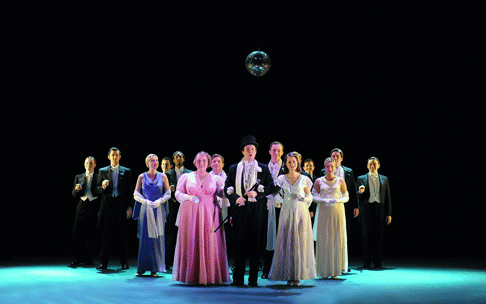 Sarah-Jane Brandon (Lisaura), Christopher Lowrey (Alessandro) and Susanna Hurrell (Rossane) with cast [Photo by Chris Christodoulou]
The supporting roles were all competently and affectingly sung by Ben Williamson, Rosie Aldridge (a notable “revenge” aria in Act Two) and John McMunn, and the Chorus made the most of their rugby-as-warfare opportunities. All were supported throughout by the resident London Handel Orchestra under Laurence Cummings, who played with verve and style, notwithstanding some dynamic imbalance in the wind section in Act Two.
London Handel Singing Competition
Turning to singing as a blood-sport, each year Handel’s own church of St. George’s, Hanover Square, fills with a crowd of dyed-in-the-wool Handelians anxious to assess this crop of Finalists, and even more determined to match their skills against those of the official Jury. As ever, this included the cream of English baroque specialists past and present – John Mark Ainsley, Christian Curnyn, Catherine Denley, Gillian Fisher, Michael George and, as Chairman, Ian Partridge.
![Ruby%20Hughes%20web[1].gif](http://www.operatoday.com/Ruby%2520Hughes%2520web%5B1%5D.gif) Ruby Hughes, winner of the London Handel Singing Competition [Photo courtesy of London Handel Festival]
Ruby Hughes, winner of the London Handel Singing Competition [Photo courtesy of London Handel Festival]
In recent years, the standard of singing has risen consistently with some
outstanding young artists emerging to confirm burgeoning careers: Andrew
Kennedy, Iestyn Davies and Lucy Crowe to name just three. This time around
there was a fascinating imbalance in the voice-types reaching the semi-finals
which may indicate merely a quirk of fashion, or may be something to worry
about: where are all the tenors and baritones? We know that Handelian tenor
roles of note are less than numerous, but surely there are ample opportunities
for a good low voice to enjoy? This year it seems, the sopranos and
countertenors ruled the roost.
Semi finalists:
David Allsopp counter-tenor
Michal Czerniawski counter-tenor
Gary Crichlow counter-tenor
Ruby Hughes soprano
George Humphreys baritone/bass
Anna Huntley mezzo-soprano
Annabel Mountford soprano
Sarah Power soprano
Alexandra Rawohl mezzo-soprano
Elinor Rolfe Johnson soprano
Kirstin Sharpin soprano
Luanda Siqueira soprano
Belinda Williams mezzo-soprano
Owen Willetts counter-tenor
Lisa Wilson soprano
Finalists:
Gary Crichlow counter-tenor
Anna Huntley mezzo-soprano
Ruby Hughes soprano
Luanda Siqueira soprano
David Allsopp counter-tenor
As it happened, on the night, all five singers had to work under some difficulty as there was an unfortunate sudden collapse of an audience member which necessitated urgent medical attention and held up proceedings for over 35 minutes. The eventual winner of both the Adair (First) Prize and the Audience Prize (for once there was no difference of opinion) was clearly not a difficult choice for the jury: young Ruby Hughes, soprano, showed a professionalism and vocal finish in her programme which stood out head and shoulders above her rivals. Her larger instrument, with a warm, bright tone that was even through the range, enabled an expressive delivery that drew every bit of drama from her choices from Theodora, Giulio Cesare, Jephtha and Samson. Anna Huntley, mezzo-soprano, was the worthy second prize winner and lacked just a little in volume and projection compared to Hughes, despite some lovely detailed work and judicious use of vibrato.
Sue Loder © 2009.