14 May 2009
Gustav Mahler: Symphony no. 3
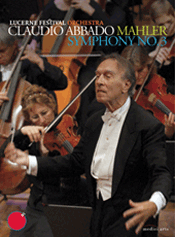
Recorded live in concert on 19 August 2007, this performance of Gustav Mahler's Third Symphony by Claudio Abbado is part of the conductor's cycle involving the Lucerne Festival.
English Touring Opera are delighted to announce a season of lyric monodramas to tour nationally from October to December. The season features music for solo singer and piano by Argento, Britten, Tippett and Shostakovich with a bold and inventive approach to making opera during social distancing.
This tenth of ten Live from London concerts was in fact a recorded live performance from California. It was no less enjoyable for that, and it was also uplifting to learn that this wasn’t in fact the ‘last’ LfL event that we will be able to enjoy, courtesy of VOCES8 and their fellow vocal ensembles (more below …).
Ever since Wigmore Hall announced their superb series of autumn concerts, all streamed live and available free of charge, I’d been looking forward to this song recital by Ian Bostridge and Imogen Cooper.
The Sixteen continues its exploration of Henry Purcell’s Welcome Songs for Charles II. As with Robert King’s pioneering Purcell series begun over thirty years ago for Hyperion, Harry Christophers is recording two Welcome Songs per disc.
Although Stile Antico’s programme article for their Live from London recital introduced their selection from the many treasures of the English Renaissance in the context of the theological debates and upheavals of the Tudor and Elizabethan years, their performance was more evocative of private chamber music than of public liturgy.
In February this year, Albanian soprano Ermonela Jaho made a highly lauded debut recital at Wigmore Hall - a concert which both celebrated Opera Rara’s 50th anniversary and honoured the career of the Italian soprano Rosina Storchio (1872-1945), the star of verismo who created the title roles in Leoncavallo’s La bohème and Zazà, Mascagni’s Lodoletta and Puccini’s Madama Butterfly.
Evidently, face masks don’t stifle appreciative “Bravo!”s. And, reducing audience numbers doesn’t lower the volume of such acclamations. For, the audience at Wigmore Hall gave soprano Elizabeth Llewellyn and pianist Simon Lepper a greatly deserved warm reception and hearty response following this lunchtime recital of late-Romantic song.
Collapsology. Or, perhaps we should use the French word ‘Collapsologie’ because this is a transdisciplinary idea pretty much advocated by a series of French theorists - and apparently, mostly French theorists. It in essence focuses on the imminent collapse of modern society and all its layers - a series of escalating crises on a global scale: environmental, economic, geopolitical, governmental; the list is extensive.
For this week’s Live from London vocal recital we moved from the home of VOCES8, St Anne and St Agnes in the City of London, to Kings Place, where The Sixteen - who have been associate artists at the venue for some time - presented a programme of music and words bound together by the theme of ‘reflection’.
'Such is your divine Disposation that both you excellently understand, and royally entertaine the Exercise of Musicke.’
Amongst an avalanche of new Mahler recordings appearing at the moment (Das Lied von der Erde seems to be the most favoured, with three) this 1991 Mahler Second from the 2nd Kassel MahlerFest is one of the more interesting releases.
‘And there was war in heaven: Michael and his angels fought against the dragon; and the dragon fought and his angels, And prevailed not; neither was their place found any more in heaven … that old serpent … Satan, which deceiveth the whole world: he was cast out into the earth, and his angels were cast out with him.’
If there is one myth, it seems believed by some people today, that probably needs shattering it is that post-war recordings or performances of Wagner operas were always of exceptional quality. This 1949 Hamburg Tristan und Isolde is one of those recordings - though quite who is to blame for its many problems takes quite some unearthing.
There was never any doubt that the fifth of the twelve Met Stars Live in Concert broadcasts was going to be a palpably intense and vivid event, as well as a musically stunning and theatrically enervating experience.
‘Love’ was the theme for this Live from London performance by Apollo5. Given the complexity and diversity of that human emotion, and Apollo5’s reputation for versatility and diverse repertoire, ranging from Renaissance choral music to jazz, from contemporary classical works to popular song, it was no surprise that their programme spanned 500 years and several musical styles.
The Academy of St Martin in the Fields have titled their autumn series of eight concerts - which are taking place at 5pm and 7.30pm on two Saturdays each month at their home venue in Trafalgar Square, and being filmed for streaming the following Thursday - ‘re:connect’.
The London Symphony Orchestra opened their Autumn 2020 season with a homage to Oliver Knussen, who died at the age of 66 in July 2018. The programme traced a national musical lineage through the twentieth century, from Britten to Knussen, on to Mark-Anthony Turnage, and entwining the LSO and Rattle too.
With the Live from London digital vocal festival entering the second half of the series, the festival’s host, VOCES8, returned to their home at St Annes and St Agnes in the City of London to present a sequence of ‘Choral Dances’ - vocal music inspired by dance, embracing diverse genres from the Renaissance madrigal to swing jazz.
Just a few unison string wriggles from the opening of Mozart’s overture to Le nozze di Figaro are enough to make any opera-lover perch on the edge of their seat, in excited anticipation of the drama in music to come, so there could be no other curtain-raiser for this Gala Concert at the Royal Opera House, the latest instalment from ‘their House’ to ‘our houses’.
"Before the ending of the day, creator of all things, we pray that, with your accustomed mercy, you may watch over us."
Recorded live in concert on 19 August 2007, this performance of Gustav Mahler's Third Symphony by Claudio Abbado is part of the conductor's cycle involving the Lucerne Festival.
Like the DVD of Mahler’s Second Symphony, which was already released, this one of the Third conveys the energy of the live performance. From the start, various details become evident, as with the presence onstage from the start of the soloist Anna Larsson and also the choruses in the balcony above the stage. Likewise, the cameras catch in the opening minutes of the first movement the prominently raised bells of the French horns, as indicated in the score with the marking “Schalltrichter auf” (“bells up”). Beyond the adherence to such markings, the playing is energetic from the start, with vigorous bowing in the strings, to create the full and incisive sound characteristic of this performance. At the same time, the quieter effects are clearly present, and it is useful to have the camera focus, for example, on the timpani passage, which is to be played softly. The softer sound is no mistake, and the film confirms the sound with the visual image. Elsewhere, it is possible to see the ways in which Abbado achieves his fine result, as with the cloth coverin the bells of the trumpets and trombones certain passages of the Finale, a variation on the way in which some conductors sometimes have the brass play into the music stands.
Yet it is details like these that set apart Abbado’s performance in this recording from other performances of this Symphony. His sense of the form of the expansive first movement brings the various thematic ideas together convincingly. At the point in the score just before the reprise that signals the concluding section, Abbado achieves a the notated dynamic level without sacrificing precision or control. Rather, the softer volume allows the ensemble to articulate the musical ideas with welcome precision as Abbado brings the movement to an exciting and resonant conclusion.
Similar details emerge in the second movement, which follows relatively quickly after the first movement. While Mahler marked the score to have a break of at least five minutes between those two movements, absolute precision with the timing is not necessary, as evident here. It is useful for the orchestra to regroup, as it were, before proceeding with the second movement and thus to convey to shift of mood in this orchestral idyll. Some of the figuration evident here evokes connections with the accompaniment of the song “Das himmlische Leben,” which Mahler used as the Finale of the Fourth Symphony and was, at one time, considered for inclusion in the third. Elsewhere the string writing suggests the reflective tone Mahler had achieved in the second movement of the Second Symphony. Here, though, the ensemble brings about the precision which allows the shifting colors of the movement to be heard cleanly.
At the center of the Third Symphony are three movements which have vocal connections: the third movement is a Scherzo in which Mahler makes use of his Wunderhorn setting “Ablősung im Sommer”; the setting for alto of a text from Nietsche’s Also sprach Zarathustra; and the Wunderhorn poem “Es sungen drei Engel” for alto and chorus. Abbado makes the lyrical element apparent without belaboring, and this is nicely balanced in the third movement. In that piece the closeups of the woodwinds reveal the engagement of the players as they work together in tight ensemble. The result is a distinctive execution of the accompaniment which allows the cantabile line to emerge with ease. In fact, the intensity Abbado has given to the third movement is remarkable for the way it brings out thematic ideas that are often found in analysis, but not often made so audible. In bringing out the vocal elements, Abbado allows the motives in the accompaniment to be heard distinctly. At the same time some of the figures anticipate ideas that Mahler will pursue in the subsequent movements of this work, as with the motives in the timpani, which will be heard in augmentation in the Finale. Throughout this movement, the Abbado carefully follows the dynamics, so that the climax is precisely where the composer wanted it, and this leads directly to the conclusion of this remarkable Scherzo.
With the fourth movement, Anna Larsons is heard for the first time in this work, and her interpretation of Nietzsche’s “O Mensch, gib acht” is impressive for the singer’s engagement with the text. The accompaniment may seem louder than sometimes occurs in the concert hall, and this might be the result of the recording techniques. Even so, the balance between the vocal part and the instrumental accompaniment is effective, with the closing measures of the movement appropriately reserved. The relatively quiet ending stands in contrast to the ringin opening of the choral movement which follows. Here, again, the sound is relatively close and perhaps louder than one usually hears in a live performance. Nevertheless the solid recording techniques allow the choral sound to blend nicely with the orchestra beneath it. While the solo part for Larsons is relatively short, it shows the mezzo soprano in fine style as she sings the part of the repentant Saint Peter in this Wunderhorn setting.
In bringing the work to its conclusion, Abbado contributes a well-thought pacing to the slow movement with which the Third Symphony ends. While never belaboring the slow tempos, Abbado is also keen to allow for some flexibility, as with the motive in the horns near the beginning of the movement, which requires the agitato approach he has given it. The pauses which Abbado brings to the movement are entirely appropriate to the musical structure and also the resonant sonorities he achieves in the performance. This and other nuances in tempo are essential the movement, and Abbado is particularly effective in this regard. Within the larger structure of the slow movement, the individual sections that comprise have shape and, as individual units, contribute to the whole. At the core of the movement is the warm, rich string sound, which is quite apparent in this recording. The intensity of the playing, along with Abbado’s fine direction results in an outstanding performance of this movement.
This film of the Third Symphony shows the hall in a brighter light than evident on some other videos from Abbado’s Lucerne cycle, and this allows for some fine shots of the orchestra, along with Abbado himself. The conductor’s presence can be visually more convincing with the audience around him, rather than as a silhouette with an almost black background. At some points the lighting makes it possible to read the music on the instrumentalists’ stands, an element that contributes to the overall sense of the live performance. It is, however, unfortunate, that the blue exit signs in the hallways are sometimes prominent. This is a minor point, but in a video this compelling, such a detail emerges along with the other, positive ones.
The accompanying booklet is lists the movements, timings, principals, and some production details, without the extensive notes that sometimes occur. Werner Pfister’s short essay “Selige Zuversicht” (“Blissful Trust,” as translated here), is useful in giving some perspectives on the aims of the Lucerne Festival and Abbado’s aims with this specific performance. Pfister’s comment that “Abbado’s Mahler is precisely calculated and at the same time intuitively felt” bears explication, though. Some of the connotations of “kalkuliert” in English suggest the pejorative, and it is clear that the precision Abbado achieves serves his purpose in bringing to his audience a thorough and reliable reading of the score. No matter what the program notes state about it, listeners have the opportunity to hear for themselves how well Abbado performs Mahler’s Third Symphony.
Several DVD performances of Mahler’s Third Symphony exist, but this one by Abbado stands out as particularly effective for its impeccable interpretation and execution. A challenging work because of its length and the range of music within it, the Third sometimes reaches audiences with some elements wanting, and that is not the case in this recent release. One of the foremost conductors of his generation, Abbado demonstrates yet again his masterful approach to Mahler’s demanding scores in this festival peformance of the Third Symphony. The rhythmic applause and extended ovation at the end are certainly an appropriate response to the efforts of Abbado and the Lucerne Festival Orchestra.
James L. Zychowicz