Recently in Reviews
English Touring Opera are delighted to announce a season of lyric monodramas to tour nationally from October to December. The season features music for solo singer and piano by Argento, Britten, Tippett and Shostakovich with a bold and inventive approach to making opera during social distancing.
This tenth of ten Live from London concerts was in fact a recorded live performance from California. It was no less enjoyable for that, and it was also uplifting to learn that this wasn’t in fact the ‘last’ LfL event that we will be able to enjoy, courtesy of VOCES8 and their fellow vocal ensembles (more below …).
Ever since Wigmore Hall announced their superb series of autumn concerts, all streamed live and available free of charge, I’d been looking forward to this song recital by Ian Bostridge and Imogen Cooper.
The Sixteen continues its exploration of Henry Purcell’s Welcome Songs for Charles II. As with Robert King’s pioneering Purcell series begun over thirty years ago for Hyperion, Harry Christophers is recording two Welcome Songs per disc.
Although Stile Antico’s programme article for their Live from London recital introduced their selection from the many treasures of the English Renaissance in the context of the theological debates and upheavals of the Tudor and Elizabethan years, their performance was more evocative of private chamber music than of public liturgy.
In February this year, Albanian soprano Ermonela Jaho made a highly lauded debut recital at Wigmore Hall - a concert which both celebrated Opera Rara’s 50th anniversary and honoured the career of the Italian soprano Rosina Storchio (1872-1945), the star of verismo who created the title roles in Leoncavallo’s La bohème and Zazà, Mascagni’s Lodoletta and Puccini’s Madama Butterfly.
Evidently, face masks don’t stifle appreciative “Bravo!”s. And, reducing audience numbers doesn’t lower the volume of such acclamations. For, the audience at Wigmore Hall gave soprano Elizabeth Llewellyn and pianist Simon Lepper a greatly deserved warm reception and hearty response following this lunchtime recital of late-Romantic song.
Collapsology. Or, perhaps we should use the French word ‘Collapsologie’ because this is a transdisciplinary idea pretty much advocated by a series of French theorists - and apparently, mostly French theorists. It in essence focuses on the imminent collapse of modern society and all its layers - a series of escalating crises on a global scale: environmental, economic, geopolitical, governmental; the list is extensive.
For this week’s Live from London vocal recital we moved from the home of VOCES8, St Anne and St Agnes in the City of London, to Kings Place, where The Sixteen - who have been associate artists at the venue for some time - presented a programme of music and words bound together by the theme of ‘reflection’.
'Such is your divine Disposation that both you excellently understand, and royally entertaine the Exercise of Musicke.’
Amongst an avalanche of new Mahler recordings appearing at the moment (Das Lied von der Erde seems to be the most favoured, with three) this 1991 Mahler Second from the 2nd Kassel MahlerFest is one of the more interesting releases.
‘And there was war in heaven: Michael and his angels fought against the dragon; and the dragon fought and his angels, And prevailed not; neither was their place found any more in heaven … that old serpent … Satan, which deceiveth the whole world: he was cast out into the earth, and his angels were cast out with him.’
If there is one myth, it seems believed by some people today, that probably needs shattering it is that post-war recordings or performances of Wagner operas were always of exceptional quality. This 1949 Hamburg Tristan und Isolde is one of those recordings - though quite who is to blame for its many problems takes quite some unearthing.
There was never any doubt that the fifth of the twelve Met Stars Live in Concert broadcasts was going to be a palpably intense and vivid event, as well as a musically stunning and theatrically enervating experience.
‘Love’ was the theme for this Live from London performance by Apollo5. Given the complexity and diversity of that human emotion, and Apollo5’s reputation for versatility and diverse repertoire, ranging from Renaissance choral music to jazz, from contemporary classical works to popular song, it was no surprise that their programme spanned 500 years and several musical styles.
The Academy of St Martin in the Fields have titled their autumn series of eight concerts - which are taking place at 5pm and 7.30pm on two Saturdays each month at their home venue in Trafalgar Square, and being filmed for streaming the following Thursday - ‘re:connect’.
The London Symphony Orchestra opened their Autumn 2020 season with a homage to Oliver Knussen, who died at the age of 66 in July 2018. The programme traced a national musical lineage through the twentieth century, from Britten to Knussen, on to Mark-Anthony Turnage, and entwining the LSO and Rattle too.
With the Live from London digital vocal festival entering the second half of the series, the festival’s host, VOCES8, returned to their home at St Annes and St Agnes in the City of London to present a sequence of ‘Choral Dances’ - vocal music inspired by dance, embracing diverse genres from the Renaissance madrigal to swing jazz.
Just a few unison string wriggles from the opening of Mozart’s overture to Le nozze di Figaro are enough to make any opera-lover perch on the edge of their seat, in excited anticipation of the drama in music to come, so there could be no other curtain-raiser for this Gala Concert at the Royal Opera House, the latest instalment from ‘their House’ to ‘our houses’.
"Before the ending of the day, creator of all things, we pray that, with your accustomed mercy, you may watch over us."
Reviews
26 May 2009
Haydn’s “Il Ritorno Di Tobia” , Oratorio Or Opera Seria?
Joseph Haydn's place in the history of the oratorio has been secured by his masterpieces The Creation (1798) and The Seasons (1801). His first appearance, however, on the Mount Parnassus of oratorio was a good quarter of a century beforehand with Il ritorno di Tobia.
Recently performed at the Accademia di Santa Cecilia in Rome (May 16-19) with an all star cast as a part of the celebration for the bicentenary of Haydn’s death. It is also the indication of revival of a nearly forgotten masterpiece: a few months ago Il ritorno di Tobia had been performed in London and Poissy under the baton of Sir Roger Norrington.
Il ritorno di Tobia had had a promising start: in April 1775 Haydn directed the first two performances of his work, written for the Vienna Tonkünstler-Societät. This success was no mere accident: Haydn had tailored his first oratorio as much as possible to suit Viennese taste. At this time Vienna was, to a certain extent, the bastion of the Italian oratorio north of the Alps. An Italian libretto was therefore indispensable, and for his subject matter, Haydn had chosen an exceptionally popular story: in the XVIII century, the Old Testament Book of Tobias was found everywhere, in painting, sculpture, literature and music; in Vienna alone it had been set to music dozens of times. Oratorios were performed in theatres because , during Lent, opera performances were forbidden; from the Playbills of the time we know that tickets for Il ritorno di Tobia were as high as those for a major opera seria performance. There was also some politics: the main theme of Il ritorno is conjugal love and parenthood; this would fit very well Empress Marie Thérèse’s view of the world- a world then rapidly changing , only a few years from Così fan tutte wives’ swapping and Marquis de Sade’s novels.
Within a short space of time copies of the score were circulating throughout Europe and Haydn himself counted the work among his most successful. It is also no surprise, however, that as early as 1781 a planned repeat performance in Vienna failed owing to the subsequent change in public taste; and besides this, as it took almost three hours to perform, the work was considered simply too long. Haydn, , was after all an experienced man of the theatre who had earned his stripes at the Esterházys’ opera house, and as such was perfectly capable of tackling the reworking of his Tobia in view of its difficulties. The parts of the Tonkünstler-Societät and Haydn’s autograph testify to this in a variety of ways: Haydn himself made alterations in a number of places in his score to passages of secco recitative, which, being accompanied only by the continuo instrument, allow the singer greater freedom in which to be creative. On the other hand, the orchestral material contains cuts in much of the extravagant coloratura, and also the repeated sections in the arias. Not only did this bring about the shortening of the work deemed necessary, it also reduced the technical demands of the arias significantly, and so made the rôles easier to cast. It is no longer possible to reconstruct beyond doubt when exactly and for which performance these alterations were made.
Even if the action is not set directly scene by scene, Il ritorno di Tobia still provides moments of striking theatricality. In matters of text setting, the Italianate oratorio of the XVIII century followed the opera seria closely: this begins with the sequence of recitatives and arias and continues with the ways in which these formal elements are given shape. The recitative is characterized from the outset by dialogue and the dramatic structure imposed by the characters’ immediate reactions to one other. This is not even altered by the fact that repeated events already bygone are brought back to life in the recitatives.
Haydn takes the opera as his model not only for the dialogical texture but also for the aria’s structure. Unlike the opera seria of the time, in which the involvement of the chorus is reserved for particularly festive types such as the Festa teatrale, in the Italianate oratorio both parts traditionally concluded with a chorus; usually the choir also played a part in the opening scene. Besides this, the inclusion of contrapuntal techniques is typical of oratorio. The basic question is still unanswered: it is an oratorio or a grand opera seria?
After performances in Vienna at the Kärtnertortheater in 1775 and in 1784 at the Hofburgtheater, where it was heard again in 1808 , Il ritorno di Tobia faded away until very recently. There only a couple of recording available - and not very easy to find and purchase.
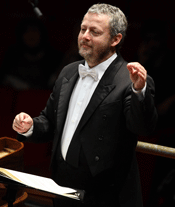
Santa Cecilia’s lavish production is to be considered an Italian premiere. The symphony orchestra was superbly conducted by Flavio Biondi, the creator and leader of the Europa Galante ensemble. To borrow from Giuseppe Verdi one of his favorite quote Biondi “made the orchestra dance” . A few cuts were made in the very long score; I attended the Monday subscription performance starting at 9 pm. Even after the cut, the work, unknown to most of the audience, appeared too to some; at end (well after midnight) only half of the large auditorium (2800 seats) was full but those who sat through the end gave a generous applause to the orchestra, the chorus and the soloist.
The chorus deserves a special mention. There important and very difficult choral sections in Il ritorno di Tobia. They require considerable skills; conducted by Filipp Maria Bessan, the Santa Cecilia Chorus had a warm deserved applause.
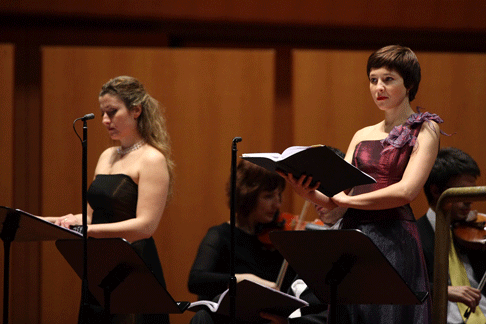
Somewhat uneven the soloist cast. Maria Grazia Schiavo was an excellent Sara and gained an open stage applause after her long second act arias where her acute reached very high heights. An Allenberg is a alto specializing in baroque and XVIII century music; she was a very motherly Anne descending to very grave tonalities. Bernard Richter , Tobia,is a lyric tenor: he braved out a role requiring to climb very steep acute mountains. Less satisfactory Johannes Weisser , Tobit , and Valentina Farcas, Raffaele.
Giuseppe Pennisi