Recently in Reviews
English Touring Opera are delighted to announce a season of lyric monodramas to tour nationally from October to December. The season features music for solo singer and piano by Argento, Britten, Tippett and Shostakovich with a bold and inventive approach to making opera during social distancing.
This tenth of ten Live from London concerts was in fact a recorded live performance from California. It was no less enjoyable for that, and it was also uplifting to learn that this wasn’t in fact the ‘last’ LfL event that we will be able to enjoy, courtesy of VOCES8 and their fellow vocal ensembles (more below …).
Ever since Wigmore Hall announced their superb series of autumn concerts, all streamed live and available free of charge, I’d been looking forward to this song recital by Ian Bostridge and Imogen Cooper.
The Sixteen continues its exploration of Henry Purcell’s Welcome Songs for Charles II. As with Robert King’s pioneering Purcell series begun over thirty years ago for Hyperion, Harry Christophers is recording two Welcome Songs per disc.
Although Stile Antico’s programme article for their Live from London recital introduced their selection from the many treasures of the English Renaissance in the context of the theological debates and upheavals of the Tudor and Elizabethan years, their performance was more evocative of private chamber music than of public liturgy.
In February this year, Albanian soprano Ermonela Jaho made a highly lauded debut recital at Wigmore Hall - a concert which both celebrated Opera Rara’s 50th anniversary and honoured the career of the Italian soprano Rosina Storchio (1872-1945), the star of verismo who created the title roles in Leoncavallo’s La bohème and Zazà, Mascagni’s Lodoletta and Puccini’s Madama Butterfly.
Evidently, face masks don’t stifle appreciative “Bravo!”s. And, reducing audience numbers doesn’t lower the volume of such acclamations. For, the audience at Wigmore Hall gave soprano Elizabeth Llewellyn and pianist Simon Lepper a greatly deserved warm reception and hearty response following this lunchtime recital of late-Romantic song.
Collapsology. Or, perhaps we should use the French word ‘Collapsologie’ because this is a transdisciplinary idea pretty much advocated by a series of French theorists - and apparently, mostly French theorists. It in essence focuses on the imminent collapse of modern society and all its layers - a series of escalating crises on a global scale: environmental, economic, geopolitical, governmental; the list is extensive.
For this week’s Live from London vocal recital we moved from the home of VOCES8, St Anne and St Agnes in the City of London, to Kings Place, where The Sixteen - who have been associate artists at the venue for some time - presented a programme of music and words bound together by the theme of ‘reflection’.
'Such is your divine Disposation that both you excellently understand, and royally entertaine the Exercise of Musicke.’
Amongst an avalanche of new Mahler recordings appearing at the moment (Das Lied von der Erde seems to be the most favoured, with three) this 1991 Mahler Second from the 2nd Kassel MahlerFest is one of the more interesting releases.
‘And there was war in heaven: Michael and his angels fought against the dragon; and the dragon fought and his angels, And prevailed not; neither was their place found any more in heaven … that old serpent … Satan, which deceiveth the whole world: he was cast out into the earth, and his angels were cast out with him.’
If there is one myth, it seems believed by some people today, that probably needs shattering it is that post-war recordings or performances of Wagner operas were always of exceptional quality. This 1949 Hamburg Tristan und Isolde is one of those recordings - though quite who is to blame for its many problems takes quite some unearthing.
There was never any doubt that the fifth of the twelve Met Stars Live in Concert broadcasts was going to be a palpably intense and vivid event, as well as a musically stunning and theatrically enervating experience.
‘Love’ was the theme for this Live from London performance by Apollo5. Given the complexity and diversity of that human emotion, and Apollo5’s reputation for versatility and diverse repertoire, ranging from Renaissance choral music to jazz, from contemporary classical works to popular song, it was no surprise that their programme spanned 500 years and several musical styles.
The Academy of St Martin in the Fields have titled their autumn series of eight concerts - which are taking place at 5pm and 7.30pm on two Saturdays each month at their home venue in Trafalgar Square, and being filmed for streaming the following Thursday - ‘re:connect’.
The London Symphony Orchestra opened their Autumn 2020 season with a homage to Oliver Knussen, who died at the age of 66 in July 2018. The programme traced a national musical lineage through the twentieth century, from Britten to Knussen, on to Mark-Anthony Turnage, and entwining the LSO and Rattle too.
With the Live from London digital vocal festival entering the second half of the series, the festival’s host, VOCES8, returned to their home at St Annes and St Agnes in the City of London to present a sequence of ‘Choral Dances’ - vocal music inspired by dance, embracing diverse genres from the Renaissance madrigal to swing jazz.
Just a few unison string wriggles from the opening of Mozart’s overture to Le nozze di Figaro are enough to make any opera-lover perch on the edge of their seat, in excited anticipation of the drama in music to come, so there could be no other curtain-raiser for this Gala Concert at the Royal Opera House, the latest instalment from ‘their House’ to ‘our houses’.
"Before the ending of the day, creator of all things, we pray that, with your accustomed mercy, you may watch over us."
Reviews
12 May 2009
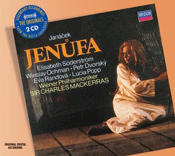
Janáček: Jenůfa and Kátya Kabanová
Recorded four years apart, these two classic recordings of Leos Janáček's dramatic masterpieces now reappear in Decca's The Originals series, thankfully still with full librettos and excellent booklet essays.
Charles Mackerras continues to reign as the supreme conductor of Janáček’s music, and these sets provide further evidence of that, not least by filling up the second discs with other pieces. The Jenůfa set includes the final scene in the revised orchestration that introduced the opera to most of the world, before Mackerras led the return to Janáček’s original score, and the set concludes with an overture considered for the opera but never used. Janáček ‘s Concertino and Capriccio close the Kátya Kabanová set, both in witty performances conducted by David Atherton. The mood of those pieces is quite a bit different from that of the opera, it should be said.
Both sets feature informative essays by John Tyrrell, which give not only detailed background on Janáček’s compositions, including almost academic musical analysis, but also ample information on the original works behind the operas. In the Kabanová booklet Tyrrell’s essay is followed by a note from Mackerras, relating his first exposure to the composer who would become such a large part of his career.
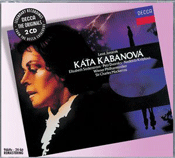 The Kabanová set came in 1978, and its sound world is quite different from that of Jenůfa, composed many years before. The later work comes from the composer’s mature period, and it combines the exciting rhythms and naturalistic declamation found in the earlier work with a richer orchestral fabric, somewhat resembling the textures of his Taras Bulba. However, it seems to be the earlier opera that has established itself as the more performed of the two, undoubtedly due to the power of its story and characters. Both stories deal mainly in pain and distress, but Jenůfa ends with a gorgeous duet of redemptive love, whereas Kabanová’s heroine throws herself into a river, unable to find a way to live a new life or return to her old one. Nonetheless, as pure listening experience, your reviewer finds Kátya Kabanová a more entrancing score to listen to, with its greater variety of tone and mood. Jenůfa, on the other hand, works best on stage, where its characters come to full life, and can break the hearts of most any audience.
Elisabeth Soderstrom stars on both sets, her warm, womanly sound appropriate for both characters, and her command of the idiom as sound as her conductor’s. Peter Dvorsky gets to portray both the handsome but weak Steva of Jenůfa and the handsome but weak Boris in the Kabanová. He does so handsomely, with no weakness. Wieslaw Ochman earns his redemption as Laca with urgent, masculine passion. The Kostelnička, Eva Randova, has a full, secure voice, whereas on stage the role is often taken by a veteran singer whose voice may be worn but who can embody the character convincingly. The counterpart role in Kabanová, Kátya’s mother-in-law, is sung with fierce relish by Nadězda Kniplová.
For any opera lover who somehow never managed to acquire these sets in the long years when they were only available at full-price, now is the time to search them out and add them to your collection. Indispensable.
Chris Mullins