![Susan Bullock as Katerina Ismailova [Photo courtesy of Opera Australia]](http://www.operatoday.com/Lady_Macbeth_Mtensk_Austral.gif)
12 May 2009
Lady Macbeth of Mtsensk — Opera Australia
For two years following its premiere Shostakovich’s Lady Macbeth of Mtsesnk was one of the most often performed contemporary operas.
English Touring Opera are delighted to announce a season of lyric monodramas to tour nationally from October to December. The season features music for solo singer and piano by Argento, Britten, Tippett and Shostakovich with a bold and inventive approach to making opera during social distancing.
This tenth of ten Live from London concerts was in fact a recorded live performance from California. It was no less enjoyable for that, and it was also uplifting to learn that this wasn’t in fact the ‘last’ LfL event that we will be able to enjoy, courtesy of VOCES8 and their fellow vocal ensembles (more below …).
Ever since Wigmore Hall announced their superb series of autumn concerts, all streamed live and available free of charge, I’d been looking forward to this song recital by Ian Bostridge and Imogen Cooper.
The Sixteen continues its exploration of Henry Purcell’s Welcome Songs for Charles II. As with Robert King’s pioneering Purcell series begun over thirty years ago for Hyperion, Harry Christophers is recording two Welcome Songs per disc.
Although Stile Antico’s programme article for their Live from London recital introduced their selection from the many treasures of the English Renaissance in the context of the theological debates and upheavals of the Tudor and Elizabethan years, their performance was more evocative of private chamber music than of public liturgy.
In February this year, Albanian soprano Ermonela Jaho made a highly lauded debut recital at Wigmore Hall - a concert which both celebrated Opera Rara’s 50th anniversary and honoured the career of the Italian soprano Rosina Storchio (1872-1945), the star of verismo who created the title roles in Leoncavallo’s La bohème and Zazà, Mascagni’s Lodoletta and Puccini’s Madama Butterfly.
Evidently, face masks don’t stifle appreciative “Bravo!”s. And, reducing audience numbers doesn’t lower the volume of such acclamations. For, the audience at Wigmore Hall gave soprano Elizabeth Llewellyn and pianist Simon Lepper a greatly deserved warm reception and hearty response following this lunchtime recital of late-Romantic song.
Collapsology. Or, perhaps we should use the French word ‘Collapsologie’ because this is a transdisciplinary idea pretty much advocated by a series of French theorists - and apparently, mostly French theorists. It in essence focuses on the imminent collapse of modern society and all its layers - a series of escalating crises on a global scale: environmental, economic, geopolitical, governmental; the list is extensive.
For this week’s Live from London vocal recital we moved from the home of VOCES8, St Anne and St Agnes in the City of London, to Kings Place, where The Sixteen - who have been associate artists at the venue for some time - presented a programme of music and words bound together by the theme of ‘reflection’.
'Such is your divine Disposation that both you excellently understand, and royally entertaine the Exercise of Musicke.’
Amongst an avalanche of new Mahler recordings appearing at the moment (Das Lied von der Erde seems to be the most favoured, with three) this 1991 Mahler Second from the 2nd Kassel MahlerFest is one of the more interesting releases.
‘And there was war in heaven: Michael and his angels fought against the dragon; and the dragon fought and his angels, And prevailed not; neither was their place found any more in heaven … that old serpent … Satan, which deceiveth the whole world: he was cast out into the earth, and his angels were cast out with him.’
If there is one myth, it seems believed by some people today, that probably needs shattering it is that post-war recordings or performances of Wagner operas were always of exceptional quality. This 1949 Hamburg Tristan und Isolde is one of those recordings - though quite who is to blame for its many problems takes quite some unearthing.
There was never any doubt that the fifth of the twelve Met Stars Live in Concert broadcasts was going to be a palpably intense and vivid event, as well as a musically stunning and theatrically enervating experience.
‘Love’ was the theme for this Live from London performance by Apollo5. Given the complexity and diversity of that human emotion, and Apollo5’s reputation for versatility and diverse repertoire, ranging from Renaissance choral music to jazz, from contemporary classical works to popular song, it was no surprise that their programme spanned 500 years and several musical styles.
The Academy of St Martin in the Fields have titled their autumn series of eight concerts - which are taking place at 5pm and 7.30pm on two Saturdays each month at their home venue in Trafalgar Square, and being filmed for streaming the following Thursday - ‘re:connect’.
The London Symphony Orchestra opened their Autumn 2020 season with a homage to Oliver Knussen, who died at the age of 66 in July 2018. The programme traced a national musical lineage through the twentieth century, from Britten to Knussen, on to Mark-Anthony Turnage, and entwining the LSO and Rattle too.
With the Live from London digital vocal festival entering the second half of the series, the festival’s host, VOCES8, returned to their home at St Annes and St Agnes in the City of London to present a sequence of ‘Choral Dances’ - vocal music inspired by dance, embracing diverse genres from the Renaissance madrigal to swing jazz.
Just a few unison string wriggles from the opening of Mozart’s overture to Le nozze di Figaro are enough to make any opera-lover perch on the edge of their seat, in excited anticipation of the drama in music to come, so there could be no other curtain-raiser for this Gala Concert at the Royal Opera House, the latest instalment from ‘their House’ to ‘our houses’.
"Before the ending of the day, creator of all things, we pray that, with your accustomed mercy, you may watch over us."
For two years following its premiere Shostakovich’s Lady Macbeth of Mtsesnk was one of the most often performed contemporary operas.
With simultaneous premieres in Leningrad and Moscow followed, at one point, by simultaneous productions in three Moscow theatres alone foreign productions followed. After the American premiere the sensational opera became topical enough to be mentioned in the Rodgers and Hart musical On Your Toes and in London, where it was performed in concert in 1936 followed by BBC broadcast, the young Benjamin Britten heard it and was impressed by its powerful interludes (and also by one of the singers, Peter Pears, who had a minor role). The came Stalin’s visit to a performance in Moscow and the subsequent attacks in Pravda on the opera, the ballet The Limpid Stream and the composer himself. The opera was withdrawn immediately. There was difficulty obtaining the music for that London concert in 1936 and after then it disappeared from every stage until 1959 when the Dusseldorf Opera managed to wrangle the orchestral music from the Soviet authorities. By then Shostakovich was testing the waters: Stalin had died and Kruschev had made public the extent of Stalin’s terror: by issuing a revised version of the opera. Only slowly, and not until after Shostakovich’s death, did the original version regain its fame.
For Opera Australia’s production, director Francesca Zambello updates the story to the Soviet era where overbearing male sexuality is just another form of oppression. The bored and sexually unfulfilled Katerina (Susan Bullock) is married to an impotent weakling Zinovy (David Corcoran) while all around her there is an environment of rampaging male sexuality. Even her lecherous father-in-law Boris (Daniel Sumegi) constantly prowls around her bedroom fantasising about doing Zinovy’s matrimonial duty for him.
After seventy years Shostakovich’s music is still exuberant and irreverent but with astonishing power in places, like those cathartic interludes that so impressed Britten. The first two acts, leading up Katerina and her lover Sergei (Richard Berkeley-Steele) murdering her husband seethe with threatening or raucous music that explode in the scenes of sex or violence that are still very confronting. In the opening scene trombones blurt slyly as Boris insinuates that she is looking for a lover and again in a later scene when he predicts her infidelity. Finally, alone in her room with Sergei the notorious on-stage sex scene, those trombones now grunt wildly along with every thrust in music that reaches a literal climax and aftermath that has to be heard to be believed! Zambello has their lovemaking as frenzied and confronting as the frenzied music and in the other notorious scene where the cook Aksinya (Jacqueline Dark) is attacked by the workmen is turned into a near mass rape, the near naked workmen groping her and themselves in a scene that begins during the linking interlude where the sleazy music accompanies Sergei signalling the workmen to gather in the wash house and making it obvious the attack is well planned and that Sergei is the ringleader. The coarseness of the male sexuality as played here sets Katerina’s ecstatic sexual awakening in sharp relief. Even though it is very confrontingly depicted it looks positively virtuous in comparison with the Boris and his worker’s lechery.
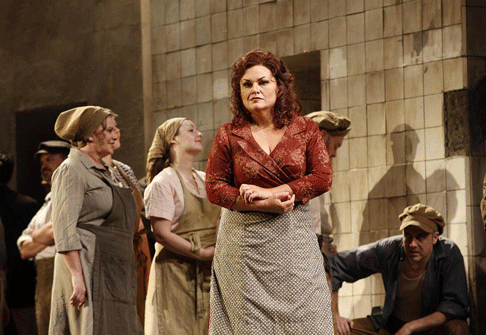 Susan Bullock as Katerina Ismailova [Photo by Jeff Busby]
Bullock is astounding in this most difficult role. A notable Elektra, her voice rides the huge orchestra in the dramatic scenes with a cut and edge that remains clean and steady at all times. Her recent success in the Chandos recording of Salome, where she scales down her tone to an insinuating whisper is no studio trick either. In the opening scene and later, in the plaintive about animals mating happily but not her, she can spin her voice into a mournful whisper. In the same way she projects the aria in the last act about the black lake out into the auditorium while draining her voice of colour to suggest Katerina numb from both cold and Sergei’s rejection. She acts the highly charged scenes with the same conviction she invests in every other scene right down to weary resignation with which she drowns herself and Sergei’s new mistress. I suspect now that the lulling, romantic and otherwise polite repertoire she chose for her recital was to show her vocal nice side.
Berkeley-Steele copes magnificently the short, jabbing vocal lines Shostakovich gives Sergei, as though he were — appropriately: a cock crowing. Sumegi, looking like Stalin and groping himself as often as his vodka bottle is an unashamedly disgusting Boris. All thee have excellent diction and project the text well.
Sung in English the translation is by the opera producer David Pountney for his English National Opera production which is coy in places other translations are not and forthright in places others are tamer. Katerina’s aria about animals mating, for instance, uses more sexualised language than the translations accompanying either of the two commercial CD recordings of the opera.
The smaller but necessary roles have been cast from strength. Shostakovich drives his buffo tenors hard it seems; the tenor singing the Police Captain in his earlier opera The Nose is required to sing in alt and reach an E above top C. As the shabby peasant Kanen Breen is taxed by the orchestral tsunami Shostakovich sets against the scene in which he discovers Zinovy’s body. As a result he is barely audible against the wild mazurka played forte by the full orchestra and resorts to a frenzied semaphore for the scene.
Deputising for the late Richard Hickox, who was to conduct the Sydney and Melbourne seasons this year, Richard Armstrong had apparently not conducted the work before. With the same authority he brings to Richard Strauss, he scored point after point of the music’s Janus nature, colouring the lyrical passages for Katerina, the quirky but sinister little violin passage as Boris eats the fatal mushrooms and, most importantly, exploding the interludes with shattering force. The orchestra responded superbly to the full barrage of the young and uncensored Shostakovich.
Zambello’s update appears to be roughly the same time that the opera was written. Like Patrice Chereau, who set a trend (most famously in his 1976 Ring cycle at Bayreuth) for setting an opera in the time it was written rather the time it is set, this simple action often contextualises a work in rewarding ways, even without imposing many social or political references from the time. As the Marxist overtones pervaded Chereau’s interpretation of Wagner, the ruthlessness of the purges and oppressions that were beginning in the Soviet Union underpin the story, giving some idea of what was really disturbing to Stalin and his committee. The sudden sighting of a portable television, however, spoiled the otherwise compelling concept. The poverty of regional Russia under Soviet collectivisation was superbly conveyed and gives the Ismailova’s a level of desperation not in Leskov’s original story of comfortable bourgeoisie. Here the sordid environment is both physical and metaphorical.
Michael Magnusson