![Diana Damrau as Adina and Giuseppe Filianoti as Nemorino [Photo by Johan Persson courtesy of The Royal Opera House]](http://www.operatoday.com/ELISIR-2009_00883-DAMRAU-AS.gif)
14 May 2009
L’elisir d’amore at Covent Garden
L’elisir d’amore is perhaps Donizetti’s silliest opera — but also one of his most charming.
English Touring Opera are delighted to announce a season of lyric monodramas to tour nationally from October to December. The season features music for solo singer and piano by Argento, Britten, Tippett and Shostakovich with a bold and inventive approach to making opera during social distancing.
This tenth of ten Live from London concerts was in fact a recorded live performance from California. It was no less enjoyable for that, and it was also uplifting to learn that this wasn’t in fact the ‘last’ LfL event that we will be able to enjoy, courtesy of VOCES8 and their fellow vocal ensembles (more below …).
Ever since Wigmore Hall announced their superb series of autumn concerts, all streamed live and available free of charge, I’d been looking forward to this song recital by Ian Bostridge and Imogen Cooper.
The Sixteen continues its exploration of Henry Purcell’s Welcome Songs for Charles II. As with Robert King’s pioneering Purcell series begun over thirty years ago for Hyperion, Harry Christophers is recording two Welcome Songs per disc.
Although Stile Antico’s programme article for their Live from London recital introduced their selection from the many treasures of the English Renaissance in the context of the theological debates and upheavals of the Tudor and Elizabethan years, their performance was more evocative of private chamber music than of public liturgy.
In February this year, Albanian soprano Ermonela Jaho made a highly lauded debut recital at Wigmore Hall - a concert which both celebrated Opera Rara’s 50th anniversary and honoured the career of the Italian soprano Rosina Storchio (1872-1945), the star of verismo who created the title roles in Leoncavallo’s La bohème and Zazà, Mascagni’s Lodoletta and Puccini’s Madama Butterfly.
Evidently, face masks don’t stifle appreciative “Bravo!”s. And, reducing audience numbers doesn’t lower the volume of such acclamations. For, the audience at Wigmore Hall gave soprano Elizabeth Llewellyn and pianist Simon Lepper a greatly deserved warm reception and hearty response following this lunchtime recital of late-Romantic song.
Collapsology. Or, perhaps we should use the French word ‘Collapsologie’ because this is a transdisciplinary idea pretty much advocated by a series of French theorists - and apparently, mostly French theorists. It in essence focuses on the imminent collapse of modern society and all its layers - a series of escalating crises on a global scale: environmental, economic, geopolitical, governmental; the list is extensive.
For this week’s Live from London vocal recital we moved from the home of VOCES8, St Anne and St Agnes in the City of London, to Kings Place, where The Sixteen - who have been associate artists at the venue for some time - presented a programme of music and words bound together by the theme of ‘reflection’.
'Such is your divine Disposation that both you excellently understand, and royally entertaine the Exercise of Musicke.’
Amongst an avalanche of new Mahler recordings appearing at the moment (Das Lied von der Erde seems to be the most favoured, with three) this 1991 Mahler Second from the 2nd Kassel MahlerFest is one of the more interesting releases.
‘And there was war in heaven: Michael and his angels fought against the dragon; and the dragon fought and his angels, And prevailed not; neither was their place found any more in heaven … that old serpent … Satan, which deceiveth the whole world: he was cast out into the earth, and his angels were cast out with him.’
If there is one myth, it seems believed by some people today, that probably needs shattering it is that post-war recordings or performances of Wagner operas were always of exceptional quality. This 1949 Hamburg Tristan und Isolde is one of those recordings - though quite who is to blame for its many problems takes quite some unearthing.
There was never any doubt that the fifth of the twelve Met Stars Live in Concert broadcasts was going to be a palpably intense and vivid event, as well as a musically stunning and theatrically enervating experience.
‘Love’ was the theme for this Live from London performance by Apollo5. Given the complexity and diversity of that human emotion, and Apollo5’s reputation for versatility and diverse repertoire, ranging from Renaissance choral music to jazz, from contemporary classical works to popular song, it was no surprise that their programme spanned 500 years and several musical styles.
The Academy of St Martin in the Fields have titled their autumn series of eight concerts - which are taking place at 5pm and 7.30pm on two Saturdays each month at their home venue in Trafalgar Square, and being filmed for streaming the following Thursday - ‘re:connect’.
The London Symphony Orchestra opened their Autumn 2020 season with a homage to Oliver Knussen, who died at the age of 66 in July 2018. The programme traced a national musical lineage through the twentieth century, from Britten to Knussen, on to Mark-Anthony Turnage, and entwining the LSO and Rattle too.
With the Live from London digital vocal festival entering the second half of the series, the festival’s host, VOCES8, returned to their home at St Annes and St Agnes in the City of London to present a sequence of ‘Choral Dances’ - vocal music inspired by dance, embracing diverse genres from the Renaissance madrigal to swing jazz.
Just a few unison string wriggles from the opening of Mozart’s overture to Le nozze di Figaro are enough to make any opera-lover perch on the edge of their seat, in excited anticipation of the drama in music to come, so there could be no other curtain-raiser for this Gala Concert at the Royal Opera House, the latest instalment from ‘their House’ to ‘our houses’.
"Before the ending of the day, creator of all things, we pray that, with your accustomed mercy, you may watch over us."
L’elisir d’amore is perhaps Donizetti’s silliest opera — but also one of his most charming.
Laurent Pelly’s 2006 staging, first seen at Covent Garden in 2007 and revived here by Daniel Dooner, certainly supplies much absurdity, capriciousness and inanity, but it is rather lacking in genuine warmth and tenderness. In this ‘busy’ staging, characters are entertaining but not fully engaging; we smile gently at their follies and witticisms, but they don’t truly touch our hearts. We don’t really care; and, it seems, neither do they. The humour is largely visual: indeed, on the opening night the largest laughs were raised by the manic terrier which intermittently whips across the stage, and by the between-scenes front cloth advertising Doctor Dulcamara’s entire range of miraculous potions and lotions - the clutter of cures for Constipazione and Impotenze recalling an email inbox, deluged by SPAM offering fake Viagra.
Striving for a realism that would put many a verismo production to shame, Pelly furnishes his stage with a relentless assemblage of period props — tractors, lorries and Vespas — to evoke rural, post-war Italy. The curtain rises on a precipitous mound of hay-bales. It’s true that this Nemorino — a foolish bumpkin — certainly has a mountain to climb if he’s to win the hand of Diana Damrau’s feisty, spoiled Adina. While the workers toil in the sun-drenched fields, the queen bee perches aloft, preening herself beneath her pink parasol, laughing disdainfully at tales of ‘real’, un-dying love of the kind that will later catch her unawares.
No-one could accuse Giuseppe Filianoti of lack of commitment: as Nemorino he, literally, throws himself into the part, hurling himself around the stage like a hyperactive child, tumbling and flailing in a hopeless effort to catch the eye of the indifferent Adina. When Dulcamara declares that he met a few fools in his time but none quite as dim as Nemorino we are inclined to nod in agreement. While this self-deprecating slapstick raised a few chuckles, it did not distract from Filianoti’s vocal weaknesses. His is a dark-toned tenor, but the upper range is strained and reedy, and his opening number was particularly uncomfortable. In the Act 1 finale he seemed completely adrift, musically and dramatically. Despite these problems, there were moments to admire. Filianoti’s diction is excellent, he uses the words well, and his performance did improve as he slowly warmed up. He certainly conveyed Nemorino’s ardency and sincerity in the Act 2 ‘Una furtiva lagrima’. Yet, it was rather an effort, and the simple elegance required to communicate the profound, ‘poetic’ sensibility to be found beneath the buffoon’s clownish exterior was lacking.
As Adina, the German soprano, Diana Damrau, commands the stage. Dressed in a seductively low-cut dress (costumes are by Chantal Thomas), she flirts and flaunts, incessantly prancing, posing and pouting. However, while she entirely lacks innocence and does not really earn our sympathy, she can be forgiven for these exaggerated excesses as she renders Donizetti’s lyrical melodies and capricious coloratura with delicious beauty and ease. Outraged by the attention that Nemorino’s new-found wealth garners from the other girls, Damrau’s fiery fioratura is flawless. And, her declaration of love - a stunning two-octave plunge sealing her promise to make him ‘as happy as I used to make you miserable’ - is the high-point of the evening.
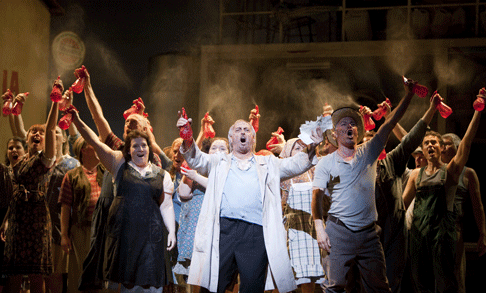 Simone Alaimo as Dulcamara and The Royal Opera Chorus [Photo by Johan Persson courtesy of The Royal Opera House]
The Sicilian bass-baritone, Simone Alaimo, played Dulcamara as if this was his five-thousandth performance of the role … perhaps it was. His buffo gestures were rather tired; even the chorus, who excitedly anticipated his entrance, didn’t wait around to hear his sales pitch — leaving Alaimo addressing an empty stage. A sharp, red suit in Act 2 enlivened him somewhat; responding to Adina’s confident assertions that the power of her own physical attributes is more than a match for any elixir Dulcamara cares to offer, he demonstrated more energy and sparkle. But, Pelly seems to view the quack doctor less as a loveable rogue than as a greasy slime-ball. Like Anthony Michaels-Moore’s cock-sure Sergeant Belcore, he is presented as a cynical opportunist. In Belcore’s opening aria, despite standing aloft the hay-bales, a ‘king of the mountain’, Michaels-Moore struggled to project his baritone; he was a rather one-dimensional figure throughout, a charmless bully. The Japanese soprano, Eri Nakamura, supplied the evening’s one genuine moment of sweet, unaffected tenderness, as Giannetta.
Pelly’s direction of the chorus is confusing and over-emphatic. At times, they are uncompromisingly involved in the action, was in the opening scene when they taunt and torment Nemorino with an alarming aggression! Elsewhere they ignore the action entirely, and face forwards, immobile, to address the audience — a gesture which lacks subtlety, relevance and becomes increasingly irritating.
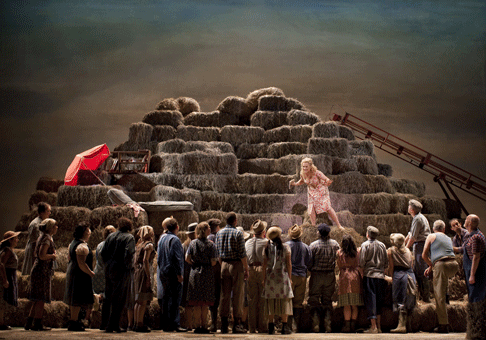 A scene from L’elisir d’amore [Photo by Johan Persson courtesy of The Royal Opera House]
Despite Pelly’s desire for realism, this production does not truly convey the dark side of the drama - the potential sadness, even tragedy, hiding behind the comic frills, or the cynical exposure of the true elixir of love: money. Fortunately, Bruno Campanella understands the aesthetics of bel canto, and he stylishly controlled the colour and pace of the performance from the pit.
So, in this visually catchy production there is lots to entertain and much to admire, but perhaps rather less to enchant.
Claire Seymour