Recently in Reviews
English Touring Opera are delighted to announce a season of lyric monodramas to tour nationally from October to December. The season features music for solo singer and piano by Argento, Britten, Tippett and Shostakovich with a bold and inventive approach to making opera during social distancing.
This tenth of ten Live from London concerts was in fact a recorded live performance from California. It was no less enjoyable for that, and it was also uplifting to learn that this wasn’t in fact the ‘last’ LfL event that we will be able to enjoy, courtesy of VOCES8 and their fellow vocal ensembles (more below …).
Ever since Wigmore Hall announced their superb series of autumn concerts, all streamed live and available free of charge, I’d been looking forward to this song recital by Ian Bostridge and Imogen Cooper.
The Sixteen continues its exploration of Henry Purcell’s Welcome Songs for Charles II. As with Robert King’s pioneering Purcell series begun over thirty years ago for Hyperion, Harry Christophers is recording two Welcome Songs per disc.
Although Stile Antico’s programme article for their Live from London recital introduced their selection from the many treasures of the English Renaissance in the context of the theological debates and upheavals of the Tudor and Elizabethan years, their performance was more evocative of private chamber music than of public liturgy.
In February this year, Albanian soprano Ermonela Jaho made a highly lauded debut recital at Wigmore Hall - a concert which both celebrated Opera Rara’s 50th anniversary and honoured the career of the Italian soprano Rosina Storchio (1872-1945), the star of verismo who created the title roles in Leoncavallo’s La bohème and Zazà, Mascagni’s Lodoletta and Puccini’s Madama Butterfly.
Evidently, face masks don’t stifle appreciative “Bravo!”s. And, reducing audience numbers doesn’t lower the volume of such acclamations. For, the audience at Wigmore Hall gave soprano Elizabeth Llewellyn and pianist Simon Lepper a greatly deserved warm reception and hearty response following this lunchtime recital of late-Romantic song.
Collapsology. Or, perhaps we should use the French word ‘Collapsologie’ because this is a transdisciplinary idea pretty much advocated by a series of French theorists - and apparently, mostly French theorists. It in essence focuses on the imminent collapse of modern society and all its layers - a series of escalating crises on a global scale: environmental, economic, geopolitical, governmental; the list is extensive.
For this week’s Live from London vocal recital we moved from the home of VOCES8, St Anne and St Agnes in the City of London, to Kings Place, where The Sixteen - who have been associate artists at the venue for some time - presented a programme of music and words bound together by the theme of ‘reflection’.
'Such is your divine Disposation that both you excellently understand, and royally entertaine the Exercise of Musicke.’
Amongst an avalanche of new Mahler recordings appearing at the moment (Das Lied von der Erde seems to be the most favoured, with three) this 1991 Mahler Second from the 2nd Kassel MahlerFest is one of the more interesting releases.
‘And there was war in heaven: Michael and his angels fought against the dragon; and the dragon fought and his angels, And prevailed not; neither was their place found any more in heaven … that old serpent … Satan, which deceiveth the whole world: he was cast out into the earth, and his angels were cast out with him.’
If there is one myth, it seems believed by some people today, that probably needs shattering it is that post-war recordings or performances of Wagner operas were always of exceptional quality. This 1949 Hamburg Tristan und Isolde is one of those recordings - though quite who is to blame for its many problems takes quite some unearthing.
There was never any doubt that the fifth of the twelve Met Stars Live in Concert broadcasts was going to be a palpably intense and vivid event, as well as a musically stunning and theatrically enervating experience.
‘Love’ was the theme for this Live from London performance by Apollo5. Given the complexity and diversity of that human emotion, and Apollo5’s reputation for versatility and diverse repertoire, ranging from Renaissance choral music to jazz, from contemporary classical works to popular song, it was no surprise that their programme spanned 500 years and several musical styles.
The Academy of St Martin in the Fields have titled their autumn series of eight concerts - which are taking place at 5pm and 7.30pm on two Saturdays each month at their home venue in Trafalgar Square, and being filmed for streaming the following Thursday - ‘re:connect’.
The London Symphony Orchestra opened their Autumn 2020 season with a homage to Oliver Knussen, who died at the age of 66 in July 2018. The programme traced a national musical lineage through the twentieth century, from Britten to Knussen, on to Mark-Anthony Turnage, and entwining the LSO and Rattle too.
With the Live from London digital vocal festival entering the second half of the series, the festival’s host, VOCES8, returned to their home at St Annes and St Agnes in the City of London to present a sequence of ‘Choral Dances’ - vocal music inspired by dance, embracing diverse genres from the Renaissance madrigal to swing jazz.
Just a few unison string wriggles from the opening of Mozart’s overture to Le nozze di Figaro are enough to make any opera-lover perch on the edge of their seat, in excited anticipation of the drama in music to come, so there could be no other curtain-raiser for this Gala Concert at the Royal Opera House, the latest instalment from ‘their House’ to ‘our houses’.
"Before the ending of the day, creator of all things, we pray that, with your accustomed mercy, you may watch over us."
Reviews
![Peter Grimes (Stuart Skelton) and Ellen Orford (Amanda Roocroft) [Photo by Clive Barda courtesy of English National Opera]](http://www.operatoday.com/peter_grimes002.gif)
13 May 2009
Peter Grimes — English National Opera, London Coliseum
In David Alden’s extraordinary new staging of Britten’s
masterpiece, with sets by Paul Steinberg, the Borough is populated by stylised
grotesques, a clever twist on the opera’s existing ‘Little
England’ character stereotypes.
In one of the production’s
creepiest moments, the big man-hunt chorus in the middle of Act 3 is
accompanied by waving of miniature Union Jacks.
Everyone you focus on has a darker secret than the last. At the more normal
end of the range are Felicity Palmer’s Miss Marple-esque Mrs Sedley and
Leigh Melrose’s apparently speed-addicted Ned Keene. The most disturbing
include Darren Jeffery’s Hobson, who appears to have a whole boy-killing
factory of his own going on unnoticed right under everybody else’s noses.
Weirdest of all are Auntie and the Nieces — Rebecca de Pont Davies as a
club-footed cross-dresser with a pinstripe suit and walking cane, and Mairéad
Buicke and Gillian Ramm as a pair of possessed zombie twins in identical school
uniform and pigtails. The Nieces are the production’s only faintly
jarring note, with their vacant and jerky choreography which makes them barely
even recognisable as human beings, but if they have one dramatic function
it’s giving a new layer of depravity to Bob Boles, Swallow and everybody
else who shows a sexual interest in them. Perhaps they are the ultimate product
of this diseased community.
Yes, it’s the norm here to be disturbed, deformed or damaged (even
Balstrode, sung by the excellent Gerald Finley, is missing an arm —
besides the costumes, this is the most obvious visual clue to the
production’s 1940s setting, though Auntie seems a throwback to the 30s)
and Peter and Ellen are seemingly the only complete and sane individuals among
them. Although her even-temperedness and common sense make her stand out from
her neighbours, Ellen is integrated into the community — a community
where people do everything together, moving in swarms — but Grimes is a
loner, and it is this and this alone which leads to his becoming the local
scapegoat. By the end, they have poisoned him into madness, but at least he is
able to escape through death. Ellen is the one who has to live with it all, and
I dare say she fits right in with the rest of them after all she has been
through. With Amanda Roocroft in the role, there are echoes of her recent,
brilliant Jenufa here — a bright-natured, attractive young woman worn
down through her experiences. At times her singing is shrill on top and her
diction indifferent, but her character portrait is spot on, the relationship
with Grimes filled with real tenderness.
The Australian tenor Stuart Skelton is as fine a Grimes as you could wish to
hear, wielding both his large voice and burly physique with intelligence and
subtlety. Emerging from the man-hunt and the subsequent pained calm of the
final interlude, Alden’s staging of the mad scene is devastating in its
simplicity: the surtitle screen and orchestra pit go dark, and Grimes is alone
in the abyss beneath a grey and foggy sky. Skelton maximises the effect the
solitude of the setting with a performance of heartbreaking vulnerability and
emotional intensity.
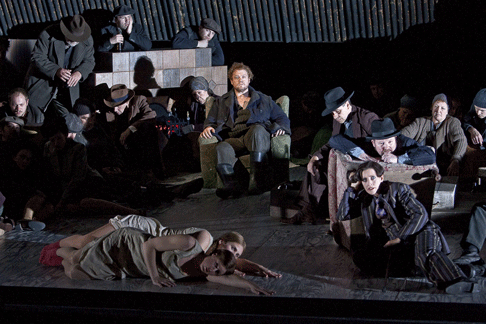 Peter Grimes (Stuart Skelton); Auntie (Rebecca de Pont Davies) (front rt); Bob Boles (Michael Colvin) (front rt in upturned chair); First Niece (Gillian Ramm) (lying down front nearest); Second Niece (Mairéad Buicke) (behind first neice)
As Grimes hears the drum-led procession approaching his hut — in a
clear and chilling musical echo of his vision, moments earlier, of the first
dead boy — he is distracted into letting go of the rope with which he is
making safe John’s descent down the cliff. Thus the villagers become
directly responsible both for the death of the apprentice and for Peter’s
self-destruction as a result of it. It is a heart-stopping coup-de-theatre.
In the two years that Ed Gardner has been ENO’s Musical Director I
don’t think he has ever drawn a better performance from the house
orchestra than in this detailed but never fussy account of the score. The
playing of the interludes was virtually faultless, with a particularly
memorable brass timbre, the jazzy shape of the phrases in the Storm Interlude
crafted so as to introduce the incongruous 1930s vintage of the inhabitants of
the Boar. A number of remarkable and inventive Grimes stagings have been seen
in London this decade, but musically, this is head and shoulders above the
others. It is perhaps ENO’s finest musical achievement this decade.
Ruth Elleson © 2009