Where the German-American composer’s oeuvre will rank among the other thirty eight remains to be seen, but its subtly gives it a shot at longevity its predecessors didn’t enjoy.
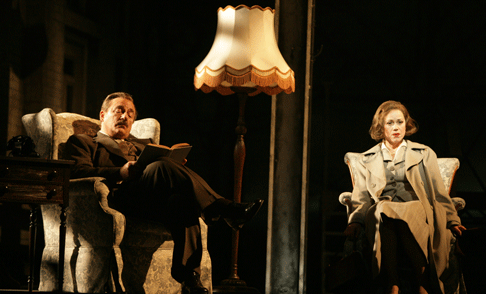
Based jointly on the Noël Coward play Still Life and the 1945 film from which the opera took its title, Brief Encounter is a simple story. Two married parents, Laura (soprano Elizabeth Futral) and Alec (baritone Nathan Gunn) run into each other in a train station. Since Laura makes a trip to the city where Alec works once a week, the pair fortuitously find each other several times and develop an infatuation that turns into an affair. Both struggle with the moral implications of their relationship, and Fred, Laura’s loving yet aloof husband (sung by bass-baritone Kim Josephson) remains ignorant to her deception. Ultimately, the couple ends the fling for their families’ sake, not for a lack of mutual desire.
As theater, Brief Encounter didn’t qualify as compelling drama. The story began in an anachronistic fashion, amid the final goodbyes after the couple ended the affair—Laura then told the story of what preceded the farewell. Yet after the two hour opera finished and the story was recounted, nothing really had happened. Part of the problem is that no one cared about their affair—the only “risk” the couple faced was their own internal strife. Once Fred sensed something different in Laura, the opera was almost over and Laura had long since decided not to continue the affair. Over the course of the performance, the lovers talked about themselves, talked about their affair, talked about their families, kissed once, and then talked some more. Despite all this talking, the characters weren’t developed—they seemed only to have relevant existences within the context of the affair. John Caird’s odd libretto didn’t help much, seeming at times more like a movie script than an operatic text: on more than one occasion Previn’s music leaned towards a deliberate, romantic sound while the lovers sang verbose, chatty lines. Caird also ended several scenes with trite, pithy emotional outbursts that watered down any real sentiments the characters expressed.
Previn’s occasionally dense instrumental orchestration firmly fits in the through-composed film score tradition of the 1940s and 1950s. The German-American composer utilized a litany of styles in this mostly tonal opera, none of which overpowered the others. The vocal line, however, was more difficult to categorize. Futral had several ariosi where she showed soaring fortissimi and dramatic pathos, yet in other sections (notably her scenes with Gunn), the vocal construction resembled very light musical theater composition. Previn’s score included much swelling in the strings with very little release, mirroring the events on stage. In the end, the orchestra served a bel canto function of supporting the singers without drowning them out or drawing attention away from their lines. It would be difficult to pinpoint any outstanding suites or excerptable arias, but in the end that may very well be how Previn sees the story. Not a lot happens in Brief Encounter, musically or dramatically. Alec and Laura are restrained, always bordering on allowing themselves to give in to their desires. A score that somehow indicated a world that contradicted their own would be confusing. Theirs is a subtle environment—a world of coming home to children and spouses with little to no excitement, just steady presences. The steady presence of Previn’s orchestration mirrors this reality throughout the opera.
 Laura (Elizabeth Futral) and Fred (Kim Josephson) [Felix Sanchez, Courtesy of Houston Grand Opera]
Futral as Laura gave a splendid performance, although she pushed during some of her heavier sections. Nathan Gunn’s Alec was not seductive vocally or theatrically—he was a regular man in love with a regular woman. At times out of place in large scale works, Gunn disproved any critics by giving a smooth, clear performance that never resorted to blustering. Despite the strange vocal lines, credit should go to Previn for knowing the strengths of these two main characters. Bass-baritone Kim Josephson was a steady presence as Laura’s husband, Fred, providing a more mature voice that contrasted well with Gunn’s lighter baritone. Meredith Arwady as Myrtle Bagot showed a shockingly deep and dark contralto, almost so dark at times as to lose clarity. All cast members could have worked a little more on their English diction, though. The confusing half-American-half-English accents resulted in more than several indistinguishable phrases. Music director Patrick Summers led an appropriately restrained performance and showed much deference to Previn during the curtain calls.
The most innovation was shown by the direction and design team of John Caird (who directed in addition to writing the libretto), Bunny Christie (set/costumes), and Paul Pyant (lighting). The train station where Alec and Laura first meet served as the backdrop for the rest of the production, with elegant, seamless sets dropping in from above to create Laura’s home, a public plaza, a boathouse, and a riverbank. Extensive use of fog kept the train station theme present, and (very loud) dry ice machines created a believable river setting. Christie’s assignment was not easy—over eight scenes in the eighty minute first act alone—but his scene changes were fast, credible, and not distracting. Pre-war furniture and costumes were utilized well, inculcating the subtle lives led by the characters. Nothing stood out, but that was the point—these stories could happen to anyone, anywhere.
Brief Encounter isn’t the next great American opera. It is, above all, a subtle work that serves as a snapshot of the lives of two everyday people. The fact that it doesn’t resort to heavy drama makes it somehow more relevant, though, and Previn’s orchestration underscores this fact. Opera can be subtle, and so can the stories the art form relates. Brief Encounter gets that point across, to an overall positive effect.
Paul Wooley
![Laura (Elizabeth Futral) and Alec (Nathan Gunn) in Brief Encounter [Photo by Felix Sanchez, Courtesy of Houston Grand Opera]](http://www.operatoday.com/Brief_Encounters01.gif)