Subscribe to
Opera Today

Receive articles and news via RSS feeds or email subscription.


twitter_logo[1].gif


UCP_9780226043425.gif

Recently in Reviews

Domingo Conducts Holdridge’s New Opera Dulce Rosa

Dulce Rosa, a brand new opera, had its world premiere Friday night, May 17, 2013 at the Broad Stage in Santa Monica, California. It was produced by Los Angeles Opera, but staged in the smaller theater.

Verdi’s Falstaff at Glyndebourne

Richard Jones’ 2009 production of Verdi’s Falstaff translates the action from the first Elizabethan age to the start of the second.

Gareth John, Wigmore Hall

Baritone Gareth John is rapidly accumulating a war-chest of honours. Winner of the 2013 Kathleen Ferrier Award, he recently won the Royal Academy of Music Patrons’ Award and was presented the Silver Medal by the Worshipful Company of Musicians.

La bohème at ENO

This second revival of Jonathan Miller’s La bohème was the first time I had caught the production.

Rolando Villazón: Verdi (International Opera Stars Series 2013)

It’s Verdi’s bicentenary year and Rolando Villazón has two new CDs to plug — titled somewhat confusingly, ‘Villazón: Verdi’ and ‘Villazón’s Verdi’, the latter a ‘personal selection’ of favourite numbers performed by stars of the past and present.

Brahms Third in San Francisco

Nicola Luisotti and the San Francisco Opera Orchestra climbed out of the War Memorial pit, braved the wind whipped bay and held spellbound an audience at Cal Performances’ Zellerbach Auditorium at UC Berkeley.

Ariane et Barbe-Bleue on Blu-Ray

Paul Dukas’ Ariane et Barbe-Bleue, first heard in 1907, once seemed important. Arturo Toscanini conducted the Met premiere in 1911 with Farrar and later arranged some of its music for a 1947 recording with his NBC Symphony.

Glyndebourne: Ariadne auf Naxos

Utterly mad but absolutely right — Richard Strauss’s Ariadne auf Naxos started the Glyndebourne 2013 season with an explosion. Strauss could hardly have made his intentions more clear. Ariadne auf Naxos is not “about” Greek myth so much as a satire on art and the way art is made.

Wozzeck at ENO

“Man is an abyss. It makes one dizzy to look into it.” So utters Georg Büchner’s Woyzeck, repeating what was also a recurring motif in the playwright’s own letters.

Mulhouse: Rare Britten Well Done

National Opera Company of the Rhine has marked this year’s Benjamin Britten celebration with a remarkably compelling, often gripping new production of the seldom-seen Owen Wingrave.

Frankfurt's Intriguing Idomeneo

Once upon a time, Frankfurt Opera had the baddest ass reputation in Germany as “the” cutting edge producer of must-see opera.

Rigoletto at Lyric Opera of Chicago

Productions of Giuseppe Verdi’s Rigoletto can serve as a vehicle for individual singers to make a strong impression and become afterward associated with specific roles in the opera.

Britten Sinfonia with Ian Bostridge

Just in case we were not aware that the evening’s programme was ‘themed’, the Britten Sinfonia designed a visual accompaniment to their musical exploration of night, sleep and dreams.

Aida, Manitoba Opera

Poor Aida! She never seems to have anything go her way.

Superlative singing: Don Carlo, Royal Opera House

Is it possible to upstage Jonas Kaufmann? Kaufmann was brilliant in this Verdi Don Carlo at the Royal Opera House, London, but the rest of the cast was so good that he was but first among equals. Don Carlo is a vehicle for stars, but this time the stars were everyone on stage and in the pit. Even the solo arias, glorious as they are, grow organically out of perfect ensemble. This was a performance that brought out the true beauty of Verdi's music.

Sarah Connolly: French Song at Wigmore Hall

The big names were absent: Duparc, D’Indy, Debussy, Ravel … and while Fauré, Chausson, Roussel and several members of Les Six put in an appearance, in less than familiar guises, this survey of French song of the early 20th century and interwar years deliberately took us on a journey through infrequently travelled terrain.

Rare restoration: Handel’s Esther 1720

Composed between 1718 and 1720, Handel’s Esther is sometimes described as the ‘first English Oratorio’, but is in fact a hybrid form, mixing elements of oratorio, masque, pastoral and opera.

The Damnation of Faust, London

Hector Berlioz's légende dramatique, La Damnation de Faust, exists somewhere between cantata and opera. Berlioz's flexible attitude to dramatic form made the piece unworkable on the stages of early 19th century Paris and his music is so vivid that you wonder whether the piece needs staging at all.

Elizabeth Connell Memorial Concert, St John's Smith Square

St. John’s Smith Square was the site of Elizabeth Connell’s final London concert, intended as a farewell to London on her moving to Australia. It was rendered ultimately final by her unexpected death.

Aida with all the Trimmings, Even a Blue Silk Elephant!

With the building of the Suez Canal, Egypt became more interesting to Western Europeans. Khedive Ismail Pasha wanted a hymn by Verdi for the opening of a new opera house in Cairo, but the composer said he did not write occasional pieces.

OPERA TODAY ARCHIVES »

Reviews

Kathleen Keske as Amelia and Francis Liska as Riccardo [Photo courtesy Brooklyn Repertory Opera]
24 Jun 2009

A Masked Ball by Brooklyn Repertory Opera

Amato Opera went to the netherworld of expired extravaganzas this spring, a one-man operation whose one man was weary. As New York’s oldest down-the-block and semi-pro company, it’s loss was regrettable — though it’s many years since Amato gave up doing interesting repertory.

Giuseppe Verdi: A Masked Ball

Amelia: Kathleen Keske; Oscar: Pamela Scanlon; Ulrico: Nicholas Tamagna; Riccardo: Francis Liska; Renato: Charles Karel, Sam: Ilberto Lagana; Tom: Ernest McCoy. Couducted by Stephen Francis Vasta. Brooklyn Repertory Opera, performance of June 14.

Above: Kathleen Keske as Amelia and Francis Liska as Riccardo

All photos courtesy of Brooklyn Repertory Opera.


Agreeable — and surprising — to find that several other shoestring companies are flourishing, despite these bad financial times, and that venues pop up in the unlikeliest parts of town — well, the rent is lower if the address is stranger.

The Brooklyn Lyceum, for example, is a 1910 public bathhouse on Fourth Avenue at President Street — they used to call it Flatbush, and now the rebuilders say “Lower Slope,” but for many decades the plain between the Brooklyn Academy of Music and Greenwood Cemetery was several miles of vacant. Today it is reviving, there are tidy homes and restaurants, and you can stroll by night and jitter-free. The Lyceum, tattered brick and the remains of tile, contains a performing space about the size of a basketball court — you could fit a dozen Amatos there — on a stage built over the former pool. The look recalls the BAM Harvey (which was left to look that way on purpose), but the stairs aren’t so steep at the Lyceum and the bathrooms far easier to find. I strolled by one recent day for the last of Brooklyn Repertory Opera’s four performances of Verdi’s A Masked Ball — Brooklyn Rep always performs in English — and I was delighted I had done so.

Full disclosure: The company prima donna, Kathleen Keske, is an old friend whose voice I have admired in such roles as Weber’s Rezia but had not heard in several years. I was eager to hear her Amelia, and she assured me the rest of the cast was good. I had misgivings — I’ve been to a lot of these little companies across the years — sometimes thrilled, sometimes appalled. You never know. And Ballo is tricky, five big roles and intricate orchestration. (Most such companies use a piano or two — not Brooklyn Rep.)
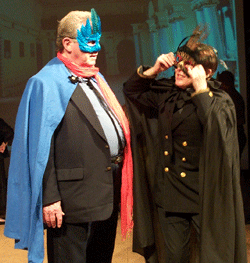
karel-scanlon-masked-2.gifPamela Scanlon as Oscar and Francis Liska as Riccardo

To my delighted surprise, the cast was solid, mature enough for Verdi, and eager to sing out; the orchestra, under Stephen Francis Vasta, professional and clear, making Verdi’s points. The chorus was on the small side, and overly weighted towards ladies, but costs were really cut on sets (mostly projections of the royal palace in Stockholm) and costumes, haphazard at best. The wince-making translation was uncredited in the program — I wouldn’t admit to it either. (But I found I could shut my eyes and think of the Italian, and let the voices carry the show.)

I’m delaying things: To my regret, Keske was not at her best in this role. Amelia has two personalities, the defeated subject of domestic tragedy and the full-throttle Verdi passionista; Keske did not possess the weight or the well-supported power for those grand arching phrases. In her quiet aria, however — the one that, in Italian, begins “Morrô, ma prima in grazia” — she sang with well-placed tone and great feeling for a woman in despair, facing with resignation the loss of everything dear to her.

The other soprano, the boy Oscar, was sung by Pamela Scanlon, whose strong, bright soprano and clear, certain coloratura impressed me as a voice ready to tackle Violetta and likely to give a good account of it. Her acting, as called for by this trouser role, was on the cute side — but not a garish, gender-mocking space alien, as in the current Met production. Riccardo — promoted to king here but not Swedished as Gustav — was sung by Francis Liska, with a graceful lyric line and the right air of narcissistic indifference to the deep emotional waters in which he treads. Charles Karel sang Renato with a sturdy, genuine Verdi baritone, warm, heartfelt and — ultimately — grim.
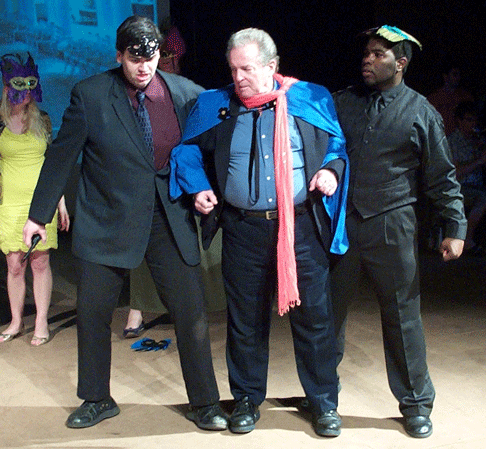
murderer-caught.gifA scene from A Masked Ball

Then out came Ulrica — you know — the fortune teller — the Marian Anderson/Ewa Podles role. Already there had been intimations of surprise, in references in the first scene, to a “magician” named “Ulrico.” (Why not just Ulrich?) I seized the program and, staggered, read the name: Nicholas Tamagna. “You sprang that on me! You didn’t warn me!” I later accused Madame Keske, who smiled. “Would you have come if I’d told you?” “Maybe not.” “And did you like him?” she went on smiling.

Mr. Tamagna, a countertenor who usually sings roles like Orfeo (last April at the Brooklyn Rep, sorry I missed it) and Handel’s Cesare (in D.C. in the fall), earned his Book of World Records (and Wikipedia) moment as the first man ever to sing this diehard mezzo role in a full performance of Verdi’s opera. A slim figure with a shaven head and satanic contact lenses, he sang it all — in a room of considerable size, remember — in a seamless top-to-bottom alto with no hootiness, no doubtful support, loud as anyone (and everyone) else in a healthy cast, the phrases as beautiful as their eldritch import allowed. (Verdi didn’t want his witches to sound too beautiful, you know.) It was a totally astonishing performance, and in five minutes conquered what reservations I had — and I’m a stickler for certain traditions. Tamagna’s has an alto in which I wished to bask.

But the joy of the entire afternoon was being in a big room where big, healthy voices were singing big, healthy Verdi — up close, full throttle, no electronics, no cutting corners. Pleasure of operatic caliber. This is not lip-service lyric but a company that knows what it’s doing.

John Yohalem

Send to a friend

Send a link to this article to a friend with an optional message.

Friend's Email Address: (required)

Your Email Address: (required)

Message (optional):