07 Jun 2009
A shockingly different Lulu at the Royal Opera House, London
The buzz was right — this new Lulu at the Royal Opera House, London is shockingly different. Christof Loy's production is what minimalism should be.
English Touring Opera are delighted to announce a season of lyric monodramas to tour nationally from October to December. The season features music for solo singer and piano by Argento, Britten, Tippett and Shostakovich with a bold and inventive approach to making opera during social distancing.
This tenth of ten Live from London concerts was in fact a recorded live performance from California. It was no less enjoyable for that, and it was also uplifting to learn that this wasn’t in fact the ‘last’ LfL event that we will be able to enjoy, courtesy of VOCES8 and their fellow vocal ensembles (more below …).
Ever since Wigmore Hall announced their superb series of autumn concerts, all streamed live and available free of charge, I’d been looking forward to this song recital by Ian Bostridge and Imogen Cooper.
The Sixteen continues its exploration of Henry Purcell’s Welcome Songs for Charles II. As with Robert King’s pioneering Purcell series begun over thirty years ago for Hyperion, Harry Christophers is recording two Welcome Songs per disc.
Although Stile Antico’s programme article for their Live from London recital introduced their selection from the many treasures of the English Renaissance in the context of the theological debates and upheavals of the Tudor and Elizabethan years, their performance was more evocative of private chamber music than of public liturgy.
In February this year, Albanian soprano Ermonela Jaho made a highly lauded debut recital at Wigmore Hall - a concert which both celebrated Opera Rara’s 50th anniversary and honoured the career of the Italian soprano Rosina Storchio (1872-1945), the star of verismo who created the title roles in Leoncavallo’s La bohème and Zazà, Mascagni’s Lodoletta and Puccini’s Madama Butterfly.
Evidently, face masks don’t stifle appreciative “Bravo!”s. And, reducing audience numbers doesn’t lower the volume of such acclamations. For, the audience at Wigmore Hall gave soprano Elizabeth Llewellyn and pianist Simon Lepper a greatly deserved warm reception and hearty response following this lunchtime recital of late-Romantic song.
Collapsology. Or, perhaps we should use the French word ‘Collapsologie’ because this is a transdisciplinary idea pretty much advocated by a series of French theorists - and apparently, mostly French theorists. It in essence focuses on the imminent collapse of modern society and all its layers - a series of escalating crises on a global scale: environmental, economic, geopolitical, governmental; the list is extensive.
For this week’s Live from London vocal recital we moved from the home of VOCES8, St Anne and St Agnes in the City of London, to Kings Place, where The Sixteen - who have been associate artists at the venue for some time - presented a programme of music and words bound together by the theme of ‘reflection’.
'Such is your divine Disposation that both you excellently understand, and royally entertaine the Exercise of Musicke.’
Amongst an avalanche of new Mahler recordings appearing at the moment (Das Lied von der Erde seems to be the most favoured, with three) this 1991 Mahler Second from the 2nd Kassel MahlerFest is one of the more interesting releases.
‘And there was war in heaven: Michael and his angels fought against the dragon; and the dragon fought and his angels, And prevailed not; neither was their place found any more in heaven … that old serpent … Satan, which deceiveth the whole world: he was cast out into the earth, and his angels were cast out with him.’
If there is one myth, it seems believed by some people today, that probably needs shattering it is that post-war recordings or performances of Wagner operas were always of exceptional quality. This 1949 Hamburg Tristan und Isolde is one of those recordings - though quite who is to blame for its many problems takes quite some unearthing.
There was never any doubt that the fifth of the twelve Met Stars Live in Concert broadcasts was going to be a palpably intense and vivid event, as well as a musically stunning and theatrically enervating experience.
‘Love’ was the theme for this Live from London performance by Apollo5. Given the complexity and diversity of that human emotion, and Apollo5’s reputation for versatility and diverse repertoire, ranging from Renaissance choral music to jazz, from contemporary classical works to popular song, it was no surprise that their programme spanned 500 years and several musical styles.
The Academy of St Martin in the Fields have titled their autumn series of eight concerts - which are taking place at 5pm and 7.30pm on two Saturdays each month at their home venue in Trafalgar Square, and being filmed for streaming the following Thursday - ‘re:connect’.
The London Symphony Orchestra opened their Autumn 2020 season with a homage to Oliver Knussen, who died at the age of 66 in July 2018. The programme traced a national musical lineage through the twentieth century, from Britten to Knussen, on to Mark-Anthony Turnage, and entwining the LSO and Rattle too.
With the Live from London digital vocal festival entering the second half of the series, the festival’s host, VOCES8, returned to their home at St Annes and St Agnes in the City of London to present a sequence of ‘Choral Dances’ - vocal music inspired by dance, embracing diverse genres from the Renaissance madrigal to swing jazz.
Just a few unison string wriggles from the opening of Mozart’s overture to Le nozze di Figaro are enough to make any opera-lover perch on the edge of their seat, in excited anticipation of the drama in music to come, so there could be no other curtain-raiser for this Gala Concert at the Royal Opera House, the latest instalment from ‘their House’ to ‘our houses’.
"Before the ending of the day, creator of all things, we pray that, with your accustomed mercy, you may watch over us."
The buzz was right — this new Lulu at the Royal Opera House, London is shockingly different. Christof Loy's production is what minimalism should be.
Pared down to essentials, all attention is on the music. The stage is almost empty, no props, no furnishings. At first you think, why stage this at all, then? Why not just a concert performance? But gradually it dawns that the “empty” space isn’t empty at all but inhabited by the music, uncompromising and unadorned. That’s why it’s so disturbing. Without décor to cushion the narrative, it’s impossible to escape.
The word “concept” is sneered at in our anti-intellectual world, but without intellect we are no more than beasts. Berg was an extremely conceptual composer. Lulu is constructed like a complex maze, with mathematical symmetries and interrelationships. Berg was obsessed by secret codes and numerology, with patterns and images shifting as if in a kaleidoscope. Berg is doing much more than telling a story in sound. He’s creating a whole new concept, where ideas are expressed through abstraction. He’s not literal, so this very non-literal production reveals just how radical his ideas could be.
The stage is bare but for a wall of glass. Like the glass, Lulu is opaque, impenetrable. Like Lulu, the glass takes on whatever role is projected onto it, whether the scene takes place in a mansion, prison or slum. The glass is Lulu’s mirror image. No wonder there’s no need for a painted portrait. The glass is staring us in the face.
Although the designs look sleek and sophisticated, danger lurks beneath the surface. Twice the narrative is interrupted by news of a revolution in Paris. Then the Third Act takes place in Paris. Everything’s askew like The Cabinet of Dr Caligari where you don’t know who the madman is, doctor or patient. So there’s no film sequence in this production. It “is” the essence of film, and of the opera, and it’s even in black and white.
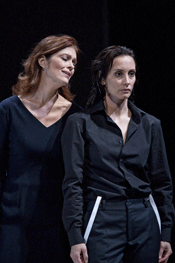 Jennifer Larmore as Countess Geschwitz and Agneta Eichenholz as Lulu
The Caligari reference is relevant for throughout this opera people are becoming what they are not, pretending to be someone else, reappearing in different forms. It’s in the music too, with its intricate constructions. So the Professor of Medicine sits with his back to the audience as Lulu fools around with the painter, has his heart attack then rises discreetly from the dead and walks off to become theatre manager and banker. The Painter doesn’t have to commit suicide “convincingly” because he comes back as The Negro. Berg isn’t being naturalistic, he’s playing games of patterns and subterfuge. If Loy’s production is confusing, that’s because the opera is about confusion.
This is not “Lulu for Beginners”, though, conversely, if it’s taken entirely on its own terms, without assumptions of what opera “should” be, it might even be easier to grasp the concept of Lulu as a musical puzzle The first time I saw Lulu was 1978 - the original of the 3 act version - and was so shocked by the passive anti-drama of Lulu’s personality that I didn’t realize that this was exactly what Berg wanted to do. Here, Loy has taken away the obvious signposts to narrative, so we’re forced, like Lulu, to be constantly alert, always aware that things may not be what they seem, and be prepared to shift and adjust. We are drawn into the jungle of shadowy dangers: hence the references to Africa (unknown territory), to snakes and predatory men. It’s a far deeper insight into Lulu’s background than the basic assumption that she was abused as a child. Loy’s implication is that the whole world’s a place where people are forced to play tricks to survive, like the Animal Trainer’s charges.
No doubt there’ll be huge opposition to this Lulu but it’s one that will keep generating ideas for a long time to come. Spartan as it is, each detail is significant. For example, when Dr Schön embraces Lulu, his arms go round her, but his palms are stretched outward. When he starts to disintegrate emotionally in Act Two, there’s a smudge of greasepaint on one side of his face. Lulu had worn such makeup when she was a dancer, and he is a man about to marry someone else. Now he’s the vulnerable one. These details are fleeting, easily missed and may mean different things, so repeated visits to this Lulu are in order.
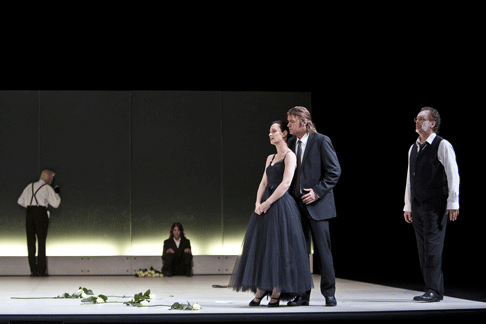 A scene from Lulu
Indeed, the full impact of this production may not emerge until long after it’s over. Since coming away from it, I’ve been thinking about Berg’s obsessive sense of order. If the world is in perpetual, confusing chaos, then compulsive orderliness is a means of staving off danger. Berg’s symmetries and palindromes aren’t simply pattern making but a kind of secret incantation. Was he on the verge of something really radical when he died? We shall never know but it’s stimulating to wonder.
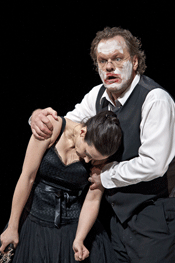 Agneta Eichenholz as Lulu and Michael Volle as Dr Schön
Because this production throws so much emphasis on the music, it’s quite a surprise at first how soft edged the orchestra sounded. Because Boulez is so exceptional, I have to adjust to anyone else. In rehearsals, Antonio Pappano has emphasized the Viennese aspects of this opera, and its submerged romanticism. Submerged, like Lulu’s tragedy. Despite the violence in this opera, it’s tender and dignified. So I can see where the soft focus is coming from. It acts like a counterbalance to the stark sharpness of the staging: Boulez conducting a production like this would be almost too intense to bear.
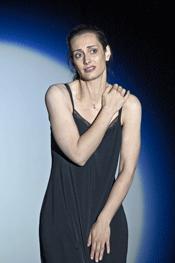
Agneta Eichenholz was Lulu. She’s quite experienced though mainly in Sweden, which is perhaps appropriate for a Lulu, whose background is unknown. A First Night at Covent Garden was perhaps the highest profile she’s ever had, so if she sounded tense, it’s completely understandable.. It’s a difficult part to sing, and to some extent shrillness fits in with the character. She doesn’t quite have the hypnotizing presence of Christine Schäfer, but it really is asking too much of anyone to expect such standards.
Michael Volle’s Dr Schön is a benchmark realization, all the more impressive because it’s his first time in the role, though he sang Wozzeck only a few months ago. This is Dr Schön’s tragedy as much as Lulu’s. He’s a man who showed compassion when he took Lulu off the streets, even if he may have got something back for doing so. Lulu clearly loves him, though she’s incapable of giving him the same kindness. Because Volle’s Dr Schön looks vigorous and in his prime, his disintegration is all the more distressing. He embodies Berg’s theme of control and chaos: an authoritative, powerful voice but the actorly skills to transit from magnate to tortured soul.
Paradoxically - Lulu is full of paradoxes - the most unrealistic scene in the opera occurs when Countess Geschwitz and Lulu swap clothes and personalities. That couldn’t happen in real life but in Loy’s production the two women really do look alike. Jennifer Larmore’s Countess Geschwitz is also a far more sympathetic portrayal than the butch Cruella DeVille some assume gay people must be. Berg’s sister Smagarda was lesbian, so he knew they were people just like anyone else. Again, this production captures the essence of the opera by not giving the game away with obvious clues. You have to concentrate when Larmore and Eichenholz aren’t singing to keep track of which is which.
Sturdy performances from Klaus Florian Vogt as Alwa and Peter Rose as the Animal Trainer/Athlete. Schigolch, though, might have needed greater definition. Unlike the other characters, he stays the same. He’s the animal who can’t be tamed, and a counter to Lulu herself, so more should have been made of the role. Gywnne Howell sang well, but the wild edge to the part wasn’t present.
Get to this production. Chances are it won’t be seen too often as it’s hardly box office candy. Some ladies sitting near me were day trippers from the country on a package tour of the capital. They must have wondered what hit them.
Anne Ozorio