
17 Jun 2009
Die schöne Müllerin at Wigmore Hall
Matthias Goerne and Christoph Eschenbach unite in a Schöne Müllerin of searing intensity.
English Touring Opera are delighted to announce a season of lyric monodramas to tour nationally from October to December. The season features music for solo singer and piano by Argento, Britten, Tippett and Shostakovich with a bold and inventive approach to making opera during social distancing.
This tenth of ten Live from London concerts was in fact a recorded live performance from California. It was no less enjoyable for that, and it was also uplifting to learn that this wasn’t in fact the ‘last’ LfL event that we will be able to enjoy, courtesy of VOCES8 and their fellow vocal ensembles (more below …).
Ever since Wigmore Hall announced their superb series of autumn concerts, all streamed live and available free of charge, I’d been looking forward to this song recital by Ian Bostridge and Imogen Cooper.
The Sixteen continues its exploration of Henry Purcell’s Welcome Songs for Charles II. As with Robert King’s pioneering Purcell series begun over thirty years ago for Hyperion, Harry Christophers is recording two Welcome Songs per disc.
Although Stile Antico’s programme article for their Live from London recital introduced their selection from the many treasures of the English Renaissance in the context of the theological debates and upheavals of the Tudor and Elizabethan years, their performance was more evocative of private chamber music than of public liturgy.
In February this year, Albanian soprano Ermonela Jaho made a highly lauded debut recital at Wigmore Hall - a concert which both celebrated Opera Rara’s 50th anniversary and honoured the career of the Italian soprano Rosina Storchio (1872-1945), the star of verismo who created the title roles in Leoncavallo’s La bohème and Zazà, Mascagni’s Lodoletta and Puccini’s Madama Butterfly.
Evidently, face masks don’t stifle appreciative “Bravo!”s. And, reducing audience numbers doesn’t lower the volume of such acclamations. For, the audience at Wigmore Hall gave soprano Elizabeth Llewellyn and pianist Simon Lepper a greatly deserved warm reception and hearty response following this lunchtime recital of late-Romantic song.
Collapsology. Or, perhaps we should use the French word ‘Collapsologie’ because this is a transdisciplinary idea pretty much advocated by a series of French theorists - and apparently, mostly French theorists. It in essence focuses on the imminent collapse of modern society and all its layers - a series of escalating crises on a global scale: environmental, economic, geopolitical, governmental; the list is extensive.
For this week’s Live from London vocal recital we moved from the home of VOCES8, St Anne and St Agnes in the City of London, to Kings Place, where The Sixteen - who have been associate artists at the venue for some time - presented a programme of music and words bound together by the theme of ‘reflection’.
'Such is your divine Disposation that both you excellently understand, and royally entertaine the Exercise of Musicke.’
Amongst an avalanche of new Mahler recordings appearing at the moment (Das Lied von der Erde seems to be the most favoured, with three) this 1991 Mahler Second from the 2nd Kassel MahlerFest is one of the more interesting releases.
‘And there was war in heaven: Michael and his angels fought against the dragon; and the dragon fought and his angels, And prevailed not; neither was their place found any more in heaven … that old serpent … Satan, which deceiveth the whole world: he was cast out into the earth, and his angels were cast out with him.’
If there is one myth, it seems believed by some people today, that probably needs shattering it is that post-war recordings or performances of Wagner operas were always of exceptional quality. This 1949 Hamburg Tristan und Isolde is one of those recordings - though quite who is to blame for its many problems takes quite some unearthing.
There was never any doubt that the fifth of the twelve Met Stars Live in Concert broadcasts was going to be a palpably intense and vivid event, as well as a musically stunning and theatrically enervating experience.
‘Love’ was the theme for this Live from London performance by Apollo5. Given the complexity and diversity of that human emotion, and Apollo5’s reputation for versatility and diverse repertoire, ranging from Renaissance choral music to jazz, from contemporary classical works to popular song, it was no surprise that their programme spanned 500 years and several musical styles.
The Academy of St Martin in the Fields have titled their autumn series of eight concerts - which are taking place at 5pm and 7.30pm on two Saturdays each month at their home venue in Trafalgar Square, and being filmed for streaming the following Thursday - ‘re:connect’.
The London Symphony Orchestra opened their Autumn 2020 season with a homage to Oliver Knussen, who died at the age of 66 in July 2018. The programme traced a national musical lineage through the twentieth century, from Britten to Knussen, on to Mark-Anthony Turnage, and entwining the LSO and Rattle too.
With the Live from London digital vocal festival entering the second half of the series, the festival’s host, VOCES8, returned to their home at St Annes and St Agnes in the City of London to present a sequence of ‘Choral Dances’ - vocal music inspired by dance, embracing diverse genres from the Renaissance madrigal to swing jazz.
Just a few unison string wriggles from the opening of Mozart’s overture to Le nozze di Figaro are enough to make any opera-lover perch on the edge of their seat, in excited anticipation of the drama in music to come, so there could be no other curtain-raiser for this Gala Concert at the Royal Opera House, the latest instalment from ‘their House’ to ‘our houses’.
"Before the ending of the day, creator of all things, we pray that, with your accustomed mercy, you may watch over us."
Matthias Goerne and Christoph Eschenbach unite in a Schöne Müllerin of searing intensity.
I first reviewed Goerne’s interpretation of Die schöne Müllerin in 2000, a revelatory experience in that his was the first version of this work which seemed to belong more to the world of Winterreise than to the gemütlichkeit with which Schubert’s first Müller song cycle is generally associated. In conversation a couple of years later on, he gave his view of the work — “All this naïveté — the boy walking through the trees… finding love and all that, is not what the work is about; it is much, much more involved with what might be called ‘Sturm und Drang’” — and he regarded the songs after ‘Pause’ as ‘a descending spiral for which the only culmination is death by suicide.’ Judging by this evening’s performance, he has now decided that the descent begins much earlier than that.
Goerne has at times appeared to shop around for his accompanists, seemingly in a quest to find the one who most nearly comes close to his own unique concept of Lieder. Previously it was Eric Schneider who filled that role, but in Christoph Eschenbach he seems to have found the ‘Seelenfreund’ whose playing is, if anything, even more rapt, mesmerizingly slow and intense than his singing. If ever a singer and pianist were as one in their freedom from the constriction of the bar lines, then these two are.
This is the ultimate serious This is the ultimate serious Schöne Müllerin, barely leavened with a touch of lightness — all the humour is sardonic, all the beauty deceptive, all the tempi so slow as to seem at times in danger of standing still. Of course I loved every phrase, but I can quite see that for many, this is not “their” Schöne Müllerin — for that, you need to go to Quasthoff or just about any other Lieder singer around today. barely leavened with a touch of lightness — all the humour is sardonic, all the beauty deceptive, all the tempi so slow as to seem at times in danger of standing still. Of course I loved every phrase, but I can quite see that for many, this is not “their” Schöne Müllerin — for that, you need to go to Quasthoff or just about any other Lieder singer around today.
‘Das Wandern’ is not a jolly romp but prefigures what is to come — within the subtle variations of “vom Wasser” and “Wandern” we are made aware that this is not a frolicsome lad but one whose ultimate fate is to be in thrall to an illusion — the spirit of that other deceptive piece of “rural idyll” Tennyson’s ‘May Queen’ seems to hover over us throughout — “They say he’s dying all for love, but that can never be: / They say his heart is breaking, mother — what is that to me?” Goerne seems to have decided that the crucial turning point in the cycle comes much earlier than generally supposed — here, with the line “Ist das denn meine Strasse?” sung in tones of suppressed fear and anguish, we are virtually in suicide land with the second song.
The wonderful ‘Danksagung an den Bach’ is so often sung as pretty ditty, but here we had frank, straightforward questions about the speaker’s future, culminating in superficial yet ultimately doomed exuberance. I have never heard ‘Der Neugierige’ performed with such intensity — singer and pianist united as if in prayer, the little questioning phrases after “ob mich mein Herz belog” played almost in a reverie, “die ganze Welt mir ein” taken so slowly that it became a kind of litany. I need hardly add that the earth stood still as far as most of the audience were concerned, but I can quite see how some might find it a little, shall we say, over-wrought?
‘Eifersucht und Stolz’ like most of the more vigorous songs was taken at a cracking pace, the diction at “da steckt kein sittsam Kind den Kopf zum Fenster ‘naus” remarkably crisp despite the speed, and this was followed by a ‘Die liebe farbe’ only just short of psychotic — the amount of sheer hatred packed into the seemingly innocent line “mein Schatz hat’s Grün so gern” had to be heard to be believed.
The bleakness never really lets up, ‘Trockne Blumen’ touching new depths of the most profound sadness, no triumph at “der Mai ist kommen” instead only the sense that the coming of May is cruel in the same way as Eliot’s April is, because it brings the Spring and hope so welcome to all but the poet. The final “lullaby” was again taken at a “slow and stopping pace” and some of the words were a little mangled in the process — indeed, scrupulous though his concern for the language is, Goerne does have a tendency, alarming to those of nervous disposition, to be somewhat free with what goes where in a song. One could put this down to his fervent intensity getting the better of him, since it cannot surely be lack of familiarity with the text.
Goerne says that “People always think of Winterreise as being dark, gloomy, but the man does not die at the end, he goes on, unlike the youth” (in Die schöne Müllerin). Indeed, and the wanderer’s “Nun weiter denn, nur weiter” of the later work seems positively rosy-cheeked cheeriness compared to this miller lad’s desire to weep the green grass “ganz totenbleich.” One anticipates Wednesday’s Winterreise and Saturday’s Schwanengesang with eagerness tempered with apprehension — this first installment of Goerne and Eschenbach’s interpretation of these works (recorded on Harmonia Mundi, and soon to be followed by further discs) promises evenings of an intensity as troubling as it is breathtaking.
Melanie Eskenazi
 |
 |
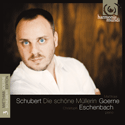 |
| Sehnsucht | An mein Herz | Die schöne Müllerin |