Recently in Reviews
English Touring Opera are delighted to announce a season of lyric monodramas to tour nationally from October to December. The season features music for solo singer and piano by Argento, Britten, Tippett and Shostakovich with a bold and inventive approach to making opera during social distancing.
This tenth of ten Live from London concerts was in fact a recorded live performance from California. It was no less enjoyable for that, and it was also uplifting to learn that this wasn’t in fact the ‘last’ LfL event that we will be able to enjoy, courtesy of VOCES8 and their fellow vocal ensembles (more below …).
Ever since Wigmore Hall announced their superb series of autumn concerts, all streamed live and available free of charge, I’d been looking forward to this song recital by Ian Bostridge and Imogen Cooper.
The Sixteen continues its exploration of Henry Purcell’s Welcome Songs for Charles II. As with Robert King’s pioneering Purcell series begun over thirty years ago for Hyperion, Harry Christophers is recording two Welcome Songs per disc.
Although Stile Antico’s programme article for their Live from London recital introduced their selection from the many treasures of the English Renaissance in the context of the theological debates and upheavals of the Tudor and Elizabethan years, their performance was more evocative of private chamber music than of public liturgy.
In February this year, Albanian soprano Ermonela Jaho made a highly lauded debut recital at Wigmore Hall - a concert which both celebrated Opera Rara’s 50th anniversary and honoured the career of the Italian soprano Rosina Storchio (1872-1945), the star of verismo who created the title roles in Leoncavallo’s La bohème and Zazà, Mascagni’s Lodoletta and Puccini’s Madama Butterfly.
Evidently, face masks don’t stifle appreciative “Bravo!”s. And, reducing audience numbers doesn’t lower the volume of such acclamations. For, the audience at Wigmore Hall gave soprano Elizabeth Llewellyn and pianist Simon Lepper a greatly deserved warm reception and hearty response following this lunchtime recital of late-Romantic song.
Collapsology. Or, perhaps we should use the French word ‘Collapsologie’ because this is a transdisciplinary idea pretty much advocated by a series of French theorists - and apparently, mostly French theorists. It in essence focuses on the imminent collapse of modern society and all its layers - a series of escalating crises on a global scale: environmental, economic, geopolitical, governmental; the list is extensive.
For this week’s Live from London vocal recital we moved from the home of VOCES8, St Anne and St Agnes in the City of London, to Kings Place, where The Sixteen - who have been associate artists at the venue for some time - presented a programme of music and words bound together by the theme of ‘reflection’.
'Such is your divine Disposation that both you excellently understand, and royally entertaine the Exercise of Musicke.’
Amongst an avalanche of new Mahler recordings appearing at the moment (Das Lied von der Erde seems to be the most favoured, with three) this 1991 Mahler Second from the 2nd Kassel MahlerFest is one of the more interesting releases.
‘And there was war in heaven: Michael and his angels fought against the dragon; and the dragon fought and his angels, And prevailed not; neither was their place found any more in heaven … that old serpent … Satan, which deceiveth the whole world: he was cast out into the earth, and his angels were cast out with him.’
If there is one myth, it seems believed by some people today, that probably needs shattering it is that post-war recordings or performances of Wagner operas were always of exceptional quality. This 1949 Hamburg Tristan und Isolde is one of those recordings - though quite who is to blame for its many problems takes quite some unearthing.
There was never any doubt that the fifth of the twelve Met Stars Live in Concert broadcasts was going to be a palpably intense and vivid event, as well as a musically stunning and theatrically enervating experience.
‘Love’ was the theme for this Live from London performance by Apollo5. Given the complexity and diversity of that human emotion, and Apollo5’s reputation for versatility and diverse repertoire, ranging from Renaissance choral music to jazz, from contemporary classical works to popular song, it was no surprise that their programme spanned 500 years and several musical styles.
The Academy of St Martin in the Fields have titled their autumn series of eight concerts - which are taking place at 5pm and 7.30pm on two Saturdays each month at their home venue in Trafalgar Square, and being filmed for streaming the following Thursday - ‘re:connect’.
The London Symphony Orchestra opened their Autumn 2020 season with a homage to Oliver Knussen, who died at the age of 66 in July 2018. The programme traced a national musical lineage through the twentieth century, from Britten to Knussen, on to Mark-Anthony Turnage, and entwining the LSO and Rattle too.
With the Live from London digital vocal festival entering the second half of the series, the festival’s host, VOCES8, returned to their home at St Annes and St Agnes in the City of London to present a sequence of ‘Choral Dances’ - vocal music inspired by dance, embracing diverse genres from the Renaissance madrigal to swing jazz.
Just a few unison string wriggles from the opening of Mozart’s overture to Le nozze di Figaro are enough to make any opera-lover perch on the edge of their seat, in excited anticipation of the drama in music to come, so there could be no other curtain-raiser for this Gala Concert at the Royal Opera House, the latest instalment from ‘their House’ to ‘our houses’.
"Before the ending of the day, creator of all things, we pray that, with your accustomed mercy, you may watch over us."
Reviews
15 Jun 2009
Haydn’s Bicentenary : 20 Capitals Salute “The Creation” With Standing Ovations
The Austrian Ministry of Culture and the Committee for the Celebrations of
Haydn’s Bicentenary had a brilliant idea: on May 31st , the day of the
composer’s death, 20 symphony orchestras and/or opera houses performed
one of his greatest and best known oratorios Die Schöpfung (The
Creation) .
Because of different time-zones, Die Schöpfung day started
in New Zealand and ended in Honolulu. An earnest radio listener could enjoy the
different performances over 24 hours and appreciate the difference in
conducting as well as in singing. Opera houses were included because in certain
countries (e.g. Germany) Die Schöpfung is also staged as a music
drama: computer technology and animation are a superb support to show the
initial chaos , the creation of the animals, of the flowers, of the lakes, of
the rivers and of the mountain as well as the Eden garden with the passionate
Adam and Eve duet.
In Rome, the Orchestra Sinfonica - Fondazione Roma (OsFr) was selected for
the task. The OsFr is a peculiarity in the Italian musical landscape: it is the
only fully private symphony orchestra. It does not receive any State,
Regional., Provincial or Municipal support but it is financed by the Fondazione
Roma ( a nonprofit foundation) and by a few companies. It has 90 permanent
elements (average age: 30), a budget which is less than one-fifth of that of
the main symphony orchestra in the Italian capital (l’Accademia Nazionale
di Santa Cecilia) and a low- priced ticket policy to attract young and old
people with modest income (season tickets for 30 concerts vary from € 260
to € 90 according to the category). Its music director and permanent
conductor is Maestro Francesco La Vecchia, who is also principal guest
conductor of the Berliner Symphoniker. La Vecchia has been music director of
Opera Houses and symphony orchestras in Central Europe (Budapest), Latin
America (Rio de Janeiro) and Portugal (Lisbon). The OsFr started some eight
years ago after a EU-supported training program for young graduates from
European conservatories. It has gained an important place in the international
music scenes also due to its tournée in Germany, Poland and China.
In January, the Accademia di Santa Cecilia had offered a different version
of Die Schöpfung — performed by Frieburger Barochester conducted
by René Jacobs and with Julia Kleiter, Donat Havar and Johanner Weisser as
soloists. The difference, of course, is not in the score (both Jacobs and La
Vecchia conducted the full score without cuts or intermission) but in the
style: dry, albeit almost religious, Jacobs’; passionate (even in the
approach to religion) La Vecchia’s .
Die Schöpfung is well known. Thus, there is no need to provide
Opera Today readers with background on its composition, on its Austrian and
London premières and on its contents. Its three parts are operatic acts. In the
first and in the second, the three archangels Gabriel, Uriel and Raphael
observe the Creation by following very closely the biblical text. In the third
act, we are no longer witnessing from a distance the works of the Creator. The
scene is the Eden Garden. After an introduction of Uriel, the act is long love
scene of Adam and Eve that includes a duet supported by a choral background. As
Haydn planned, there are five characters but three singers: the bass and the
soprano are Raphael and Gabriel in the first and second act but become Adam and
Eve in the third act. The roles are taxing both for the duration (nearly two
hours of music ) and for the “virtuoso” singing — they imply
“coloratura”, “agility”, quite a few high Cs and many
Fs.
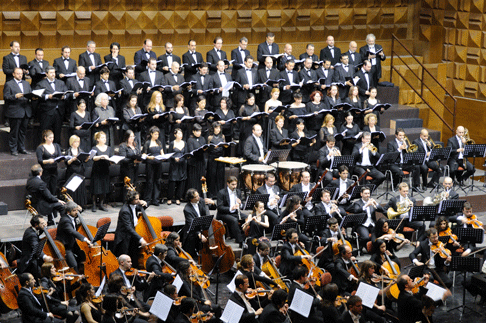
Maestro La Vecchia recalls that in 1992 he had conducted Die
Schöpfung in the Amazonian Forest, at the vey confluence of the Rio Branco
with the Rio Petro. Over 10,000 Indios attended the performance thrilled by the
Haydn’s score. Most likely, the memory of that performance influenced
conducting on May 31st. In the first part, it is noteworthy how conductor,
orchestra and singers amplified the transition from the chaos (C minor) to the
newly lit world (A major) . In the second act, the emphasis is on the
descriptive imagery as in the portrayal of the animals: the cheerful, but rude,
trombone blast of the lion, the pouncing tiger, the placing grazing of cattle,
the sinuous music for the worm. The third act is less contemplative than
normally performed: the love between Adam and Eve is powerful, not merely
platonic; their duet is rapturous and timeless, an essential transition to the
glorious final chorus.
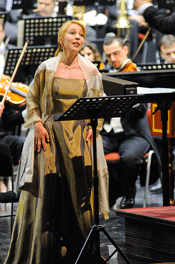
La Vecchia and the symphony orchestra had three excellent singers to work
with. Anita Selvaggio is a “soprano assoluto” better known outside
Italy than in her own country. Both as an archangel and as Eve she displayed a a remarkable flexibility in the upper extension and an extraordinary use of
messa di voce (a quality that many sopranos seem neither to care for
nor to practice enough). Michael Smallwood is an up-and-coming Australian tenor
with a delicate sensuous “legato”. David Wilson Johson is the best
known of the three soloists. He once again confirmed his talent and
versatility.
Giuseppe Pennisi (Based On May 31st Rome Symphony Orchestra Performance)