Recently in Reviews
English Touring Opera are delighted to announce a season of lyric monodramas to tour nationally from October to December. The season features music for solo singer and piano by Argento, Britten, Tippett and Shostakovich with a bold and inventive approach to making opera during social distancing.
This tenth of ten Live from London concerts was in fact a recorded live performance from California. It was no less enjoyable for that, and it was also uplifting to learn that this wasn’t in fact the ‘last’ LfL event that we will be able to enjoy, courtesy of VOCES8 and their fellow vocal ensembles (more below …).
Ever since Wigmore Hall announced their superb series of autumn concerts, all streamed live and available free of charge, I’d been looking forward to this song recital by Ian Bostridge and Imogen Cooper.
The Sixteen continues its exploration of Henry Purcell’s Welcome Songs for Charles II. As with Robert King’s pioneering Purcell series begun over thirty years ago for Hyperion, Harry Christophers is recording two Welcome Songs per disc.
Although Stile Antico’s programme article for their Live from London recital introduced their selection from the many treasures of the English Renaissance in the context of the theological debates and upheavals of the Tudor and Elizabethan years, their performance was more evocative of private chamber music than of public liturgy.
In February this year, Albanian soprano Ermonela Jaho made a highly lauded debut recital at Wigmore Hall - a concert which both celebrated Opera Rara’s 50th anniversary and honoured the career of the Italian soprano Rosina Storchio (1872-1945), the star of verismo who created the title roles in Leoncavallo’s La bohème and Zazà, Mascagni’s Lodoletta and Puccini’s Madama Butterfly.
Evidently, face masks don’t stifle appreciative “Bravo!”s. And, reducing audience numbers doesn’t lower the volume of such acclamations. For, the audience at Wigmore Hall gave soprano Elizabeth Llewellyn and pianist Simon Lepper a greatly deserved warm reception and hearty response following this lunchtime recital of late-Romantic song.
Collapsology. Or, perhaps we should use the French word ‘Collapsologie’ because this is a transdisciplinary idea pretty much advocated by a series of French theorists - and apparently, mostly French theorists. It in essence focuses on the imminent collapse of modern society and all its layers - a series of escalating crises on a global scale: environmental, economic, geopolitical, governmental; the list is extensive.
For this week’s Live from London vocal recital we moved from the home of VOCES8, St Anne and St Agnes in the City of London, to Kings Place, where The Sixteen - who have been associate artists at the venue for some time - presented a programme of music and words bound together by the theme of ‘reflection’.
'Such is your divine Disposation that both you excellently understand, and royally entertaine the Exercise of Musicke.’
Amongst an avalanche of new Mahler recordings appearing at the moment (Das Lied von der Erde seems to be the most favoured, with three) this 1991 Mahler Second from the 2nd Kassel MahlerFest is one of the more interesting releases.
‘And there was war in heaven: Michael and his angels fought against the dragon; and the dragon fought and his angels, And prevailed not; neither was their place found any more in heaven … that old serpent … Satan, which deceiveth the whole world: he was cast out into the earth, and his angels were cast out with him.’
If there is one myth, it seems believed by some people today, that probably needs shattering it is that post-war recordings or performances of Wagner operas were always of exceptional quality. This 1949 Hamburg Tristan und Isolde is one of those recordings - though quite who is to blame for its many problems takes quite some unearthing.
There was never any doubt that the fifth of the twelve Met Stars Live in Concert broadcasts was going to be a palpably intense and vivid event, as well as a musically stunning and theatrically enervating experience.
‘Love’ was the theme for this Live from London performance by Apollo5. Given the complexity and diversity of that human emotion, and Apollo5’s reputation for versatility and diverse repertoire, ranging from Renaissance choral music to jazz, from contemporary classical works to popular song, it was no surprise that their programme spanned 500 years and several musical styles.
The Academy of St Martin in the Fields have titled their autumn series of eight concerts - which are taking place at 5pm and 7.30pm on two Saturdays each month at their home venue in Trafalgar Square, and being filmed for streaming the following Thursday - ‘re:connect’.
The London Symphony Orchestra opened their Autumn 2020 season with a homage to Oliver Knussen, who died at the age of 66 in July 2018. The programme traced a national musical lineage through the twentieth century, from Britten to Knussen, on to Mark-Anthony Turnage, and entwining the LSO and Rattle too.
With the Live from London digital vocal festival entering the second half of the series, the festival’s host, VOCES8, returned to their home at St Annes and St Agnes in the City of London to present a sequence of ‘Choral Dances’ - vocal music inspired by dance, embracing diverse genres from the Renaissance madrigal to swing jazz.
Just a few unison string wriggles from the opening of Mozart’s overture to Le nozze di Figaro are enough to make any opera-lover perch on the edge of their seat, in excited anticipation of the drama in music to come, so there could be no other curtain-raiser for this Gala Concert at the Royal Opera House, the latest instalment from ‘their House’ to ‘our houses’.
"Before the ending of the day, creator of all things, we pray that, with your accustomed mercy, you may watch over us."
Reviews
17 Jun 2009
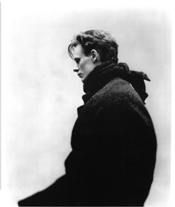
Ian Bostridge at the Chicago Symphony Orchestra
In a recent Chicago Symphony Orchestra concert featuring twentieth-century
instrumental and vocal compositions Ian Bostridge sang Benjamin Britten’s
Les Illuminations under the direction of principal conductor Bernard
Haitink.
The concert opened with a contemporary arrangement of early music,
Steven Stucky’s transcription of Henry Purcell’s Funeral Music
for Queen Mary, this version receiving its first performances by the
Chicago Symphony Orchestra. The second half of the program offered a masterful
account of Dimitri Shostakovich’s Symphony No. 15, the performance here
yielding considerable opportunity for both soloists and orchestral ensemble.
The brief transcription of Funeral Music in four parts,
beginning and ending with a march, honors the musical spirit of Purcell while
offering a modern interpretation of the same. After an introduction emphasizing
low notes for the flute, a steady piano accompaniment gives way to the drums
signaling a dignified realization of death. Following this opening, the CSO
brass played an appropriately somber dirge, indeed one associated with the
elevated stance of passing royalty. An oboe solo, performed here with great
effect by Eugene Izotov, was echoed by the brass, such types of musical
dialogue informing much of the remainder of Stucky’s transcription of
Purcell. Sustained notes held by the use of the vibraphone introduced a
continuity leading to a final stately reprise, with the repetition of drums
calling the funereal tone into an ultimate focus.
The significance of Purcell’s music for Benjamin Britten is certainly
recognized from the latter’s instrumental compositions, and the pairing
in this concert with Les Illuminations functioned as yet further
homage to the earlier composer. Britten was first inspired by the poetry of
Arthur Rimbaud in the late 1930s and finished in 1940 his cycle of songs,
Les Illuminations for high voice and strings, based on
Rimbaud’s texts of the same name. The singer’s approach to the
poetic texts by Rimbaud and interaction with the string orchestra is key to a
unified approach in a performance of this cycle. Bostridge has given ample
consideration to a multi-faceted approach evident in this program. He injects a
sense of drama without appearing overwrought in tone while, at the same time,
maintaining sufficient ironic distance so that his performance serves as both
song and commentary on the text and music being performed. In the introductory
lines of “Fanfare” Bostridge declares with proud conviction
“J’ai seul la clef de cette parade” [“I alone have the
keys to this parade”]. When these words are repeated and varied ending
piano on the phrase “cette parade sauvage” [“this savage
parade”], the singer becomes a keeper of secrets, one who bears the mask
of an omniscient observer. With this alternating perspective Bostridge guided
the listeners through the following series of poems chosen and set by Britten.
“Villes” [“Cities”] details the varied and stirring
activity of the modern city, filled with moving individuals and their means of
transportation. To illustrate the mix of ancient and modern — the seeming
paradox of nature, myth, and metropolis — Bostridge intoned, in effective
succession, a rising followed by a descending scale on the verbal forms in the
phrase “la lune brûle et hurle.”[“the moon burns and
howls”]. At the close of this song the paradox of frenetic movement and
ancient model was capped softly by Bostridge as he asked “d’ou
viennent mes sommeils…?” [“from where does my sleep come
…?”] with tender inquisitiveness. In the following text of
“Phrase” the lyrical I speaks, almost as one of the fates,
stretching cords from one pinnacle or window to another. While describing
movement here with the statement, “et je danse” [“and I
dance”], the tenor emphasized the physical verb starting on a crystalline
high note that progressed, glissando and gracefully all-encompassing, to a
concluding low. In the following three pieces, before an orchestral interlude,
the tone sways between the private and the open spheres. “Antique”
is a direct address to the son of Pan, both description and attempt to
communicate, during which Bostridge used his voice to suggest the musical
instrument associated with the deity. The range of notes struck so effectively
by the singer in the conclusion to this song evoked the female and male aspects
of the “double sexe” as cited. In “Royauté” an
unidentified couple indeed play at the roles of royalty for an extended day,
their self-absorption brought out especially in the ironic detachment of this
performance. The movements of the ocean and foam slapping against a boat in
“Marine” were convincingly imitated by melismatic effects on
“l’écume” [“foam”] and the final emphasis of
“tourbillons de lumière” [“whirlpools of light”].
As the first in the second group of texts following the orchestral
interlude, “Being Beauteous,” as titled by Rimbaud, is replete with
contrasting images that call into question the concepts of actual and idealized
appearance. Through notable shifts in tempo Bostridge underlined these
contrasts while allowing the text to maintain its own organic flow. The tone of
the song was aptly concluded with a low, almost heavy vocal projection on the
words “de l’air leger” [“of the soft air”],
suggesting by the performer antithesis in one’s perceptions of beauty. In
the final two songs, “Parade” and “Départ,” the soloist
released a crescendo of varied emotions as he observed and commented on the
parade of humanity, a further and elongated assurance here given that the key
to the parade rested with the perception of this voice. In “Départ”
Bostridge looked truly weary as he sang “Assez vu” [“Enough
seen”], the slow and quiet intonations now concluding a cycle of
contradictions, as the final phrase, “l’affection et le bruit
neufs” [“the new affection and noise”] trailed softly into
memory.
In the Symphony No. 15 by Shostakovich, performed after the intermission,
Haitink gave cohesive direction to a sprawling work that blends original motifs
with ample quotation. In the first movement, marked Allegretto, an initial
motif was introduced by the solo flute, played poignantly by Mathieu Dufour and
leading into a series of other solo parts in succession. After the bassoon,
oboe, and trombone contributed their parts, combinations of instruments — e.g.
flute and brass, piccolo and strings — were punctuated by intermittent
references to the William Tell overture by Rossini. In the second, Adagio
movement a solo for cello was played exquisitely by John Sharp, who was
subsequently joined by Dufour in a duet followed by the full complement of
strings. The concluding movements of the Symphony, with various tempo markings
including — again — Allegretto, contain yet further quotations from the
composer’s own works as well. The integration of the past and
transformation into a new composition remained the guiding force behind
Haitink’s memorable interpretation.
Salvatore Calomino