![Elīna Garanča as Angelina [Photo by Ken Howard courtesy of The Metropolitan Opera]](http://www.operatoday.com/CENERENTOLA_Garanca_as_Ange.gif)
21 Jun 2009
La Cenerentola at the MET
La Cenerentola runs third in popularity among Rossini’s comic operas — the Met didn’t get around to it at all until the present staging was created for Cecilia Bartoli.
English Touring Opera are delighted to announce a season of lyric monodramas to tour nationally from October to December. The season features music for solo singer and piano by Argento, Britten, Tippett and Shostakovich with a bold and inventive approach to making opera during social distancing.
This tenth of ten Live from London concerts was in fact a recorded live performance from California. It was no less enjoyable for that, and it was also uplifting to learn that this wasn’t in fact the ‘last’ LfL event that we will be able to enjoy, courtesy of VOCES8 and their fellow vocal ensembles (more below …).
Ever since Wigmore Hall announced their superb series of autumn concerts, all streamed live and available free of charge, I’d been looking forward to this song recital by Ian Bostridge and Imogen Cooper.
The Sixteen continues its exploration of Henry Purcell’s Welcome Songs for Charles II. As with Robert King’s pioneering Purcell series begun over thirty years ago for Hyperion, Harry Christophers is recording two Welcome Songs per disc.
Although Stile Antico’s programme article for their Live from London recital introduced their selection from the many treasures of the English Renaissance in the context of the theological debates and upheavals of the Tudor and Elizabethan years, their performance was more evocative of private chamber music than of public liturgy.
In February this year, Albanian soprano Ermonela Jaho made a highly lauded debut recital at Wigmore Hall - a concert which both celebrated Opera Rara’s 50th anniversary and honoured the career of the Italian soprano Rosina Storchio (1872-1945), the star of verismo who created the title roles in Leoncavallo’s La bohème and Zazà, Mascagni’s Lodoletta and Puccini’s Madama Butterfly.
Evidently, face masks don’t stifle appreciative “Bravo!”s. And, reducing audience numbers doesn’t lower the volume of such acclamations. For, the audience at Wigmore Hall gave soprano Elizabeth Llewellyn and pianist Simon Lepper a greatly deserved warm reception and hearty response following this lunchtime recital of late-Romantic song.
Collapsology. Or, perhaps we should use the French word ‘Collapsologie’ because this is a transdisciplinary idea pretty much advocated by a series of French theorists - and apparently, mostly French theorists. It in essence focuses on the imminent collapse of modern society and all its layers - a series of escalating crises on a global scale: environmental, economic, geopolitical, governmental; the list is extensive.
For this week’s Live from London vocal recital we moved from the home of VOCES8, St Anne and St Agnes in the City of London, to Kings Place, where The Sixteen - who have been associate artists at the venue for some time - presented a programme of music and words bound together by the theme of ‘reflection’.
'Such is your divine Disposation that both you excellently understand, and royally entertaine the Exercise of Musicke.’
Amongst an avalanche of new Mahler recordings appearing at the moment (Das Lied von der Erde seems to be the most favoured, with three) this 1991 Mahler Second from the 2nd Kassel MahlerFest is one of the more interesting releases.
‘And there was war in heaven: Michael and his angels fought against the dragon; and the dragon fought and his angels, And prevailed not; neither was their place found any more in heaven … that old serpent … Satan, which deceiveth the whole world: he was cast out into the earth, and his angels were cast out with him.’
If there is one myth, it seems believed by some people today, that probably needs shattering it is that post-war recordings or performances of Wagner operas were always of exceptional quality. This 1949 Hamburg Tristan und Isolde is one of those recordings - though quite who is to blame for its many problems takes quite some unearthing.
There was never any doubt that the fifth of the twelve Met Stars Live in Concert broadcasts was going to be a palpably intense and vivid event, as well as a musically stunning and theatrically enervating experience.
‘Love’ was the theme for this Live from London performance by Apollo5. Given the complexity and diversity of that human emotion, and Apollo5’s reputation for versatility and diverse repertoire, ranging from Renaissance choral music to jazz, from contemporary classical works to popular song, it was no surprise that their programme spanned 500 years and several musical styles.
The Academy of St Martin in the Fields have titled their autumn series of eight concerts - which are taking place at 5pm and 7.30pm on two Saturdays each month at their home venue in Trafalgar Square, and being filmed for streaming the following Thursday - ‘re:connect’.
The London Symphony Orchestra opened their Autumn 2020 season with a homage to Oliver Knussen, who died at the age of 66 in July 2018. The programme traced a national musical lineage through the twentieth century, from Britten to Knussen, on to Mark-Anthony Turnage, and entwining the LSO and Rattle too.
With the Live from London digital vocal festival entering the second half of the series, the festival’s host, VOCES8, returned to their home at St Annes and St Agnes in the City of London to present a sequence of ‘Choral Dances’ - vocal music inspired by dance, embracing diverse genres from the Renaissance madrigal to swing jazz.
Just a few unison string wriggles from the opening of Mozart’s overture to Le nozze di Figaro are enough to make any opera-lover perch on the edge of their seat, in excited anticipation of the drama in music to come, so there could be no other curtain-raiser for this Gala Concert at the Royal Opera House, the latest instalment from ‘their House’ to ‘our houses’.
"Before the ending of the day, creator of all things, we pray that, with your accustomed mercy, you may watch over us."
La Cenerentola runs third in popularity among Rossini’s comic operas — the Met didn’t get around to it at all until the present staging was created for Cecilia Bartoli.
For the matter of that, they didn’t get around to L’Italiana in Algeri until the present production — the one Jean-Pierre Ponnelle was doing all over the operatic world — was created for Marilyn Horne, not so terribly long ago. Il Barbiere di Siviglia was the only Rossini opera buffa so far as New Yorkers (and most of the world) were concerned, from the very first season of the Met (in 1883) — actually from New York’s very first opera season, in 1829, when Garcia, the first Almaviva, brought his own company to town — until comparatively recent times. Il Turco in Italia ran one season at the City Opera; Il Viaggio a Reims and Le Comte Ory also played that innovative company with some success; Il Signor Bruschino has been given by the Gotham Chamber Opera; others — La Scala di Seta, L’Equivoco Stravagante, Il Cambiale di Matrimonio and so on, have had occasional or student or semi-amateur stagings hereabouts.
Cenerentola can seem long — they all can seem long — if the fun isn’t fresh and the singing less than grade A — but we live in an era of grade A Rossini singers, so there’s no excuse for that any more. It contains the usual Rossini elements: masks and mistaken identities, an orchestral storm, arias somewhat familiar from other Rossini operas, at least one aria for a minor character composed by someone else because Rossini was too busy (or lazy) (this is omitted in the Met production; it was given in the City Opera production), bravura singing for everybody, dueling comic basses, and two of Rossini’s famous wacky scene finales where Italiana and Barbiere only had one each. As is usual in dramatizations of the Cinderella legend, the stepsisters get a lot of farce time — which can be amusing at first, but wears out its welcome in time. Cenerentola ought to be more fun than it proved on this outing, and perhaps it was to those unfamiliar with the jokey Cesare Lievi/Maurizio Balò production, its garish palette, oversized rooms, and fantasy sequences.
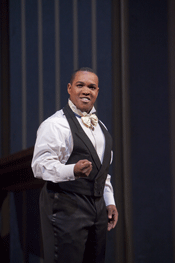 Lawrence Brownlee as Prince Ramiro
The comic basses were Simone Alberghini as Dandini, the prince’s
valet, masquerading as his master to distract Cinderella’s ghastly
family, and Alessandro Corbelli (this production’s original Dandini) now
promoted to Don Magnifico (Cinderella’s preposterous stepfather, a
snobbish, bankrupt aristocrat in the mold of the Duke of Plaza-Toro —
except the Duke is much nicer). They were the core of the evening’s fun,
stylish, absurd, graceful on the ear even when spluttering. The whole
buffa phenomenon was based on such figures and their highly personal
antics, not unlike the signature shtick of vaudeville comics — most
Italian opera houses in 1816 were small enough for any sort of nuance. Corbelli
and Alberghini are veterans who have made these sorts of roles their own.
Alberghini’s dancing prince-valet is so clearly out of musical comedy
that you wonder how anyone could fail to see he wasn’t a real prince
— except this is an opera buffa, and everyone is acting like that.
He’s just doing it better. Corbelli is a master of both the slow burn to
explosive payoff and the elegiac daydream (quoting the “voices” of
his fantasies) — he can even be romantic, as he showed in last
season’s Fille du Regiment. In contrast to this splendid buffo
fooling, the stepsisters in their mad 1920s getup rather wore out their
welcome, and the three-legged sofa is weary stuff.
One of the reasons Rossini’s operas have returned to popularity is that he wrote so many of his heroines for mezzo-sopranos, usually his lover (later wife) Isabella Colbran. The distinction was not made in Rossini’s lifetime — a soprano was a soprano; if she lacked top notes and had low notes, the composer wrote different music for her; if another singer came along, someone — not always the original composer — wrote her something new. (Sopranos often stole Rosina. Mezzos sometimes sang Rossini’s Otello.) We are living today in an age of wonderful light mezzos (one can trace the revival back to Horne, or to Simionato and Berganza if you prefer), and I believe we can all agree that they deserve more prima donna stage time than they tend to get.
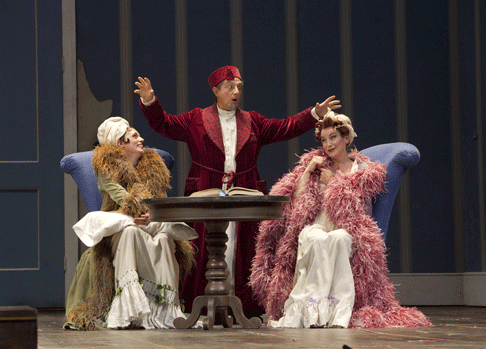 Rachelle Durkin as Clorinda, Alessandro Corbelli as Don Magnifico, Patricia Risley as Tisbe
Cenerentola — or Angelina, as she is actually named — was sung this year by Elina Garanča, a Latvian mezzo who made her Met debut last year as Rosina. She is a beautiful woman with a beautiful voice — a combination still welcome but no longer uncommon on the opera stage. She looks good in anything, including — no, especially — trousers, as Bellini’s Roméo, and she has a sweet metallic sheen that easily fills the house. What she is not, on the evidence of this performance, is a Rossini coloratura of the Rossini buffa variety, capable of torrents of notes where other composers would settle for an attractive stream. When Rossini revs it, he really revs it. Garanča sings three notes for every five written in the racy cadenzas, and those cadenzas were composed to be sung five for five — as the performances of Simionato, Berganza, von Stade, Horne and Bartoli demonstrate. Therefore I am delighted that Garanča has joined the Met roster, but puzzled why she chose Rossini to do so — perhaps just to get her foot in the door, a worthy objective — and eager to hear her in more suitable repertory.
Another reason I was eager to attend this season’s Cenerentola was finally to hear Lawrence Brownlee, the young American contender in the Rossini tenor stakes and, by the sound of audience response, already a singer the Met has taken to its heart. Brownlee has, on the evidence, a larger, more liquid sound that Juan Diego Florez’s more nasal tone or Barry Banks’s more brilliant but less sensuous instrument, and he appears to be the equal of both in rapid-fire coloratura. Don Ramiro, the prince, is, alas, not much of a role — besides a couple of duets (with Angelina and Dandini) and parts in the concertati, he only has one bravura scene — I have always been surprised when a leading tenor like Florez or Vargas condescends to take it on. Brownlee seemed comfortable on stage in all the silliness required of Don Ramiro in this production, but he does not cut a terribly romantic figure beside the taller and slimmer Miss Garanča. I look forward to hearing him again this summer in the semi-staged operas being performed at Caramoor.
Maurizio Benini led a sprightly performance without the affectations that sometimes marred his conducting of Don Pasquale. The longueurs that crept in were often as not Rossini’s fault.
John Yohalem