![Renée Fleming as Violetta Valéry [Photo by Catherine Ashmore courtesy of The Royal Opera House]](http://www.operatoday.com/Fleming_Violetta_ROH.gif)
26 Jun 2009
La Traviata at Royal Opera House
Four years have passed since the most celebrated American soprano of recent times, Renée Fleming, graced the stage at Covent Garden, in Elijah Moshinsky’s classic production of Otello.
English Touring Opera are delighted to announce a season of lyric monodramas to tour nationally from October to December. The season features music for solo singer and piano by Argento, Britten, Tippett and Shostakovich with a bold and inventive approach to making opera during social distancing.
This tenth of ten Live from London concerts was in fact a recorded live performance from California. It was no less enjoyable for that, and it was also uplifting to learn that this wasn’t in fact the ‘last’ LfL event that we will be able to enjoy, courtesy of VOCES8 and their fellow vocal ensembles (more below …).
Ever since Wigmore Hall announced their superb series of autumn concerts, all streamed live and available free of charge, I’d been looking forward to this song recital by Ian Bostridge and Imogen Cooper.
The Sixteen continues its exploration of Henry Purcell’s Welcome Songs for Charles II. As with Robert King’s pioneering Purcell series begun over thirty years ago for Hyperion, Harry Christophers is recording two Welcome Songs per disc.
Although Stile Antico’s programme article for their Live from London recital introduced their selection from the many treasures of the English Renaissance in the context of the theological debates and upheavals of the Tudor and Elizabethan years, their performance was more evocative of private chamber music than of public liturgy.
In February this year, Albanian soprano Ermonela Jaho made a highly lauded debut recital at Wigmore Hall - a concert which both celebrated Opera Rara’s 50th anniversary and honoured the career of the Italian soprano Rosina Storchio (1872-1945), the star of verismo who created the title roles in Leoncavallo’s La bohème and Zazà, Mascagni’s Lodoletta and Puccini’s Madama Butterfly.
Evidently, face masks don’t stifle appreciative “Bravo!”s. And, reducing audience numbers doesn’t lower the volume of such acclamations. For, the audience at Wigmore Hall gave soprano Elizabeth Llewellyn and pianist Simon Lepper a greatly deserved warm reception and hearty response following this lunchtime recital of late-Romantic song.
Collapsology. Or, perhaps we should use the French word ‘Collapsologie’ because this is a transdisciplinary idea pretty much advocated by a series of French theorists - and apparently, mostly French theorists. It in essence focuses on the imminent collapse of modern society and all its layers - a series of escalating crises on a global scale: environmental, economic, geopolitical, governmental; the list is extensive.
For this week’s Live from London vocal recital we moved from the home of VOCES8, St Anne and St Agnes in the City of London, to Kings Place, where The Sixteen - who have been associate artists at the venue for some time - presented a programme of music and words bound together by the theme of ‘reflection’.
'Such is your divine Disposation that both you excellently understand, and royally entertaine the Exercise of Musicke.’
Amongst an avalanche of new Mahler recordings appearing at the moment (Das Lied von der Erde seems to be the most favoured, with three) this 1991 Mahler Second from the 2nd Kassel MahlerFest is one of the more interesting releases.
‘And there was war in heaven: Michael and his angels fought against the dragon; and the dragon fought and his angels, And prevailed not; neither was their place found any more in heaven … that old serpent … Satan, which deceiveth the whole world: he was cast out into the earth, and his angels were cast out with him.’
If there is one myth, it seems believed by some people today, that probably needs shattering it is that post-war recordings or performances of Wagner operas were always of exceptional quality. This 1949 Hamburg Tristan und Isolde is one of those recordings - though quite who is to blame for its many problems takes quite some unearthing.
There was never any doubt that the fifth of the twelve Met Stars Live in Concert broadcasts was going to be a palpably intense and vivid event, as well as a musically stunning and theatrically enervating experience.
‘Love’ was the theme for this Live from London performance by Apollo5. Given the complexity and diversity of that human emotion, and Apollo5’s reputation for versatility and diverse repertoire, ranging from Renaissance choral music to jazz, from contemporary classical works to popular song, it was no surprise that their programme spanned 500 years and several musical styles.
The Academy of St Martin in the Fields have titled their autumn series of eight concerts - which are taking place at 5pm and 7.30pm on two Saturdays each month at their home venue in Trafalgar Square, and being filmed for streaming the following Thursday - ‘re:connect’.
The London Symphony Orchestra opened their Autumn 2020 season with a homage to Oliver Knussen, who died at the age of 66 in July 2018. The programme traced a national musical lineage through the twentieth century, from Britten to Knussen, on to Mark-Anthony Turnage, and entwining the LSO and Rattle too.
With the Live from London digital vocal festival entering the second half of the series, the festival’s host, VOCES8, returned to their home at St Annes and St Agnes in the City of London to present a sequence of ‘Choral Dances’ - vocal music inspired by dance, embracing diverse genres from the Renaissance madrigal to swing jazz.
Just a few unison string wriggles from the opening of Mozart’s overture to Le nozze di Figaro are enough to make any opera-lover perch on the edge of their seat, in excited anticipation of the drama in music to come, so there could be no other curtain-raiser for this Gala Concert at the Royal Opera House, the latest instalment from ‘their House’ to ‘our houses’.
"Before the ending of the day, creator of all things, we pray that, with your accustomed mercy, you may watch over us."
Four years have passed since the most celebrated American soprano of recent times, Renée Fleming, graced the stage at Covent Garden, in Elijah Moshinsky’s classic production of Otello.
So, anticipation and expectancy were running high at this performance, the second of seven, of La Traviata. Could Fleming bring the authority, emotional passion and musical intensity which characterised her Desdemona to Verdi’s dazzling courtesan-turned-angelic sacrificial-victim?
Sir Richard Eyre’s 1994 production has had countless revivals with numerous divas in the title role (and it’s scheduled for two more showings next season), but Fleming and the rest of the cast benefitted from the director’s own, and first, return to his conception. A traditional staging, this production convinces throughout, Bob Crowley’s sets and costumes raising many a gasp and round of applause. The assemblage of the sets did, however, necessitate two long intervals but the lavish designs were worth the wait — and, inadvertently, allowed the inter-act diners to avoid indigestion.
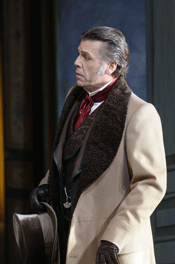 Thomas Hampson as Giorgio Germont
A frisson went through the audience when Fleming made her
glittering entry, sweeping into the sumptuous, somewhat crowded, salon where
revellers drifted and twirled around the sparkling ice-sculpture. But the
audience were made to wait for the trademark golden, floating tone: Fleming was
rather restrained and hesitant, holding back throughout the first act,
negotiating rather than relishing the demands of the coloratura fireworks in
‘Sempre libera’. She compensated for her musical caution with
exuberant dramatic gestures, flinging back the doors of the salon to hurl her
words contemptuously at those who judge her, tossing ice defiantly around the
room, and coughing loudly to foreshadow her demise. Fleming seemed a little
unhappy with Pappano’s tempi and, surprisingly, her voice lacked depth
and beauty in places, but she relaxed in the subsequent act and the audience
were rewarded for their patience with singing of outstanding, velvety warmth,
poise and pathos. Fleming moved effortlessly between soaring pianissimi and
impassioned exhortations: as satisfying a demonstration of the meaning of
bel canto as one could wish for.
A dilapidated mirror leaning haphazardly against the flaking wall, cast a sombre shadow over the now-bare stage for the famous death scene. Singing with sublime beauty and tender radiance, Fleming held the audience spellbound. ‘Prendi: quest’è l’immagine’, in which Violetta selflessly frees Alfredo to love another, was exquisitely poignant. Sadly, however, the final moments jarred somewhat. Violetta’s momentary resurgence of physical health, a false respite from suffering, was cleverly illuminated with a surge of light as Fleming sang ‘Rinasce’ (‘I'm reborn’), accompanied by a rising scale of pulsing urgency. But, rather than simply collapsing, overcome and exhausted by the intensity of this moment of joy, Fleming rushed around the room, grasping each astounded onlooker and informing them individually of her recovery. Then she fell to the floor, dead. This was an unfortunately anticlimactic end to an otherwise superb interpretation.
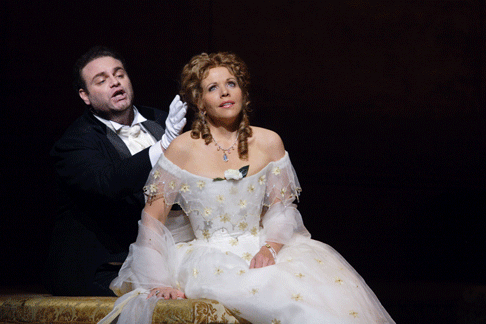 Joseph Calleja as Alfredo Germont and Renée Fleming as Violetta Valéry
Fleming’s partner, in the role of Alfredo, was the Maltese tenor, Joseph Calleja. He more than matched her musical mastery. Possessing a sweet, smooth voice, he sustained an Italianate warmth and took the Alfredo’s rigorous cabaletta, ‘O mio rimorso’, in his stride, although surprisingly he offered us only one verse. Calleja is not a natural actor, and the chemistry between him and Fleming was lacking in potency, but he inhabited the role with increasing conviction as the opera progressed, and in Act 2 his anger and bitterness were truly shocking as he hurled his gambling winnings at Violetta.
There was no weak link among the central trio. As Germont - the bourgeois father who disapproves of his son’s paramour - Thomas Hampson commanded the stage, immediately establishing his stern authority. He used his flexible baritone in his second-act aria, ‘Di Provenza’, to reveal the hypocrisy of this domineering emblem of wealth and respectability and his domineering cruelty — he brutally pushes Alfredo to the ground - while also hinting at the genuine regret which troubles his soul.
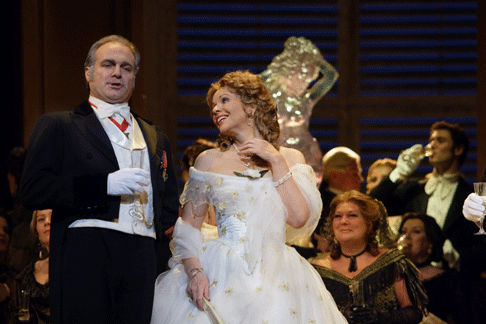 Eddie Wade as Baron Douphol and Renée Fleming as Violetta Valéry
This stunning triumvirate put every ounce of energy, focus, musicality and dramatic commitment to their task. And they were supported by some fine singing by Jette Parker Young Artists present and past in the minor roles, Monika-Evelin Liiv (Flora), Kostas Smoriginas (Marquis D’Obigny) and Haoyin Xue (Gastone de Letorières). As Annina, Sarah Pring was dramatically feisty and musically sure. The chorus, too, were in typically fine form, most notably in the Act 2 gambling scene — stunningly lit from above in complementary reds and greens — where the gypsy girls frolicked and cavorted on the enormous green baize gambling table, while matadors strutted and postured, entertaining the dissolute guests with wild abandon.
Offering a near-prefect reading of the score, Antonio Pappano gave the cast eloquent support. The expressive dynamic range he drew from his players, enlivened even the most mundane accompanying figures, powerfully colouring the words. He coaxed a rich display of expressive hues from the members of the orchestra, especially the superb clarinet solo which accompanies Violetta’s letter writing in Act 2, where the instrument’s innate variety of timbre perfectly conveyed her inner conflict and instability. The Prelude was simply stunning: delicate, scintillating strings commented on sepia projections of times past, images which anticipate the picture that Violetta will present to Alfredo just before her death.
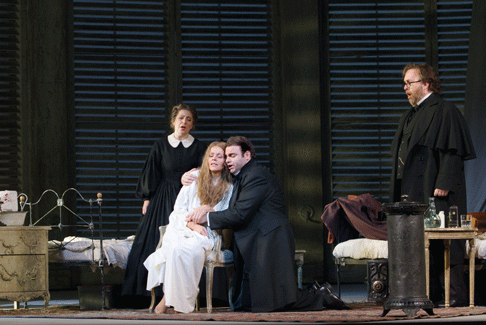 Scene from Act III — Sarah Pring as Annina, Renée Fleming as Violetta Valéry, Joseph Calleja as Alfredo Germont and Richard Wiegold as Doctor Grenvil
The catastrophic première of La Traviata at La Fenice in 1853 has entered the annals of infamous operatic disasters. During rehearsals, the librettist, Piave, had written to the Fenice management that the composer ‘insists with renewed firmness that to sing Traviata one must be young, have a graceful figure and sing with passion’. Fleming certainly ticks all the boxes. Her Violetta Valéry is neither angelic paragon of innocence or knowing schemer, but rather a high-spirited young woman of noble heart and pure soul whose self-contempt and fear of risking love win our sympathy and, ultimately, our tears and love.
Claire Seymour