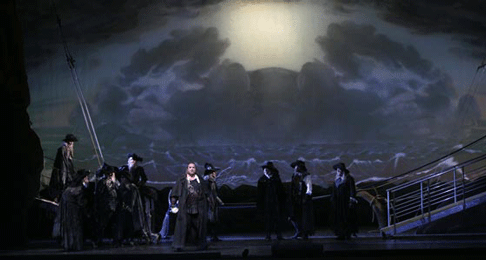
It all began very promisingly indeed with a realistic period setting,
gorgeously painted, and with luxurious Old Dutch Masters costumes, both designs
courtesy of Johannes Leiacker. I was not completely taken with the invention of
the mute character “An Angel” (Christina Polzin) who somewhat tailed the
leading man as a premonition of Senta, I guess, but never mind. Because, in a
stunning directorial stroke, Konwitschny set the second act ladies in a
gleaming white contemporary fitness center spinning class! No fooling, this
really worked. Mary was the attendant who circulated and dispensed water
bottles and towels.
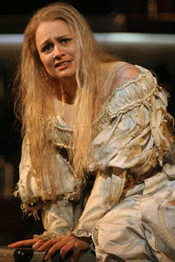 Erik entered in a white bathrobe and slippers (apparently having taken a
sauna) and it is hard to explain the rather carnal element that that visual
introduced into a scene that we usually simply suffer through. And when the
Dutchman arrived, completely anachronistic in his period Flemish drag, wow! Did
it ever hammer home the time warp he was trapped in, and the irrational
inevitability of Senta’s obsession. This was truly powerful theatre, heightened
by the fine lighting design with its isolated areas by Michael Bauer.
Erik entered in a white bathrobe and slippers (apparently having taken a
sauna) and it is hard to explain the rather carnal element that that visual
introduced into a scene that we usually simply suffer through. And when the
Dutchman arrived, completely anachronistic in his period Flemish drag, wow! Did
it ever hammer home the time warp he was trapped in, and the irrational
inevitability of Senta’s obsession. This was truly powerful theatre, heightened
by the fine lighting design with its isolated areas by Michael Bauer.
And then…Peter lost his way. The final act took place in a harbor-side
warehouse with Fest tables/benches, the Dutchman crew visibly partied stage
left, and lots of metal drums filled with flammable materials crowded the
stage. The face-off between the locals and the spooks, shorn of its element of
surprise, looked like a lame “Dance at the Gym” confrontation from West
Side Story. And in a critical artistic mis-step, after Senta’s last
outburst she torched one of the storage drums, and a huge explosion blew
everyone away. Everyone.
And…The…Music…Stopped.
Somewhere in the far distance, perhaps on a boom box in the ladies dressing
room, we faintly heard the final bars playing as the cast was revealed standing
down lit and ghostly behind a scrim. Dead as door nails. Or Dutchmen. In a box,
house left, a pained spectator yelled “For God’s sake, play the rest of the
music!” No one shushed him. He was articulating our collective grief.
It is inconceivable that the producers allowed Wagner’s opera to be shorn of
its soaring redemption at the expense of an ineffective and inappropriate
theatrical effect. Nor can I conceive that a Bernstein, or Karajan, or Maazel,
or Barenboim would have allowed this musical cut to happen.
Apparently, young (talented) conductor Cornelius Meister did not have such
leverage. Maestro Meister is the youngest General Music Director in Germany
(Heidelberg) and his star is justifiably rising. Much of his leadership was
richly incisive, with well-judged tempi and fine consideration of his singers.
But it has to be said that the tricky ensemble woodwind attacci were a might
ragged, and the brass were too many times perfunctory. The string section
however, had a fantastic night characterized by warm and accurate tutti
playing.
Even a willful re-writing of the story by a bad boy stage director, however,
could not steal the focus from the brilliance of Bryn Terfel’s assumption of
the title role. Surely this is one of the most glorious vocal instruments
currently to be heard in the lyric theatre. From his first intense sotto voce
utterance, Mr. Terfel served notice that his Dutchman was more resigned than
tortured, more refined than bombastic, more rounded and musical by miles than
most park-and-bark Wagnerian practitioners.
That rolling, richly burnished tone poured out with ease and power, and his
acting was subtle and noble. His great duet with Senta was as tender and
persuasive as I have yet experienced, and his stamina and sound technique found
him sounding as fresh at opera’s end as at the start. Richly colored, finely
detailed, superbly shaped phrases characterized Terfel’s tremendous
musicianship, and they were wedded to an easy, engaging stage presence. If we
are ever searching for members of A New Golden Age (and aren’t we always?), we
can start with Bryn Terfel.
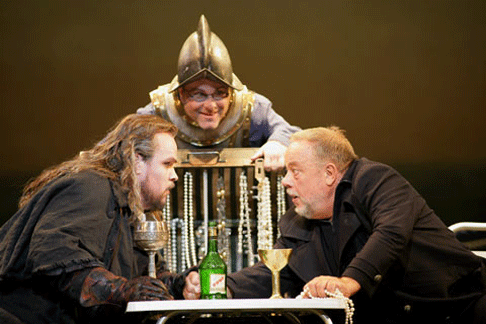
He was not alone in his success. Anje Kampe served up a radiant and vocally
generous Senta, building on her already fine reputation as a Sieglinde of
choice. While ample in volume, and secure in all ranges and volumes, the voice
is just a bit drier than, say, Hildegard Behrens, a great Senta of the recent
past. Still, her restrained vibrato made Ms. Kampe’s impersonation more
youthful than womanly, and that certainly was a rewarding take. Her acting was
passionately committed.
Nikolai Schukoff was a very fine Erik, with plenty of thrust to his
substantial, essentially lyric tenor, and a handsome and youthful stage
presence. There were plenty of sparks between him and our doomed heroine. I
first saw Matti Salminen’s seasoned Daland in Savonlinna some years ago and his
definitive performance has only deepened over time, with very little
perceptible loss in vocal allure or power. Julia Oesch contributed a handsome,
securely sung Mary. Kevin Conners seems to be a local favorite, but I found his
stentorian Steersman a bit longer on power than finesse. The hard-working
chorus performed well under the direction of Andrés Máspero.
Can this Dutchman yet be saved? Restoring the finale Wagner wrote
would be a good start. Seriously, a musically and dramatically honest re-look
of Act Three could transform this otherwise inventive and rewarding production
into a memorable one.
James Sohre
![A scene from Der fliegende Holländer [Photo courtesy of Bayerische Staatsoper]](http://www.operatoday.com/Dutchman_Munich04.gif)