24 Jun 2009
Saint Louis: Reliably Excellent
It is quite possible that Opera Theatre of Saint Louis is the leading summer opera destination in the United States.
English Touring Opera are delighted to announce a season of lyric monodramas to tour nationally from October to December. The season features music for solo singer and piano by Argento, Britten, Tippett and Shostakovich with a bold and inventive approach to making opera during social distancing.
This tenth of ten Live from London concerts was in fact a recorded live performance from California. It was no less enjoyable for that, and it was also uplifting to learn that this wasn’t in fact the ‘last’ LfL event that we will be able to enjoy, courtesy of VOCES8 and their fellow vocal ensembles (more below …).
Ever since Wigmore Hall announced their superb series of autumn concerts, all streamed live and available free of charge, I’d been looking forward to this song recital by Ian Bostridge and Imogen Cooper.
The Sixteen continues its exploration of Henry Purcell’s Welcome Songs for Charles II. As with Robert King’s pioneering Purcell series begun over thirty years ago for Hyperion, Harry Christophers is recording two Welcome Songs per disc.
Although Stile Antico’s programme article for their Live from London recital introduced their selection from the many treasures of the English Renaissance in the context of the theological debates and upheavals of the Tudor and Elizabethan years, their performance was more evocative of private chamber music than of public liturgy.
In February this year, Albanian soprano Ermonela Jaho made a highly lauded debut recital at Wigmore Hall - a concert which both celebrated Opera Rara’s 50th anniversary and honoured the career of the Italian soprano Rosina Storchio (1872-1945), the star of verismo who created the title roles in Leoncavallo’s La bohème and Zazà, Mascagni’s Lodoletta and Puccini’s Madama Butterfly.
Evidently, face masks don’t stifle appreciative “Bravo!”s. And, reducing audience numbers doesn’t lower the volume of such acclamations. For, the audience at Wigmore Hall gave soprano Elizabeth Llewellyn and pianist Simon Lepper a greatly deserved warm reception and hearty response following this lunchtime recital of late-Romantic song.
Collapsology. Or, perhaps we should use the French word ‘Collapsologie’ because this is a transdisciplinary idea pretty much advocated by a series of French theorists - and apparently, mostly French theorists. It in essence focuses on the imminent collapse of modern society and all its layers - a series of escalating crises on a global scale: environmental, economic, geopolitical, governmental; the list is extensive.
For this week’s Live from London vocal recital we moved from the home of VOCES8, St Anne and St Agnes in the City of London, to Kings Place, where The Sixteen - who have been associate artists at the venue for some time - presented a programme of music and words bound together by the theme of ‘reflection’.
'Such is your divine Disposation that both you excellently understand, and royally entertaine the Exercise of Musicke.’
Amongst an avalanche of new Mahler recordings appearing at the moment (Das Lied von der Erde seems to be the most favoured, with three) this 1991 Mahler Second from the 2nd Kassel MahlerFest is one of the more interesting releases.
‘And there was war in heaven: Michael and his angels fought against the dragon; and the dragon fought and his angels, And prevailed not; neither was their place found any more in heaven … that old serpent … Satan, which deceiveth the whole world: he was cast out into the earth, and his angels were cast out with him.’
If there is one myth, it seems believed by some people today, that probably needs shattering it is that post-war recordings or performances of Wagner operas were always of exceptional quality. This 1949 Hamburg Tristan und Isolde is one of those recordings - though quite who is to blame for its many problems takes quite some unearthing.
There was never any doubt that the fifth of the twelve Met Stars Live in Concert broadcasts was going to be a palpably intense and vivid event, as well as a musically stunning and theatrically enervating experience.
‘Love’ was the theme for this Live from London performance by Apollo5. Given the complexity and diversity of that human emotion, and Apollo5’s reputation for versatility and diverse repertoire, ranging from Renaissance choral music to jazz, from contemporary classical works to popular song, it was no surprise that their programme spanned 500 years and several musical styles.
The Academy of St Martin in the Fields have titled their autumn series of eight concerts - which are taking place at 5pm and 7.30pm on two Saturdays each month at their home venue in Trafalgar Square, and being filmed for streaming the following Thursday - ‘re:connect’.
The London Symphony Orchestra opened their Autumn 2020 season with a homage to Oliver Knussen, who died at the age of 66 in July 2018. The programme traced a national musical lineage through the twentieth century, from Britten to Knussen, on to Mark-Anthony Turnage, and entwining the LSO and Rattle too.
With the Live from London digital vocal festival entering the second half of the series, the festival’s host, VOCES8, returned to their home at St Annes and St Agnes in the City of London to present a sequence of ‘Choral Dances’ - vocal music inspired by dance, embracing diverse genres from the Renaissance madrigal to swing jazz.
Just a few unison string wriggles from the opening of Mozart’s overture to Le nozze di Figaro are enough to make any opera-lover perch on the edge of their seat, in excited anticipation of the drama in music to come, so there could be no other curtain-raiser for this Gala Concert at the Royal Opera House, the latest instalment from ‘their House’ to ‘our houses’.
"Before the ending of the day, creator of all things, we pray that, with your accustomed mercy, you may watch over us."
It is quite possible that Opera Theatre of Saint Louis is the leading summer opera destination in the United States.
There. I said it. Let the Glimmerglasswegians and the Santa Fesions rail and fuss, but OTSL has really got the whole package together: top quality musical offerings, exciting young singers well on the road to major careers, well-considered theatrical stagings that rival any major house (any), and an extra-musical ambiance that is just about unbeatable. Approaching the house through the lawn area profuse with candle-lit tables, free to any pre-show picnickers who care to use them, and being able to stay after the show to party, applaud, and mingle with the artists in the large Fest tent, well, it is sort of Glyndebourne without the ‘tude.
Add to the mix the fact that this troupe has consistently performed their repertoire in English, in a small house that fosters great immediacy of the theatrical experience, at competitive prices, and, good God, it is 'popular' opera! (Even when the title is not of the bread-and-butter variety). True, the Loretto Hilton lobby is cramped on SRO evenings but. . .there is always a stroll available on that candle-dotted lawn.
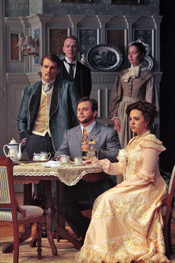
My recent visit found this resourceful company in its usual fine artistic form, beginning with as enchanting a production as I imagine possible of Mozart’s Il Re Pastore (The Shepherd King).
Wolfgang’s youthful (he was nineteen) work is set to a much-used libretto by Metastasio, and is of the formulaic opera seria vintage. You know, the kind that can be dead boring no matter how well it is performed. Not so here, thanks to a wholly winning, and dramatically truthful production directed by Chas Rader-Shieber.
For Mr. R-S has imagined it as a sort of Upstairs Downstairs episode with high notes, set in an English country house in a prior century, where a wealthy young woman and her fiance are hosting another well-to-do couple for a visit. After perusing the actual score of Re in this setting, our heroine becomes committed to the group’s enacting the story as the day’s entertainment, assigning roles to not only the other society figures, but also to the bustling servants.
This giddy, play-acting atmosphere yielded impressive results, not only in filling the story with meaningful (and not distracting) stage business, but also allowing for emotional honesty and invention in the many (usually) static set pieces of this genre. It did not hurt that David Zinn’s set was one of the most beautiful I can recall on this St. Louis stage, impeccably dressed. Nor that Robert Perziola’s classy costumes spoke volumes in defining the character relationships, and clarifying plot absurdities, including one drop-dead-gorgeous beaded gown for “Arminta.”
But all this technical brilliance would have been for naught without a top notch cast, and this, too, OTSL delivered in spades. The Gerdine Young Artists development program is a model of its kind, and this investment obviously pays off handsomely as four of the five soloists are former participants.
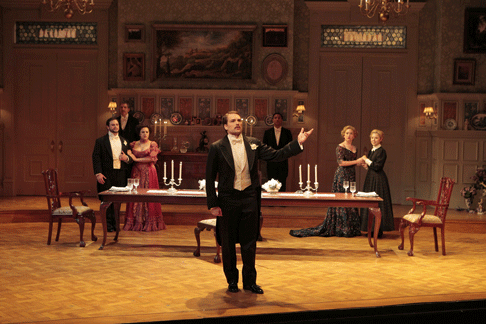 L to R (foreground): Paul Appleby as Agenore, Daniela Mak as Tamiri, Alek Shrader as Alexander, Heidi Stober as Aminta, and Maureen McKay as Elisa in Il Re Pastore
Heidi Stober was radiant as the young affianced woman who is compelled to impersonate the Shepherd King Arminta and enact his plight. Her ample, well-schooled, warm lyric soprano blossomed especially above the staff, and her stage demeanor served up a generous helping of star-quality. Miss Stober was well partnered by her “betrothed,” the tenor Alek Schrader, pressed into duty to play the emperor Alexander. Mr. Schrader has an exceptionally pleasing Mozartean timbre, and his bravura rapid-fire melismatic phrases were heart-racingly delivered.
My favorable impression of Maureen McKay in last summer’s Un Cosa Rara was here confirmed with a securely sung Elisa, a maid who briefly enjoys enacting the longings of a noblewoman. Miss KcKay is capable of regaling us with accurate cascades of fioritura, likewise deploying her crystal clear tone in melting legato phrases. Her spunky stage savvy is equally bewitching. Paul Appleby has fewer fireworks to negotiate in the role of Agenore (advisor to Alexander, in love with Tamiri), but he sang with style and panache. As Tamiri, Daniela Mack complemented her cast mates with her slightly darker rich tone and attention to every musical detail. All five offered fine English diction, coached on this occasion by soprano Erie Mills.
In the pit, conductor Jean-Marie Zeitouni discovered all the youthful spirit and buoyant lyrical possibilities in the score (after a bit of a slack rhythmic start in the first few bars), and there was wonderful solo instrumental work as well throughout the evening. His conscientious partnering of the singers seemed to free them to soar through this youthful-but-challenging work.
The baton was successfully passed the very next night to another conductor whose stock is rising, Michael Christie, who helmed a musically rich reading of The Ghosts of Versailles, by John Corigliano, libretto by William M. Hoffman. After a sensational debut at the Metropolitan Opera in the early 90’s which was followed by several other revivals in major houses, Ghosts languished, largely (it is believed) owing to the lavish original designs, and massive instrumental and vocal forces required.
At St. Louis, the production team and composer have sought to down-size the piece to make it more accessible to smaller opera companies. As evidenced here, they have been largely successful in their attempt. Corigiliano is a brilliant orchestrator, and his original score took full advantage of the huge pit and full band of the Met. Here, Ghosts was re-scored in a new performing edition commissioned by OTSL and executed by John David Earnest. It was quite a successful trade-off, and much variety and color remained, many times (favorably) suggesting the smaller scores of Benjamin Britten. While the instrumental presence was almost always ample, there were a few climactic moments that seemed a mite under-powered, not least of which was the very final sting of Act One. These minor quibbles aside, this was a very fine re-working of the piece, that retained its musical integrity.
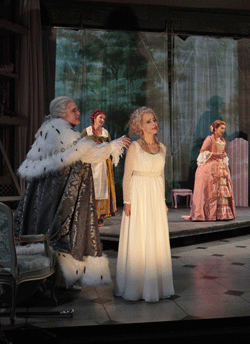 Kevin J. Glavin as Louis XVI and Maria Kanyova as Marie Antoinette with (at rear l. to r.) Dorothy Byrne as Susanna and Hanan Alattar as Rosina in The Ghosts of Versaille
We were equally fortunate with the physical production, directed by James Robinson, with sets by Allen Moyer, costumes by James Schuette, and most important, highly evocative video projections by Wendall K. Harrington. As we entered the auditorium, we discovered the theatre at Versailles, on stage, being refurbished by a contemporary restoration crew in blue jump suits. That image segued into the arrival of the ghosts, attired in lavish period costumes, and superb wigs/make-up by Tom Watson (a company treasure, he). The first notes of the score sounded, sans the usual conductor’s entrance, and the lighting melded into disorienting video work that transported us to the deserted stage of long ago, “beyond time” as the program noted. It should be said that Paul Palazzo provided the uncommonly fine lighting designs for both evening’s performances.
One element of the work that resisted diminution was the large cast demand. It took a village to get this work up, and there was great depth in the entire cast largely thanks (again) to the company’s young artists, who also formed the chorus under Sandra Horst’s direction. I did find that the dancers contributed less to the overall dramatic experience than they might have, and elimination of the dance corps might be a possible further cut-back. The stage got crowded at times, although Mr. Robinson not only managed the traffic well, but focused the important dramatic moments and developed believable characters and strong relationships.
Without creating a laundry list, it is hard to single out all who were excellent in this large ensemble cast. Certainly expectations were high for Maria Kanyova (another former apprentice) as Marie Antoinette, and she did not disappoint. Ms. Kanyova has a responsive soprano, with a hint of metal that stands her in good stead in dramatic segments, but she can also scale her voice down to float effective pianissimi that veritably float above the staff. She was a worthy successor to the great Teresa Stratas who created the role. Christopher Feigum was suitably winning as Figaro, although in his first big aria all the acting seemed to be external. The internal spark of creation crept in sometime during his (quite funny) Act One finale drag moments as the harem girl and he remained fully engaged for the rest of night. His pliant, smooth baritone gave considerable pleasure and he is a talent to watch.
Mr. Corigliano apparently loves his baritones and he created a fine complementary foil in Beaumarchais, well-taken on this occasion by James Weston. As should be, Mr. Weston has a little more maturity of tone and the bronze patina of his upper register contributed to a very effective contrast. His love for the doomed heroine was wonderfully embodied and his alternately witty and sensitive delivery enabled a well-rounded character to emerge.
As stage characters in the concurrent Figaro comedy, a jewel of an ensemble worked tightly together in a slightly heightened play-acting style. Samuel Read Levine (Leon), Paula Murrihy (Cherubino), Sean Panikkar (Almaviva) were all terrific, with young artist Jeanette Vechhione capturing the most applause for her technically secure stratospheric singing as Florestine. Hanan Alattar and Dorothy Byrne were exquisite in their limpid lyrical outpouring of the extended Act Two duet for Rosina and Susanna, a musical high point.
The real-time bad guys were equally well-served by Lee Gregory, a vocally assured and physically active (and fearless) Wilhelm, and by stentorian, tireless tenor (and fine character actor) Matthew DiBattista as Begearss. Elizabeth Batton did everything possible to amuse us in her star turn as Samira. Originally created for the particular gifts of Marilyn Horne, Ms. Batton made it her own with plummy tone, a well-modulated chest voice, and sound technique in the middle and (ringing) upper reaches. Quite a comedian, she wisely eschewed the baritonal power of Ms. Horne for an equally successful and personalized performance.
If I had to mention only three more performers, I would include the characterful Louis XVI from Kevin J. Glavin, the firm-voiced Marquis of Kevin Park, and the delightful Woman with Hat sung by Erin Holland.
Upon re-visiting The Ghosts of Versailles I still found it a particularly well-calculated mix of old and new styles, in turn challenging and comfortable, telling a dramatically satisfying and captivating story of fate and acceptance. If I still feel that the arias go on a bit longer than needed to make their musical or dramatic point, they never become uninteresting, especially in the hands of such a capable roster of performers.
This production will go on to fall’s Wexford Festival, and it alone would make it worth the trip to Ireland. It deserves many more performances.
James Sohre