With the characters afflicted by ‘anvil-hammer
headaches’, scarlet fever and debilitating foot cramps, we were reminded
that Bartolo is in fact an ‘esteemed’ doctor and that Figaro lists
‘surgeon’ as one of his skills. Indeed, it seemed that Bartolo was
right when he complained that Figaro was turning ‘this house into a
hospital’ — not least because the prima donna, Rosina, was
wheelchair-bound throughout.
This was not, however, a quirky directorial whim of the kind that
21st-century audiences have become all too familiar with. There cannot be many
Rosinas who would willingly elect to tackle the substantial challenges of the
role from this confining position, but there was little choice for the American
mezzo-soprano, Joyce DiDonato who, having continued valiantly after slipping on
the opening night, subsequently discovered that she had in fact fractured her
fibia. Forbidden to put any weight on her plaster-encased leg, DiDonato must
have been in considerable discomfort, if not pain, and the audience
whole-heartedly appreciated her determination to continue in the role,
welcoming her first stage entry with a rapturous outburst of grateful
applause.
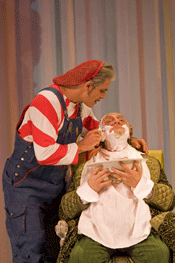 Pietro Spagnoli as Figaro and Alessandro Corbelli as Doctor Bartolo
If she was physically incapacitated, DiDonato was in no way vocally,
musically or dramatically hampered. This was an outstanding - and given the
circumstances, astonishing — performance. Capricious and independent
throughout, she overcame the physical restrictions imposed on her, offering a
consummate display of coloratura singing and acting with panache and verve.
DiDonata’s technical mastery is accompanied by innate musicality and
powers of communication: she manages to make Rossini’s idiosyncratic
twists, leaps, stutters and dynamic dips sound both effortless — in
‘Dunque io son’ she dazzled with a thrilling sparkle of a trill
— and genuine.
Paradoxically, she used her injury to superb dramatic effect. Trapped both
figuratively and literally, DiDonato presented a poignant picture of innocent
vulnerability, threatened by a domineering tyrant; but simultaneously she
twisted, pouted, whizzed from left to right, swung her undamaged legs and
flailed her arms, allowing the petulance and feistiness of the
‘real’ Rosina to shine through.
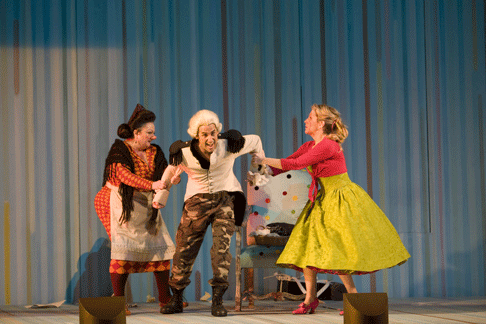 Jennifer Rhys-Davies as Berta, Juan Diego Flórez as Count Almaviva and Joyce Didonato as Rosina
DiDonato was partnered by a fine cast of principals. From the moment he
leapt onto the stage with a knowing nod and grin, after striding masterfully
through the surprised audience, Pietro Spagnoli’s Figaro held the
attention of all. This was a Figaro of enterprise, boundless energy and
optimism, and the sprightliness of Spagnoli’s stage presence was matched
by the vigour and meatiness of his singing. He relished the tongue-twisting
patter and demonstrated a rich, deep warmth when offering a supporting shoulder
to the pair of thwarted lovers. Standing in for Simon Keenlyside, this was
Spagnoli’s Covent Garden debut — and on this evidence he should be
back soon.
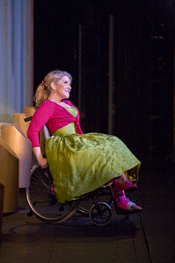 Joyce DiDonato as Rosina [Photo by Neil Gillespie courtesy of The Royal Opera House]
One pities Colin Lee, sharing the role of Count Almaviva with no less a
stellar light than Juan Diego Flórez, whose effortless dispatch of the fiendish
coloratura in the closing scene nearly brought the house to a
standstill on the opening night of the run. Understandably perhaps, Lee seemed
nervous at the start, as he strove to over-colour the words in his opening
‘Ecco ridente’, worthily emphasising the pain of unrequited love
but producing an ugly, strained timbre in the process. Fortunately he became
progressively more relaxed, and a legato tenderness and more subtlety
of tone characterised his performance subsequently. More comfortable with his
disguise as the spineless music teacher, Alonso, than as the drunken soldier
who blunders his way into Bartolo’s house, in Act 2 Lee settled into the
role, and in ‘Cessa di piu resistere’ he demonstrated a beautiful
tenore di grazia, lightly presenting the vocal flourishes and singing
with a joyful delicacy at the top of his register, with no sense of strain.
He was often criticised for creating emotionless characters, and it is true
that many of Rossini’s principal roles here are simply caricatures.
Nevertheless, Alessandro Corbelli warmed up nicely as the egotistical,
domineering Dr Bartolo, producing some wonderful comic timing. His acting
prowess was matched by Feruccio Furlanetto, as the unctuous, despicable
Basilio. Furlanetto’s massive bass resonated with menace and evil intent.
Indeed, in his calumny aria, he so revelled in the salacious, almost
hysterical, delight he gained from his plans to slander Almaviva, that he came
a little adrift from Pappano’s tempo, in one of the rare moments of shaky
ensemble between stage and pit.
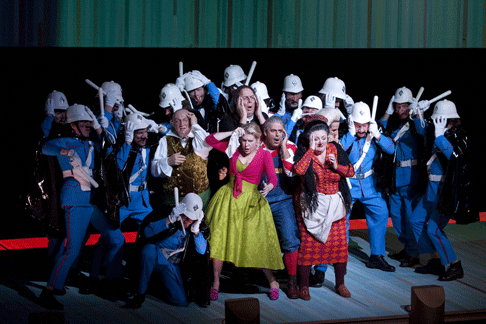 Alessandro Corbelli as Doctor Bartolo, Joyce Didonato as Rosina, Pietro Spagnoli as Figaro, Jennifer Rhys-Davies as Berta, (Back Row) Ferruccio Furlanetto as Don Basilio, and The Royal Opera Chorus as Police
The smaller roles were also strongly cast. Jennifer Rhys-Davies presented a
well-conceived Berta, singing with a verve and confidence which were equalled
by Korean baritone, Changhan Lim, a Jette Young Artist, who showed much promise
as Fiorello.
It was a minor flaw of this starry production that occasionally the zany
design of this revival of Moshe Leiser and Patrice Caurier’s wacky 2005
staging (with slight adaptations to accommodate DiDonato’s new mode of
locomotion) threatened to upstage the singing. Leiser and Caurier’s
long-term collaborators, Christian Fenouillat and Agostino Cavalca did not fail
to exaggerate every comic moment. The pastel-box set with its web of sliding
panels, trap doors and concealed windows certainly conveyed Rosina’s
entrapment, but the garish, postmodern lines and dots and pantomimesque
costumes — the nadir was reached when the police arrived sporting white,
plastic helmets and black PVC capes — were cheap and nasty. The closing
picture of red, heart-shaped balloons floating aloft was pure Eurotrash.
This is an undoubtedly funny production, but the directors over-play
Rossini’s subtle side-swipes at theatricality and operatic conventions.
In particular, the end of Act 1 was distinctly bewildering: the stage tilted
and rocked from side to side, escape routes disappeared, as the ‘dazed
and confused’ cast clutched their heads in uniform agony. Even Pappano,
elsewhere so sure and in command at the podium or harpsichord, struggled to
maintain the dramatic and musical momentum as the entire cast wobbled and
staggered like a ship in danger of sinking.
Fortunately Antonio Pappano ensured that Rossini’s music retained
prime position. From the crisp rhythms and tight runs of the overture, it was
clear that the ROH band were once again on sparkling form. Pappano coaxed fresh
colours from this well-known score and reinvigorated familiar rhythms with
spontaneity. This operatic ‘old friend’ can certainly still
astonish and impress.
Claire Seymour
![Joyce DiDonato as Rosina [Photo by Bill Cooper courtesy of The Royal Opera House]](http://www.operatoday.com/BC200907010061.gif)