Subscribe to
Opera Today

Receive articles and news via RSS feeds or email subscription.


twitter_logo[1].gif


UCP_9780226043425.gif

Recently in Reviews

Wozzeck at ENO

“Man is an abyss. It makes one dizzy to look into it.” So utters Georg Büchner’s Woyzeck, repeating what was also a recurring motif in the playwright’s own letters.

Mulhouse: Rare Britten Well Done

National Opera Company of the Rhine has marked this year’s Benjamin Britten celebration with a remarkably compelling, often gripping new production of the seldom-seen Owen Wingrave.

Frankfurt's Intriguing Idomeneo

Once upon a time, Frankfurt Opera had the baddest ass reputation in Germany as “the” cutting edge producer of must-see opera.

Rigoletto at Lyric Opera of Chicago

Productions of Giuseppe Verdi’s Rigoletto can serve as a vehicle for individual singers to make a strong impression and become afterward associated with specific roles in the opera.

Britten Sinfonia with Ian Bostridge

Just in case we were not aware that the evening’s programme was ‘themed’, the Britten Sinfonia designed a visual accompaniment to their musical exploration of night, sleep and dreams.

Aida, Manitoba Opera

Poor Aida! She never seems to have anything go her way.

Superlative singing: Don Carlo, Royal Opera House

Is it possible to upstage Jonas Kaufmann? Kaufmann was brilliant in this Verdi Don Carlo at the Royal Opera House, London, but the rest of the cast was so good that he was but first among equals. Don Carlo is a vehicle for stars, but this time the stars were everyone on stage and in the pit. Even the solo arias, glorious as they are, grow organically out of perfect ensemble. This was a performance that brought out the true beauty of Verdi's music.

Sarah Connolly: French Song at Wigmore Hall

The big names were absent: Duparc, D’Indy, Debussy, Ravel … and while Fauré, Chausson, Roussel and several members of Les Six put in an appearance, in less than familiar guises, this survey of French song of the early 20th century and interwar years deliberately took us on a journey through infrequently travelled terrain.

Rare restoration: Handel’s Esther 1720

Composed between 1718 and 1720, Handel’s Esther is sometimes described as the ‘first English Oratorio’, but is in fact a hybrid form, mixing elements of oratorio, masque, pastoral and opera.

The Damnation of Faust, London

Hector Berlioz's légende dramatique, La Damnation de Faust, exists somewhere between cantata and opera. Berlioz's flexible attitude to dramatic form made the piece unworkable on the stages of early 19th century Paris and his music is so vivid that you wonder whether the piece needs staging at all.

Elizabeth Connell Memorial Concert, St John's Smith Square

St. John’s Smith Square was the site of Elizabeth Connell’s final London concert, intended as a farewell to London on her moving to Australia. It was rendered ultimately final by her unexpected death.

Aida with all the Trimmings, Even a Blue Silk Elephant!

With the building of the Suez Canal, Egypt became more interesting to Western Europeans. Khedive Ismail Pasha wanted a hymn by Verdi for the opening of a new opera house in Cairo, but the composer said he did not write occasional pieces.

Die Zauberflöte, Royal Opera

Back for its fourth revival, David McVicar’s 2003 production of Mozart’s Die Zauberflöte has much charm, beauty and artistry.

Kaufmann Wagner

The economics of the recording companies dictate much that is not ideal. Wagner’s operas were not composed as they were in order to permit the extraction of bleeding chunks, even on those occasions when strophic song forms do occur.

The Marriage of Figaro Ends Season at Arizona Opera

Wolfgang Amadeus Mozart's opera The Marriage of Figaro has a libretto by Lorenzo daPonte based on the French play La folle journée, ou le Mariage de Figaro (The Crazy Day or the Marriage of Figaro) by Pierre Caron de Beaumarchais (1732-1799).

Baden’s Flute Goes Barefoot in the Park

For its world class Easter Festival, Baden-Baden mounted a Die Zauberflöte that owed more to the grey penitential doldrums of Lent than to the unbridled jubilance of re-birth.

Bonjour M. Gauguin in Berkeley

Once Berkeley Opera, renamed West Edge Opera, this enterprising company offers the Bay Area’s only serious alternative to corporate opera, to wit Bonjour M. Gauguin.

Mahler Lieder, Wigmore Hall

In the first of pianist Julius Drake’s three-part series, ‘Perspectives’, our gaze was directed at Gustav Mahler’s eclectic musical responses to human experiences: from the trauma and distress of anguished love to the sweet contentment of true friendship, from the agonised introspection of the artist to the diverse dramas of human interaction.

Cinderella Goes to the Opera

The Los Angeles opera company marketed its spring production of Rossini's La Cenerentola as Cinderella though there is no opera by that name. The libretto of La Cenerentola is not the Cinderella story we know.

Die Walküre, Paris

The Paris Opéra has not staged a full Ring Cycle since 1957, but its current season will conclude with a correction of this grand operatic gap.

OPERA TODAY ARCHIVES »

Reviews

Laquita Mitchell (Bess) and Eric Owens (Porgy) [Photo by Terrence McCarthy courtesy of San Francisco Opera]
03 Jul 2009

Porgy and Bess in San Francisco

For Americans of older generations Porgy and Bess is surely a primal experience, formed by the 1959 Otto Preminger film with Sammy Davis Jr. as Sportin’ Life, the audio recording derived from the 1952 London production with Leontyne Price as Bess, and a first encounter with Porgy and Bess as an opera in the artistically satisfying, and well traveled 1976 Houston production (was it twenty-five performances in the War Memorial Opera House?).

George Gershwin: Porgy and Bess

Click here for casting and other production information

Above: Laquita Mitchell (Bess) and Eric Owens (Porgy) [Photo by Terrence McCarthy courtesy of San Francisco Opera]


Maybe even some Americans were lucky enough to see the 1986 Glyndebourne production or its 1993 televised version, fabled as the best Porgy ever. Thus, with some help from its several Broadway-type attempts, the Gershwin Porgy has become a sing-along — we know every word and every note.

The San Francisco performances are a reprise of the 2005 Washington Opera production directed by Francesca Zambello, a production that has recently stopped off at the operas of Los Angeles and Chicago as well. Ms. Zambello is a noted director of large-scale opera, the Ring currently underway at the San Francisco and Washington operas, and War and Peace at the Seattle and Metropolitan operas, Billy Budd at Covent Garden as examples.

Mounting a Porgy is no small task, it has a huge cast, nine principal singers, sixteen named and solo roles that derive from an ensemble in San Francisco of forty-six [!] Black singers, not to mention three White speaking roles. Three (or more) fight scenes must be staged, plus three (or more) production numbers must be choreographed. It is scored for a full symphony orchestra that wails with the sonic abandon of big band. Can Porgy be crushed under its own weight?

The answer is an emphatic yes! Putting Porgy in the charge of a big time opera director, albeit a theatrically and operatically savvy one, magnified its weight, as did the absolute top operatic quality of its protagonists and ensemble singers (do not say chorus) placed in the hands of John DeMain, the world’s most experienced Porgy conductor. And all this thrust onto a major American opera stage where it is in de facto competition with the sophisticated operas of Benjamin Britten (maybe its closest foreign relative), not to mention the verismo of Puccini.

The end result of all this operatic know how simply lays bare the weaknesses of this Gershwin masterpiece. It does not know if it is an opera of sorts or a Broadway musical, and there is simply too much of it. Its original four hours were mercifully reduced to three hours fifteen minutes in this production, however its original two intermissions were reduced to one, making each of the two parts nearly an hour and a half. One might have preferred the longer version, but in three parts, i.e. a second pit stop. It was a long haul.
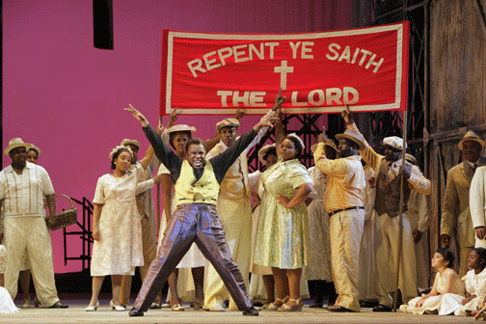
Porgy_SFO_2.gifChauncey Packer (Sportin’ Life) [Photo by Cory Weaver courtesy of San Francisco Opera]

The decision to unify its disparate stories and elements within the confines of a single unit set was a laudable, theatrically valid solution to objectify Gershwin’s well crafted dramatic structure, but it also brought visual boredom. The intimacy needed to make small scale, essentially jazz based vocals real was lost in the vast spaces of the omnipresent two level Catfish Row with a monumental warehouse door stage left (Jake’s fishing boat was pushed in and out from here as was the interior of Porgy’s hovel). Several extraordinary moments though stand out in this generally solid staging, the Kittiwah Island departure as one example, the hurricane, and particularly the moment when Bess, high on heroin is seduced by Sportin’ Life.

Strangely moving was the sense that Gershwin’s Blacks, the 1930’s Blacks, have become not only mainstream American culture but are fully realized performers of international musical arts, led in opera by some of our greatest Porgy interpreters, like Willard White (the Glyndebourne Porgy) and a host of others. The cast for the San Francisco production gave convincing if not definitive performances, led by the Porgy of baritone Eric Owens who bestowed elegant phrasing onto Gershwin’s lines. Laquita Mitchell gave a moving and real performance, vocally and physically, as Bess. Once past mourning Sammy Davis, Jr., Chauncey Packer delivered the goods as Sportin’ Life. We wanted more physical and sexual charisma from the Crown played by Lester Lynch, and in general more distinct personalities from the other principal singers as well.

The underpinnings of Porgy are humble. It is an intimate, uncomplicated story of love and lust in an ambience of poverty well known to operatic verismo, though in Porgy there are no issues, no complaint of injustice, no philosophic formulation of fate, and finally only desperate hope. It can be and is everyone’s story at distinct moments in human history. The challenge is to create an atmosphere for this humility in what is, pure and simple, an extravagant art form, and it was here that this production failed.

The copyright for this American operatic masterpiece (who cares if it has short comings, and is not really stage worthy, at least in this version) expires in 2012. The iron fist exercised by the Gershwin family over its productions will relax, the stiff royalty fees will no longer inhibit production, the insistence that its actors be black and that its locales be specific will no longer hold. Producers will be able to experiment with making this document of main-stream American culture (hardly Black-American culture) into viable theater.

Michael Milenski

Click here for a photo gallery of this production.

Send to a friend

Send a link to this article to a friend with an optional message.

Friend's Email Address: (required)

Your Email Address: (required)

Message (optional):