This strong season opened with a revival of Tim Ocel’s 2001 production of La Bohème. Puccini’s verismo masterpiece (seen on June 20) has become, as Ocel notes in the program, a ubiquitously recommended “first opera.” In fact, it does Ocel and his collaborators credit to state that I would not steer operatic initiates towards this Bohème. After all, who would introduce themselves to American cinema by watching a Robert Altman film? Ocel does such a wonderful job inspiring specific and beautiful performances from his entire cast that the simple story and famous melodies expand into an incredibly rich evening of theatre in which every shopgirl and supernumerary has a story. This is not a Bohème to be put on the kids’ menu. Rather, it is a production to be savoured.
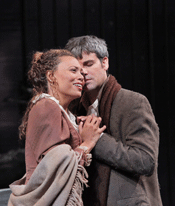 Alyson Cambridge as Mimi and Derek Taylor as Rodolfo [Photo by Ken Howard courtesy of Opera Theatre of Saint Louis]
Among the excellent ensemble cast, Alyson Cambridge was an extremely musical and insightful Mimi. Her radiant singing epitomized the transient beauty that Mimi herself represents; each note blossomed like the flowers opening in spring and it was absolutely charming to see a Mimi with a beautiful smile. When Mimi touches Rodolfo’s outstretched hand in the dark as they search for her key, Cambridge murmured a small “oh.” The simplicity and reality of the moment was perfect.
Derek Taylor, making his OTSL debut as Rodolfo, presented a less sympathetic but more realistic Bohemian than audiences may be accustomed to. In Act I, his Rodolfo’s youthful callowness justified the character’s later insecurity and possessiveness. The other Bohemians of the garret were each as strong individually as they were as an ensemble. Eugene Chan portrayed Schaunard as the baby of the group and a budding ladies’ man. Timothy Mix was strong as a Marcello with van Gogh’s coloring but, thankfully, not his temperament. Above all, Steven Humes as Colline stood out for the refinement in both his singing and acting. (Having also enjoyed Humes’ cameo as the Voice of the Pasha in The Ghosts of Versailles, I am currently of the opinion that even the most wonderful operas can be made even better by Humes’ presence onstage.)
Amanda Majeski’s Musetta sparkled in Act II, although the show-stopping quality associated with the character was lessened by the liveliness of Cambridge’s Mimi. In fact, Majeski and Cambridge represented the two young women as girls in very similar situations. Of all the cast, Majeski’s character arc (from her kittenish fit in Act II to her quiet spirituality in Act IV) most exemplified Ocel’s sentiment in his director’s notes — Bohemia isn’t a profession or a lifestyle. Rather, it is a period in a person’s life when the pipe dreams always outnumber the pennies until hunger or pain forces them to move on.
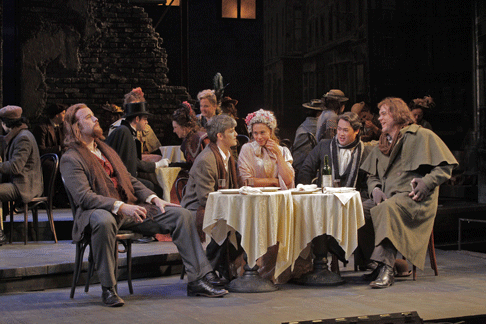 L to R: Timothy Mix as Marcello, Derek Taylor as Rodolfo, Alyson Cambridge as Mimi, Eugene Chan as Schaunard, and Steven Humes as Colline [Photo by Ken Howard courtesy of Opera Theatre of Saint Louis]
Judging by the fun he was having in the pit, conductor Ari Pelto could’ve been cast as a fifth Bohemian. There was a slight misstep when the marcia at the end of Act II dissolved into semi-chaos for a moment. Overall, though, the payoff in the orchestra and onstage was a Bohème to remember equally for its spirited and tender moments. The changes in the production, including the elimination of a large moon in Act I, improved upon the 2001 iteration by making everything less theatrical and more realistic. Robert Denton’s lighting design occasionally clashed with the rest of the naturalistic production. During Act III, despite it being a wintry dawn, strong silhouettes were thrown across the Parisian backdrop.
The Act I moon in Bohème might’ve disappeared, but it returned as part of Paul Pallazo’s stunning lighting design for Salome (seen on June 24). Along with set and costume designer Bruno Schwengl, Pallazo created an ingenious design in which the mesmeric moon was reflected onto the floor center stage and the eye was lead to the back wall. There, a circular opening acted as the entrance to the cistern which, when moved for the entrance of Jokanaan, had an effect like that of an oculus.
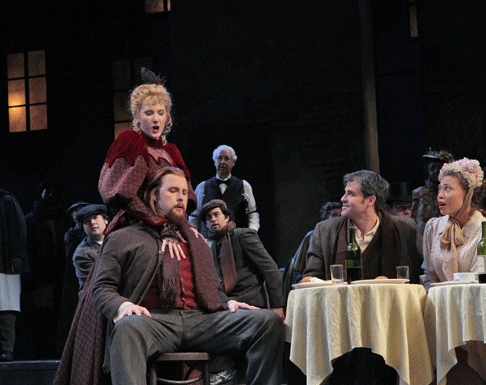 L to R: Amanda Majeski as Musetta, Timothy Mix as Marcello, Derek Taylor as Rodolfo, and Alyson Cambridge as Mimi [Photo by Ken Howard courtesy of Opera Theatre of Saint Louis]
Choreographer and director Seán Curran (assisted to some degree by dramaturg and “consulting director” James Robinson) used this semi-sterile environment as the playing space for Strauss’ fin-de-siècle psychodrama. As one would expect, the production included a ‘Dance of the Seven Veils’ par excellence. The dance was both realistically impromptu and well thought-out. Furthermore, the dance fit seamlessly into the modern-dress context of the production while also referencing the Biblical origins of the story. Each of the veils was used to unique and surprising effect, including one made of Latex. Palazzo’s lighting design became an intrinsic part of the choreography by multiplying shadows one moment and creating a seductive glow the next. The highest compliment I can pay is not to describe this ‘Dance of the Seven Veils’ in detail because its effect was transfixing and, ultimately, indescribable.
Of course, the success of the dance was largely due to Kelly Kaduce in the title role. She’s well known in St. Louis as a singing actress, but Kaduce’s Salome pushed the singer well into the realm of a triple threat. In a part that famously requires the singer to look 13 and sound 30, Kaduce fits the bill and would be an entirely believable Salome even in high-definition. Not only are her looks and singing thrilling, Kaduce’s acting reflects the psychology of Strauss’ score in captivating detail. In the moments after Jokanaan is put back into the cistern and before the party of Herod and Herodias enters, Kaduce sits downstage and transforms from a petulant teenager to a dangerous woman using only her face.
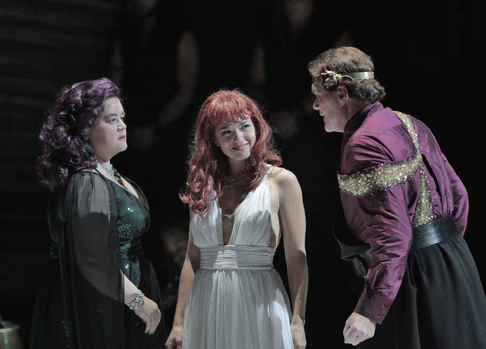 L to R: Maria Zifchak as Herodias, Kelly Kaduce as Salome, and Michael Hayes as Herod [Photo by Ken Howard courtesy of Opera Theatre of Saint Louis]
Stephen Lord conducted Kaduce and the rest of the cast with his usual panache and verve. The supporting cast acted and sang with style. As Narraboth, Eric Margiore brought level-10 intensity to his role from the moment the lights went up. Maria Zifchak was vocally compelling but she portrayed Herodias more as Herod’s wife than as Salome’s mother. In order to create real tension, it needs to be obvious that Herodias is the ultimate cougar and not a nagging housewife. Then, the instant Herod rips jewels off the mother’s neck and passes them to her own daughter, the Oedipal rivalry between the generations of women becomes shockingly apparent. Zifchak could’ve sung the part with more of the sex appeal obviously at her disposal. Tenor Michael Hayes was perhaps too desperate too soon as Herod. Remember, Herod is a bigwig, a mover and a shaker, as well as a pretty cagey guy. The audience needs to see him in control at first in order to fully register the change when his horror and paranoia “unman” him. Gregory Dahl looked perfect as Jokanaan and sounded nearly as good. Among the featured Gerdine Young Artists, Zach Borichevsky (as the Third Jew) sang particularly well.
Overall, this Salome was a gripping production included in a particularly strong season at OTSL. During this year of transition, OTSL may not have given its audiences the moon, but it definitely brought out some stars.
Alison Moritz
![Kelly Kaduce as Salome shown with the head of Jokanaan [Photo by Ken Howard courtesy of Opera Theatre of Saint Louis]](http://www.operatoday.com/Salome_Kaduce_OTSL.gif)