04 Jul 2009
The Ravenna Festival: La scuola napoletana
Ravenna once served as the capital of the Roman Empire in the 5th and 6th centuries C.E.
English Touring Opera are delighted to announce a season of lyric monodramas to tour nationally from October to December. The season features music for solo singer and piano by Argento, Britten, Tippett and Shostakovich with a bold and inventive approach to making opera during social distancing.
This tenth of ten Live from London concerts was in fact a recorded live performance from California. It was no less enjoyable for that, and it was also uplifting to learn that this wasn’t in fact the ‘last’ LfL event that we will be able to enjoy, courtesy of VOCES8 and their fellow vocal ensembles (more below …).
Ever since Wigmore Hall announced their superb series of autumn concerts, all streamed live and available free of charge, I’d been looking forward to this song recital by Ian Bostridge and Imogen Cooper.
The Sixteen continues its exploration of Henry Purcell’s Welcome Songs for Charles II. As with Robert King’s pioneering Purcell series begun over thirty years ago for Hyperion, Harry Christophers is recording two Welcome Songs per disc.
Although Stile Antico’s programme article for their Live from London recital introduced their selection from the many treasures of the English Renaissance in the context of the theological debates and upheavals of the Tudor and Elizabethan years, their performance was more evocative of private chamber music than of public liturgy.
In February this year, Albanian soprano Ermonela Jaho made a highly lauded debut recital at Wigmore Hall - a concert which both celebrated Opera Rara’s 50th anniversary and honoured the career of the Italian soprano Rosina Storchio (1872-1945), the star of verismo who created the title roles in Leoncavallo’s La bohème and Zazà, Mascagni’s Lodoletta and Puccini’s Madama Butterfly.
Evidently, face masks don’t stifle appreciative “Bravo!”s. And, reducing audience numbers doesn’t lower the volume of such acclamations. For, the audience at Wigmore Hall gave soprano Elizabeth Llewellyn and pianist Simon Lepper a greatly deserved warm reception and hearty response following this lunchtime recital of late-Romantic song.
Collapsology. Or, perhaps we should use the French word ‘Collapsologie’ because this is a transdisciplinary idea pretty much advocated by a series of French theorists - and apparently, mostly French theorists. It in essence focuses on the imminent collapse of modern society and all its layers - a series of escalating crises on a global scale: environmental, economic, geopolitical, governmental; the list is extensive.
For this week’s Live from London vocal recital we moved from the home of VOCES8, St Anne and St Agnes in the City of London, to Kings Place, where The Sixteen - who have been associate artists at the venue for some time - presented a programme of music and words bound together by the theme of ‘reflection’.
'Such is your divine Disposation that both you excellently understand, and royally entertaine the Exercise of Musicke.’
Amongst an avalanche of new Mahler recordings appearing at the moment (Das Lied von der Erde seems to be the most favoured, with three) this 1991 Mahler Second from the 2nd Kassel MahlerFest is one of the more interesting releases.
‘And there was war in heaven: Michael and his angels fought against the dragon; and the dragon fought and his angels, And prevailed not; neither was their place found any more in heaven … that old serpent … Satan, which deceiveth the whole world: he was cast out into the earth, and his angels were cast out with him.’
If there is one myth, it seems believed by some people today, that probably needs shattering it is that post-war recordings or performances of Wagner operas were always of exceptional quality. This 1949 Hamburg Tristan und Isolde is one of those recordings - though quite who is to blame for its many problems takes quite some unearthing.
There was never any doubt that the fifth of the twelve Met Stars Live in Concert broadcasts was going to be a palpably intense and vivid event, as well as a musically stunning and theatrically enervating experience.
‘Love’ was the theme for this Live from London performance by Apollo5. Given the complexity and diversity of that human emotion, and Apollo5’s reputation for versatility and diverse repertoire, ranging from Renaissance choral music to jazz, from contemporary classical works to popular song, it was no surprise that their programme spanned 500 years and several musical styles.
The Academy of St Martin in the Fields have titled their autumn series of eight concerts - which are taking place at 5pm and 7.30pm on two Saturdays each month at their home venue in Trafalgar Square, and being filmed for streaming the following Thursday - ‘re:connect’.
The London Symphony Orchestra opened their Autumn 2020 season with a homage to Oliver Knussen, who died at the age of 66 in July 2018. The programme traced a national musical lineage through the twentieth century, from Britten to Knussen, on to Mark-Anthony Turnage, and entwining the LSO and Rattle too.
With the Live from London digital vocal festival entering the second half of the series, the festival’s host, VOCES8, returned to their home at St Annes and St Agnes in the City of London to present a sequence of ‘Choral Dances’ - vocal music inspired by dance, embracing diverse genres from the Renaissance madrigal to swing jazz.
Just a few unison string wriggles from the opening of Mozart’s overture to Le nozze di Figaro are enough to make any opera-lover perch on the edge of their seat, in excited anticipation of the drama in music to come, so there could be no other curtain-raiser for this Gala Concert at the Royal Opera House, the latest instalment from ‘their House’ to ‘our houses’.
"Before the ending of the day, creator of all things, we pray that, with your accustomed mercy, you may watch over us."
Ravenna once served as the capital of the Roman Empire in the 5th and 6th centuries C.E.
Now it is a lovely Adriatic seaside spot filled with remnants of the Roman and Byzantine Empires, along with fine museums, gold mosaics and many 17th century palaces. There is an elegant 19th century theatre as well as several other locations suited to musical and theatrical performances. For the last 20 years, Ravenna has had an important multi-disciplinary festival. This summer’s program (June 14-July18), includes 80 different events for an expected audience of 70,000 (approximately 25% of which are non-Italians). Its € 6 million budget is financed by a consortium of Italian central and local authorities and of private sponsors, along with box office receipts.
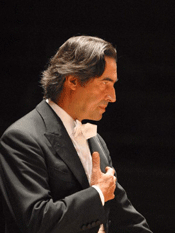
Riccardo Muti and his wife, Cristina, tirelessly promote the festival in part through international partnerships. In previous years, Ravenna has brought to the attention of Western European theatres jewels like the Moscow Helikon Opera and the Lithuanian National Opera. This year the main events are co-produced with the Salzburg Festival and the Paris Opéra. Other events will include the Maggio Musical Fiorentino. Internationally renowned Christoph von Dohànyi and Pierre Boulez are scheduled to conduct in addition to Muti.
This summer Maestro Muti continues to concentrate on his long-standing project concerning the “renaissance” of the La scuola napoletana (the “Neapolitan School”). In the 17th Century, Naples was not only the most populous capital in Europe but also the principal European music centre. There were important conservatories, each with a strict and disciplined course of studies. Music was on the top of the political agenda, with highly subsidized major theatres such as the San Carlo within the Royal Palace complex. Musicians (especially composers and castrati singers) were exported to all the Royal Courts of the continent with London and St. Petersburg being the most prodigious consumers. The Neapolitan Pietro Metastasio, official poet of the Vienna Court, became the most influential librettist of the age; and, through his librettos, Italian became the language spoken by the aristocracy in many a Court. [Editor’s Note: Click here for the full texts of Metastasio’s drammi per musica.]
The “Neapolitan School”, therefore, was fundamental in the development of musical theatre in general and of opera in particular. It faded away for several reasons: a) changes in tastes by a wider and no longer only aristocratic audience; b) the disappearance of the castrati (whose roles are often sung by mezzos or altos and, in certain cases, transposed for baritones); c) the high cost of stage sets and machinery.
Maestro Muti’s efforts to bring back the “Neapolitan School” have thus far succeeded. The Salzburg Whitsun Festival has been dedicated to this “School” for several years. This year he focuses his attention two composers: Giovanni Paisiello (actually born in Taranto but a leader of the School and a favorite of Russian Empress Katherine the Great) and Niccolò Jommelli (known in modern times mostly, if not solely, for his sacred music).
Jommelli’s Demofoonte had its revival in Salzburg in May of this year. It was then staged in Paris at the Opéra Garnier in mid-June. In Ravenna, it will be staged at the 800-seat Teatro Dante Alighieri on July 3-7. A European tour is planned for the fall. Demofoonte is one of Metastasio’s most popular libretti. It was set to music by 73 different composers, with Jommelli himself having composed four different versions (Muti is staging the last one). It is a “clemency tale” (e.g. like Mozart’s Titus) where the main plot simply consists of the king forgiving all his foes, albeit complicated by some five parallel sub-plots. The message is that royalty must be authoritarian because it is tolerant and forward-looking. In short, a benevolent despot is what we all need. Metastasio and Jommelli steered far away from any Revolutionary notions, lest they offend their aristocratic patrons.
Demofoonte follows all the rules and standards of the typical opera seria: vocally demanding arias, many of which are in the da capo form, along with the occasional duet and ensemble. And of course a happy ending after a series of adversities for all concerned. Cesare Lievi (stage direction), Margerita Palli (stage sets), Marina Luxardo (costumes) and, of course, Riccardo Muti conducting the Orchestra Giovanile Luigi Cherubini do their very best to attract a modern audience’s interest in this 3½-hour “clemency tale”. The cast is immaculate. Dmitri Korchack and Maria Grazia Schiavo are particularly commendable. It is easy to foresee that they have a brilliant future ahead. As for Jommelli’s Demofoonte, music schools should consider it insofar as it offers excellent training for young singers. Ultimately, it may reach some innovative opera house.
Paisiello’s Missa Defunctorum is also a rarity. Salzburg’s and Ravenna’s performances are practically the first performances in modern times (although some musicologists say that there is evidence of a performance in Florence in 1940 among the celebrations for the second centenary of the composer’s death). Paisiello is generally known as an opera buffa composer at the Courts of the Naples Kings , the Russian Empress and even Napoleon . The Missa Defunctorum was initially composed in 1789 when two children of the King of Naples died during a small pox epidemic. It was revised ten years later as a Requiem for Pius VI.
In the fall , the Missa Defunctorum will be toured by Muti and the Cherubini Orchestra in several Italian Churches and concert halls. In Ravenna, the performance took place in the Basilica of Sant’Apollinare in Classes— a site well known to Byzantine specialists for its gold and green mosaics.
Although a sacred musical work, Paisiello’s Missa Defunctorum has a strong operatic temperament. This requiem mass is quite different from those of Mozart, Verdi and others. It is a two-hour, one act opera where sorrow is mixed with hope. It is highly lyrical rather than dramatic. It is gentle, almost tender — like a late 18th century opéra larmoyant . The real drama is mostly at the end: the impressive chorale ‘Libera me’. The audience was enchanted; a good sign that Paisiello’s Missa Defunctorum may enter the repertory and may possibly be heard in Chicago where Muti is Music Director of the CSO.
Giuseppe Pennisi