Subscribe to
Opera Today

Receive articles and news via RSS feeds or email subscription.


twitter_logo[1].gif


UCP_9780226043425.gif

Recently in Reviews

Domingo Conducts Holdridge’s New Opera Dulce Rosa

Dulce Rosa, a brand new opera, had its world premiere Friday night, May 17, 2013 at the Broad Stage in Santa Monica, California. It was produced by Los Angeles Opera, but staged in the smaller theater.

Verdi’s Falstaff at Glyndebourne

Richard Jones’ 2009 production of Verdi’s Falstaff translates the action from the first Elizabethan age to the start of the second.

Gareth John, Wigmore Hall

Baritone Gareth John is rapidly accumulating a war-chest of honours. Winner of the 2013 Kathleen Ferrier Award, he recently won the Royal Academy of Music Patrons’ Award and was presented the Silver Medal by the Worshipful Company of Musicians.

La bohème at ENO

This second revival of Jonathan Miller’s La bohème was the first time I had caught the production.

Rolando Villazón: Verdi (International Opera Stars Series 2013)

It’s Verdi’s bicentenary year and Rolando Villazón has two new CDs to plug — titled somewhat confusingly, ‘Villazón: Verdi’ and ‘Villazón’s Verdi’, the latter a ‘personal selection’ of favourite numbers performed by stars of the past and present.

Brahms Third in San Francisco

Nicola Luisotti and the San Francisco Opera Orchestra climbed out of the War Memorial pit, braved the wind whipped bay and held spellbound an audience at Cal Performances’ Zellerbach Auditorium at UC Berkeley.

Ariane et Barbe-Bleue on Blu-Ray

Paul Dukas’ Ariane et Barbe-Bleue, first heard in 1907, once seemed important. Arturo Toscanini conducted the Met premiere in 1911 with Farrar and later arranged some of its music for a 1947 recording with his NBC Symphony.

Glyndebourne: Ariadne auf Naxos

Utterly mad but absolutely right — Richard Strauss’s Ariadne auf Naxos started the Glyndebourne 2013 season with an explosion. Strauss could hardly have made his intentions more clear. Ariadne auf Naxos is not “about” Greek myth so much as a satire on art and the way art is made.

Wozzeck at ENO

“Man is an abyss. It makes one dizzy to look into it.” So utters Georg Büchner’s Woyzeck, repeating what was also a recurring motif in the playwright’s own letters.

Mulhouse: Rare Britten Well Done

National Opera Company of the Rhine has marked this year’s Benjamin Britten celebration with a remarkably compelling, often gripping new production of the seldom-seen Owen Wingrave.

Frankfurt's Intriguing Idomeneo

Once upon a time, Frankfurt Opera had the baddest ass reputation in Germany as “the” cutting edge producer of must-see opera.

Rigoletto at Lyric Opera of Chicago

Productions of Giuseppe Verdi’s Rigoletto can serve as a vehicle for individual singers to make a strong impression and become afterward associated with specific roles in the opera.

Britten Sinfonia with Ian Bostridge

Just in case we were not aware that the evening’s programme was ‘themed’, the Britten Sinfonia designed a visual accompaniment to their musical exploration of night, sleep and dreams.

Aida, Manitoba Opera

Poor Aida! She never seems to have anything go her way.

Superlative singing: Don Carlo, Royal Opera House

Is it possible to upstage Jonas Kaufmann? Kaufmann was brilliant in this Verdi Don Carlo at the Royal Opera House, London, but the rest of the cast was so good that he was but first among equals. Don Carlo is a vehicle for stars, but this time the stars were everyone on stage and in the pit. Even the solo arias, glorious as they are, grow organically out of perfect ensemble. This was a performance that brought out the true beauty of Verdi's music.

Sarah Connolly: French Song at Wigmore Hall

The big names were absent: Duparc, D’Indy, Debussy, Ravel … and while Fauré, Chausson, Roussel and several members of Les Six put in an appearance, in less than familiar guises, this survey of French song of the early 20th century and interwar years deliberately took us on a journey through infrequently travelled terrain.

Rare restoration: Handel’s Esther 1720

Composed between 1718 and 1720, Handel’s Esther is sometimes described as the ‘first English Oratorio’, but is in fact a hybrid form, mixing elements of oratorio, masque, pastoral and opera.

The Damnation of Faust, London

Hector Berlioz's légende dramatique, La Damnation de Faust, exists somewhere between cantata and opera. Berlioz's flexible attitude to dramatic form made the piece unworkable on the stages of early 19th century Paris and his music is so vivid that you wonder whether the piece needs staging at all.

Elizabeth Connell Memorial Concert, St John's Smith Square

St. John’s Smith Square was the site of Elizabeth Connell’s final London concert, intended as a farewell to London on her moving to Australia. It was rendered ultimately final by her unexpected death.

Aida with all the Trimmings, Even a Blue Silk Elephant!

With the building of the Suez Canal, Egypt became more interesting to Western Europeans. Khedive Ismail Pasha wanted a hymn by Verdi for the opening of a new opera house in Cairo, but the composer said he did not write occasional pieces.

OPERA TODAY ARCHIVES »

Reviews

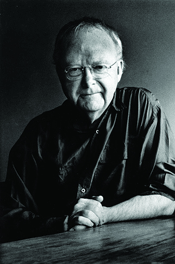
Louis Andriessen courtesy of Meltdown Festival
30 Aug 2009

Louis Andriessen De Staat at the Proms

De Staat is a seminally important work. So much modern music stems from it, not only “serious” classical music but progressive popular music too. It “is” music theatre, for it’s designed to be experienced live, the visual effect part of the action.

Louis Andriessen: De Staat; Steve Martland: Beat the Retreat; Cornelis de Bondt: Closed Doors

Netherlands Wind Ensemble, Louis Vis, Bart Schneeman (second conductor).

Above: Louis Andriessen courtesy of Meltdown Festival


At the BBC Proms in the Royal Albert Hall, it was wonderful to see the brass sections, carefully positioned at each side of the orchestra, catch the light, magnifying the blaze of sound. De Staat is so radical that it still sounds fresh after almost 40 years. Essentially, it’s a wild, almost savage piece that breaks all the rules of form and development that constitute formal music. But such manic, kinetic energy! Driving, compelling rhythmic patterns drive the piece forward. The patterns are circular, revolving on themselves relentlessly without beginning or end. Structurally, blocks of density are intersected by planes of sharp brightness.

De Staat is theatre, designed to be experienced live as its visual impact is very much part of the action. Thus two brass sections are positioned on each side of the orchestra, trombones and trumpets catching the light, so they shine in an ever more dazzling blaze. The harp is placed prominently, for it represents the plucked strings mentioned in the text.

De Staat is also interesting because it transcends text. It’s based on Plato’s The Republic where music is denounced as a form of subversion. The words matter. At early performances, audiences were given the text to read carefully before the beginning. so they’d retain the ideas rather than read them during performance. For De Staat transcends text. The singing is deliberately embedded into the music, almost abstract, like a cryptic code whose meaning goes deeper than surface words. Modern music doesn’t do simple word-painting. Meaning is absorbed, translated into abstract sound.

The texts are in ancient Greek, which most people don’t understand nowadays, which is all the more reason to focus on how the music itself expresses meaning, not just the words. The final chorus is illuminating for it quotes authoritarian dogma dictating what instruments and tonal modes may be used and which forbidden. “Musical change always invokes far-reaching danger. Any alteration in the modes of music is always followed by alteration in the most fundamental laws of the State”.

So Andriessen’s unremitting, hard planes of sound express extreme tension.This Proms performance, conducted by Lucas Vis, leading the Netherlands Wind Ensemble, celebrated the composer’s birthday, so wasn’t quite as distressful as some performances, where the relentless, pounding rhythms create severe anxiety. This is an ensemble for whom the work is basic repertoire - listen to the live recording, also by the Netherlands Wind Ensemble, from the 1978 Holland Festival, included as a CD in the book by* Robert Adlington, Louis Andriessen : De Staat* (Ashgate 2004).

This sense of fear and danger is important, for the driving repetitions represent the idea of enforced conformity. Hence the need for tight, disciplined performance. The very structure of De Staat is meaning. As Andriessen has said, “there is no hierarchy in the parts”. The chorus is only one of the several units in the piece that function in parallel, rather like society itself. . Voices may be suppressed in authoritarian states, but abstract music can still speak. This pertains to much of Andriessen’s work for music theatre and opera, where the action “is” in the music rather than the concept of opera as narrative singing with music..

Andriessen has written several operas, some of which are well known, such a Writing for Vermeer. He’s collaborated fruitfully with Peter Greenaway for several years, reflecting their common interests in music and film. in 2008, Andriessen’s “film opera” La Commedia was featured at the Holland Festival. An excerpt from the opera, The City of Dis, was premeired at the Walt Disney Hall in Los Angeles, conducted by Esa-Pekka Salonen.

This Prom program was extremely well chosen, placing De Staat between Steve Martland’s Beat the Retreat and Cornelis de Bondt’s Closed Doors. Martland’s piece mixes early English music with progressive rock. It’s a cheerful act of irreverent anarchy, written in protest against new government laws on outdoors entertainment. De Bondt’s piece, from 1985, starts and ends with a deep sonic boom that reverberated nicely in the Royal Albert Hall. It’s part of a much larger work that pivots different threads of music history upon each other. That’s why there were two conductors, not in itself any big deal (Charles Ives did it decades ago). Like De Staat, the material circulates, disparate parts that can’t meld although as a whole they make a statement.

The Proms are broadcast every day on BBC Radio 3 and are available online, on demand for seven days after the performance. See www/bbc.co.uk/proms

Anne Ozorio
Send to a friend

Send a link to this article to a friend with an optional message.

Friend's Email Address: (required)

Your Email Address: (required)

Message (optional):