![Madama Butterfly [Photo by Foto TABOCCHINI courtesy of Sferisterio Opera Festival]](http://www.operatoday.com/Madama-Butterfly_Macerata2.gif)
06 Aug 2009
On deception at Sferisterio Festival, Macerata, Italy
L’inganno is this year’s theme at the Sferisterio Festival in Macerata, Italy.
English Touring Opera are delighted to announce a season of lyric monodramas to tour nationally from October to December. The season features music for solo singer and piano by Argento, Britten, Tippett and Shostakovich with a bold and inventive approach to making opera during social distancing.
This tenth of ten Live from London concerts was in fact a recorded live performance from California. It was no less enjoyable for that, and it was also uplifting to learn that this wasn’t in fact the ‘last’ LfL event that we will be able to enjoy, courtesy of VOCES8 and their fellow vocal ensembles (more below …).
Ever since Wigmore Hall announced their superb series of autumn concerts, all streamed live and available free of charge, I’d been looking forward to this song recital by Ian Bostridge and Imogen Cooper.
The Sixteen continues its exploration of Henry Purcell’s Welcome Songs for Charles II. As with Robert King’s pioneering Purcell series begun over thirty years ago for Hyperion, Harry Christophers is recording two Welcome Songs per disc.
Although Stile Antico’s programme article for their Live from London recital introduced their selection from the many treasures of the English Renaissance in the context of the theological debates and upheavals of the Tudor and Elizabethan years, their performance was more evocative of private chamber music than of public liturgy.
In February this year, Albanian soprano Ermonela Jaho made a highly lauded debut recital at Wigmore Hall - a concert which both celebrated Opera Rara’s 50th anniversary and honoured the career of the Italian soprano Rosina Storchio (1872-1945), the star of verismo who created the title roles in Leoncavallo’s La bohème and Zazà, Mascagni’s Lodoletta and Puccini’s Madama Butterfly.
Evidently, face masks don’t stifle appreciative “Bravo!”s. And, reducing audience numbers doesn’t lower the volume of such acclamations. For, the audience at Wigmore Hall gave soprano Elizabeth Llewellyn and pianist Simon Lepper a greatly deserved warm reception and hearty response following this lunchtime recital of late-Romantic song.
Collapsology. Or, perhaps we should use the French word ‘Collapsologie’ because this is a transdisciplinary idea pretty much advocated by a series of French theorists - and apparently, mostly French theorists. It in essence focuses on the imminent collapse of modern society and all its layers - a series of escalating crises on a global scale: environmental, economic, geopolitical, governmental; the list is extensive.
For this week’s Live from London vocal recital we moved from the home of VOCES8, St Anne and St Agnes in the City of London, to Kings Place, where The Sixteen - who have been associate artists at the venue for some time - presented a programme of music and words bound together by the theme of ‘reflection’.
'Such is your divine Disposation that both you excellently understand, and royally entertaine the Exercise of Musicke.’
Amongst an avalanche of new Mahler recordings appearing at the moment (Das Lied von der Erde seems to be the most favoured, with three) this 1991 Mahler Second from the 2nd Kassel MahlerFest is one of the more interesting releases.
‘And there was war in heaven: Michael and his angels fought against the dragon; and the dragon fought and his angels, And prevailed not; neither was their place found any more in heaven … that old serpent … Satan, which deceiveth the whole world: he was cast out into the earth, and his angels were cast out with him.’
If there is one myth, it seems believed by some people today, that probably needs shattering it is that post-war recordings or performances of Wagner operas were always of exceptional quality. This 1949 Hamburg Tristan und Isolde is one of those recordings - though quite who is to blame for its many problems takes quite some unearthing.
There was never any doubt that the fifth of the twelve Met Stars Live in Concert broadcasts was going to be a palpably intense and vivid event, as well as a musically stunning and theatrically enervating experience.
‘Love’ was the theme for this Live from London performance by Apollo5. Given the complexity and diversity of that human emotion, and Apollo5’s reputation for versatility and diverse repertoire, ranging from Renaissance choral music to jazz, from contemporary classical works to popular song, it was no surprise that their programme spanned 500 years and several musical styles.
The Academy of St Martin in the Fields have titled their autumn series of eight concerts - which are taking place at 5pm and 7.30pm on two Saturdays each month at their home venue in Trafalgar Square, and being filmed for streaming the following Thursday - ‘re:connect’.
The London Symphony Orchestra opened their Autumn 2020 season with a homage to Oliver Knussen, who died at the age of 66 in July 2018. The programme traced a national musical lineage through the twentieth century, from Britten to Knussen, on to Mark-Anthony Turnage, and entwining the LSO and Rattle too.
With the Live from London digital vocal festival entering the second half of the series, the festival’s host, VOCES8, returned to their home at St Annes and St Agnes in the City of London to present a sequence of ‘Choral Dances’ - vocal music inspired by dance, embracing diverse genres from the Renaissance madrigal to swing jazz.
Just a few unison string wriggles from the opening of Mozart’s overture to Le nozze di Figaro are enough to make any opera-lover perch on the edge of their seat, in excited anticipation of the drama in music to come, so there could be no other curtain-raiser for this Gala Concert at the Royal Opera House, the latest instalment from ‘their House’ to ‘our houses’.
"Before the ending of the day, creator of all things, we pray that, with your accustomed mercy, you may watch over us."
L’inganno is this year’s theme at the Sferisterio Festival in Macerata, Italy.
Derived from the Spanish word engañar (to deceive), inganno (deception) is presented by new productions of Don Giovanni, Madama Butterfly and La traviata, by the world premiere of Matteo D’Amico ‘s Le Malentendu,by Handel’s oratorio Il Trionfo del Tempo sul disanganno and by Ugo Betti’s play Corruzione al Palazzo di Giustizia.
The production of Don Giovanni was specifically designed for the Teatro Lauro Rossi, a 400-seat gem from the 17th century. Staging is simple: two black walls, three large Plexiglas mirrors and an oversized white bed. Two of the mirrors are placed so that the theater’s boxes and loggione become an integral part of the scene. The third mirror is suspended from above showing the stage and bed. The metaphor is clear: sexual drive animates the protagonist and lives in all the other characters, but it is also a motor to deceiving, and cheating on, one another. However, this choice is not meant to narrow everything down to sex and to the cheating and deception involving sex. Don Giovanni’s tragedy descend from his determination to achieve happiness and power only through deceiving and cheating by the means of sex, irrespective of how this is obtained . This staging requires young, handsome and athletic singers with, of course, excellent voices and experience.
Pier Luigi Pizzi’s direction demands, literally, an acrobatic performance for many singers but acting was always of very high quality. The singers chosen for the production are all accustomed to large theatres in Italy and abroad (e.g., La Scala and the Met) and not to a small theater such as the Teatro Lauro Rossi. As a consequence, they sang too loudly. A stentoreous Ildebrando D'Arcangelo (Don Giovanni) and a stubbornly passionate Carmela Remigio (Donna Elvera) were the stars. Both had perfect vocalisation and diction. Myrtò Papatanasiu (Donna Anna) tended to scream such that her diction was not understandable. Marlin Miller (Don Ottavio) had difficulties with the upper range. The remaining performers were good but not excellent. The music director, Riccardo Frizza, should have provided suitable guidance in establishing a proper balance. In addition, his conducting was deficient because of the lack of pathos and of the uncertain tempi throughout the performance.
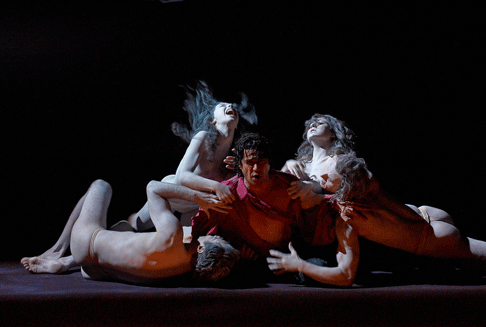 Scene from Don Giovanni
In the second opera in this series, Madama Butterfly, Pinkerton deceives little Butterfly by not taking his wedding vows seriously, by abandoning Butterfly and by subsequently marrying Kate. Performed at the open-air Arena Sferisterio di Macerata, Daniele Callegari, conducting the Orchestra Regionale delle Marche (the same orchestra as in Don Giovanni), evoked a remarkably better musical experience. We feel the subtleties of Puccini’s score (the familiar 1906 Opéra Comique version): from the Japanese folk melodies to the enthralling lyricism; from the matter of fact conversational pieces to the tragic denouement. The Coro Lirico Marchigiano “Vincenzo Bellini”, under the direction of David Crescenzi, ingeniously appear in Act II as a long procession on the 130-meter stage.
The sets and direction propose a “visionnaire” Japan – inspired by Pierre Loti’s blend of narrative and travelog. In front of the enormous wall of the Sferisterio is Butterfly’s white, spotless little house in a garden adorned by a cherry tree. By Act II, the verdant garden is transformed into a barren landscape. The widely-acclaimed Raffaella Angeletti performed the title role. Despite her petite physique, she possesses a powerful, yet delicate voice. She easily traverses the tonal range demanded by the role, her legato and phrasing being particularly noteworthy. Massimiliano Pisapia performed a credible Pinkerton with a generous tenor voice supported by a clear timbre. Although he is technically a “tenore spinto”, he has an excellent register particularly in the central tonalities. Claudio Sgura (Sharpless) and Annunziata Vestri (Suzuki) are deserving praise for their performances.
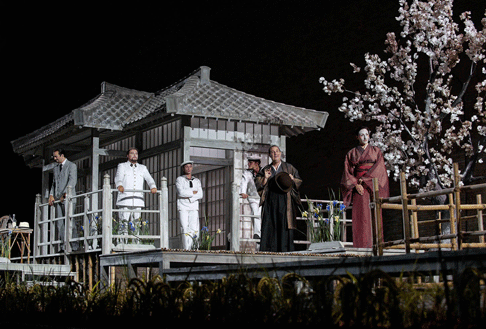 Scene from Madama Butterfly
The 61-year old Mariella Devia appeared as the protagonist in this production of La traviata, a role portraying a youngish consumptive. Nonetheless, she was magnificent, without the slightest sign of fatigue. She turned from bel canto in the first act, to hectic realism in the second act and to the pale voice of the third act. Alejandro Roy was an effective Alfredo with a big voice displaying good phrasing and a remarkable flexibility in the upper extension. On the other hand, the trim, athletic Gabriele Viviani was barely credible as Alfredo’s father, especially in the dramatic scene and concertato at the end of the second act.
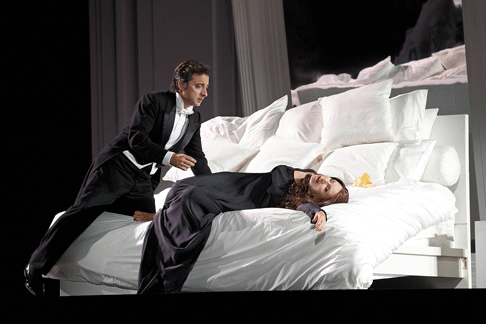 Scene from La traviata
Violetta is on stage during the overture where the opera seemingly unfolds as a long flash back of the dying protagonist’s life. Her guests resemble ghosts. At the insistence of censors, the opera was originally set in and around Paris circa 1700. This production is set in Paris circa 1880-1890 (the Third Republic) not 1853 (the Second Empire) when the work was first performed. We smell the perfume (and the opium) of Proust’s À la recherche du temps perdu (In Search of Lost Time or Remembrance of Things Past). It is not a realistic staging. For example, in the second act, Flora’s guests wore their large hats throughout the party—a symbol of the strong conventions of the upper class of the Third Republic. But this was not the custom at that time. Mariotti’s musical direction kept a good balance between the pit and the stage. It was effective, innovative and passionate in the first act overture and in the third act prelude. The remainder of the performance, however, was merely ordinary. Overall, this was not a noteworthy production or performance.
Giuseppe Pennisi –based on the July 23rd, 24th and 25th performances.