![Patricia Racette as Leslie Crosbie [Photo by Ken Howard courtesy of Santa Fe Opera]](http://www.operatoday.com/Letter_Racette.gif)
01 Aug 2009
‘Opera Noir’ Entertains at Santa Fe
Can a famously successful movie be made into an effective opera? A quick answer is: yes!
English Touring Opera are delighted to announce a season of lyric monodramas to tour nationally from October to December. The season features music for solo singer and piano by Argento, Britten, Tippett and Shostakovich with a bold and inventive approach to making opera during social distancing.
This tenth of ten Live from London concerts was in fact a recorded live performance from California. It was no less enjoyable for that, and it was also uplifting to learn that this wasn’t in fact the ‘last’ LfL event that we will be able to enjoy, courtesy of VOCES8 and their fellow vocal ensembles (more below …).
Ever since Wigmore Hall announced their superb series of autumn concerts, all streamed live and available free of charge, I’d been looking forward to this song recital by Ian Bostridge and Imogen Cooper.
The Sixteen continues its exploration of Henry Purcell’s Welcome Songs for Charles II. As with Robert King’s pioneering Purcell series begun over thirty years ago for Hyperion, Harry Christophers is recording two Welcome Songs per disc.
Although Stile Antico’s programme article for their Live from London recital introduced their selection from the many treasures of the English Renaissance in the context of the theological debates and upheavals of the Tudor and Elizabethan years, their performance was more evocative of private chamber music than of public liturgy.
In February this year, Albanian soprano Ermonela Jaho made a highly lauded debut recital at Wigmore Hall - a concert which both celebrated Opera Rara’s 50th anniversary and honoured the career of the Italian soprano Rosina Storchio (1872-1945), the star of verismo who created the title roles in Leoncavallo’s La bohème and Zazà, Mascagni’s Lodoletta and Puccini’s Madama Butterfly.
Evidently, face masks don’t stifle appreciative “Bravo!”s. And, reducing audience numbers doesn’t lower the volume of such acclamations. For, the audience at Wigmore Hall gave soprano Elizabeth Llewellyn and pianist Simon Lepper a greatly deserved warm reception and hearty response following this lunchtime recital of late-Romantic song.
Collapsology. Or, perhaps we should use the French word ‘Collapsologie’ because this is a transdisciplinary idea pretty much advocated by a series of French theorists - and apparently, mostly French theorists. It in essence focuses on the imminent collapse of modern society and all its layers - a series of escalating crises on a global scale: environmental, economic, geopolitical, governmental; the list is extensive.
For this week’s Live from London vocal recital we moved from the home of VOCES8, St Anne and St Agnes in the City of London, to Kings Place, where The Sixteen - who have been associate artists at the venue for some time - presented a programme of music and words bound together by the theme of ‘reflection’.
'Such is your divine Disposation that both you excellently understand, and royally entertaine the Exercise of Musicke.’
Amongst an avalanche of new Mahler recordings appearing at the moment (Das Lied von der Erde seems to be the most favoured, with three) this 1991 Mahler Second from the 2nd Kassel MahlerFest is one of the more interesting releases.
‘And there was war in heaven: Michael and his angels fought against the dragon; and the dragon fought and his angels, And prevailed not; neither was their place found any more in heaven … that old serpent … Satan, which deceiveth the whole world: he was cast out into the earth, and his angels were cast out with him.’
If there is one myth, it seems believed by some people today, that probably needs shattering it is that post-war recordings or performances of Wagner operas were always of exceptional quality. This 1949 Hamburg Tristan und Isolde is one of those recordings - though quite who is to blame for its many problems takes quite some unearthing.
There was never any doubt that the fifth of the twelve Met Stars Live in Concert broadcasts was going to be a palpably intense and vivid event, as well as a musically stunning and theatrically enervating experience.
‘Love’ was the theme for this Live from London performance by Apollo5. Given the complexity and diversity of that human emotion, and Apollo5’s reputation for versatility and diverse repertoire, ranging from Renaissance choral music to jazz, from contemporary classical works to popular song, it was no surprise that their programme spanned 500 years and several musical styles.
The Academy of St Martin in the Fields have titled their autumn series of eight concerts - which are taking place at 5pm and 7.30pm on two Saturdays each month at their home venue in Trafalgar Square, and being filmed for streaming the following Thursday - ‘re:connect’.
The London Symphony Orchestra opened their Autumn 2020 season with a homage to Oliver Knussen, who died at the age of 66 in July 2018. The programme traced a national musical lineage through the twentieth century, from Britten to Knussen, on to Mark-Anthony Turnage, and entwining the LSO and Rattle too.
With the Live from London digital vocal festival entering the second half of the series, the festival’s host, VOCES8, returned to their home at St Annes and St Agnes in the City of London to present a sequence of ‘Choral Dances’ - vocal music inspired by dance, embracing diverse genres from the Renaissance madrigal to swing jazz.
Just a few unison string wriggles from the opening of Mozart’s overture to Le nozze di Figaro are enough to make any opera-lover perch on the edge of their seat, in excited anticipation of the drama in music to come, so there could be no other curtain-raiser for this Gala Concert at the Royal Opera House, the latest instalment from ‘their House’ to ‘our houses’.
"Before the ending of the day, creator of all things, we pray that, with your accustomed mercy, you may watch over us."
Can a famously successful movie be made into an effective opera? A quick answer is: yes!
Santa Fe Opera has made it happen with William Wyler’s 1940 motion picture, The Letter based on Somerset Maugham’s 1920s short story and play, and now an opera. It may well be the sleeper of the Santa Fe season, unusual for a newly commissioned opera.
Within a dark toned sparsely furnished residential stage set, four collapsing palm trees grimly lowering in the background of a hot and smelly Malay rubber plantation house, a bored housewife is carrying on a torrid affair with a local dandy, her often absent and somewhat dull husband unaware. In the Wyler movie, the main feature of which is Bette Davis as Leslie Crosbie the erring wife, moments after the show opens we hear gunfire as her lover Geoff Hammond staggers across the verandah, Leslie emptying her six-shooter into him in a jealous rage. Bette Davis did it with fervor, and believe me, Santa Fe’s soprano Patricia Racette does the deed with equal vehemence. We were off to a strong start, and the intensity rarely lets up over the 100-minute opera.
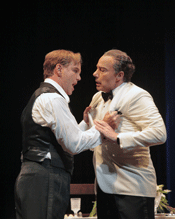 Anthony Michaels-Moore (Robert Crosbie) and James Maddalena (Howard Joyce)
The Santa Fe team, led by composer Paul Moravec with librettist Terry
Teachout, musical director Patrick Summers and stage director Jonathan Kent,
took a chance patterning their new opera so closely on the ‘noir’
qualities of old movies, but that was exactly the tone they wanted to establish
for this sordid little story, and they got it right. Even more successful is
the musical score by Paul Moravec, a professor of music at Adelphi University.
Worry not, this is no academician’s tepid exercise — it’s a
rip-snorting adventure in high-class movie music with the likes of Bernard
Herrmann, Eric Korngold and Max Steiner hovering in the background.
Moravec’s music is fluent and beautifully orchestrated. The tonal score
is through-composed, no pauses for arias or set pieces aside from brief
moments, with a good sense of storytelling and excitement resulting.
It turns out Moravec, in his first opera, is a wise and able theatre composer who knows to keep his orchestra subdued for key passages of exposition and musical dialogue, but can unleash his violins and woodwinds in romantic mood music to evoke the sweeping “love me forever passages” of Leslie and Geoff’s affair. Don’t laugh, but when it comes to writing music and vocal lines that can narrate and sustain mood, Moravec impressed me as having it all over the cognoscenti’s current darlings, Kaija Saariaho or Osvaldo Golijov, also lately heard in new works at Santa Fe. Sometimes it feels good just to get down to storytelling without trying to make musical history.
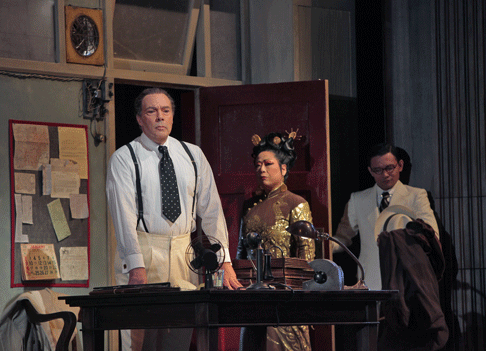 James Maddalena (Howard Joyce), Mika Shigematsu (A Chinese Woman) and Rodell Rosel (Ong Chi Seng)
Meanwhile, back at the plantation, Leslie has been caught out not only in her affair with Goeff, but his murder as well. Once she discovered Geoff was through with her, preferring his new Chinese mistress, Leslie popped him off, a woman scorned. But that’s not all: her husband Robert has to come up with a lot of cash to buy back a letter Leslie stupidly wrote to Geoff inviting him over the night she shot him, a piece of evidence that would convict the lady. The letter fell into the hands of Geoff’s mistress, and now the Chinese woman wants to cash in. Of course it will ruin husband Robert Crosbie, played and sung with great effectiveness by Anthony Michaels-Moore, using his life’s savings to redeem his adulteress wife. Sticky, eh?
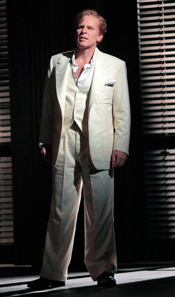 Roger Honeywell (Geoff Hammond)
Coming to the rescue is Howard Joyce, Robert’s lawyer friend, who
manages to buy and repress the letter, and convince a Singapore British jury to
let Leslie off, claiming she was the victim of Geoff’s violent attempt to
rape her. The one-act opera ends in a big mess, romance gone, careers
compromised, and then in a coupe-de-theatre, Leslie takes matters into
her own hands and resolves her dilemma. I’ll not reveal the quick
denouement.
Ms. Racette, Michaels-Moore, James Maddalena as the lawyer, and assorted secondary role singers could not have been any better. Roger Honeywell, Rodell Rosel and Keith Jameson, all tenors, played key parts in the show’s success, with the Santa Fe Opera orchestra and conductor Patrick Summers wonderfully effective in their central role. Patricia Racette is a marvel; her full lyric soprano voice is in solid shape, used with skill and much dramatic effect. She has an expressive face, and is an actor of the first order. It was a pleasure to encounter her strengths in this prima donna role. For now, she owns the part. Others will soon want to.
The Letter may to some degree be a work in progress; it seems fairly well finished, if a few minutes too long. The intensity of the Maupassant-esque plotting with all its ironies is well maintained, with good rhythm and tempo, rhetorically and musically. But in a departure from Maugham and Wyler, Morevec added a short scene in which the Chinese woman (the fine Japanese mezzo Mika Shigematsu), comes to the lawyer to deliver the letter and collect her cash. Unfortunately she is given not only a voice in the proceedings with a short aria, but brings up issues that only obfuscate and delay. I hope the authors will rethink that scene. Much effect was gained by Wyler in keeping his mysterious Chinese woman quiet — a strong presence but generalized. There can be too many ‘specifics,’ sometimes in dramatic plotting, and The Letter has a few. In the main it is unusually engaging, well-paced entertainment, handsomely performed.
J. A. Van Sant ©2009