Somehow there seems to be enough room for everyone in what can only be described as a Last Judgment atmosphere.
Though of minimal size (six million euros) and recent birth (1980) the Rossini Opera Festival has emerged as one of Europe’s great opera festivals. There is a simple reason for this pre-eminence — the great Rossini, and the complete Rossini, and this festival’s dedication to finding singers, conductors and stage directors who can bring this magnificent body of work alive.
This is not to say that the ROF always succeeds, and when it does not it is usually because of the delicacy of its task and not the quality of its work. When it succeeds we reach the absolute heights of operatic sublimity, and this occurred last summer in Daniele Abbado and Roberto Abbado’s Ermione. This summer even greater heights were achieved by Georgio Barberio Corsetti and Roberto Abbado’s Zelmira.
Last summer the huge Adriatic Arena housed two productions, Ermione and Maometto II, on identical back-to-back temporary stages that bisected this covered arena. This summer with Zelmira as its sole occupant, the ROF took advantage of the additional space to create a 1500 plus seat auditorium. This relative hugeness created the momentary impression that we had stumbled into Verona’s Roman amphitheater, but with the reverberation specifications of a gothic cathedral. It was a scary beginning.
Common to Ermione and Zelmira was conductor Roberto Abbado and the orchestra of Bologna’s Teatro Comunale, a superb ensemble wired directly to the sculptural musicianship of this extraordinary conductor. Abbado began with pure Rossini, and absorbed the mise en scène, souping up his Rossini to embrace and reinforce the sometimes strange, truly powerful and always beautiful stage images. This was post-modern opera, really a twenty-first century gesamkunstwerk based on a Rossini score.
Fifty-eight year-old actor/dramaturg/video-artist/stage director Georgio Barberio Corsetti, a bastion of the late twentieth-century Italian theatrical avant-garde (surely there is a new one by now), and for the last ten years an important presence on Italian opera stages was the metteur en scène. Sig. Corsetti had an opportunity almost unique in opera — a huge empty arena in which he could create his own made-to-order scenic machine.
It was in medias res (no overture for informed Rossinians to identify as the same one the composer had also used for this or that comedy). The villain Antenore, sung by American tenor Gregory Kunde, feigned dismay and sorrow in the first of the evening vocal flights, but conductor Abbado skillfully avoided allowing him his applause. In fact all opportunities for applause were evaded until the fifth scene when Zelmira’s loved and loving soldier husband, sung by Peruvian tenor Juan Diego Flórez, returning from war greeted his homeland in a dazzling tenorial display. This evoked a nearly twenty-minute ovation (N.B. this was the applause at the August 12 performance).
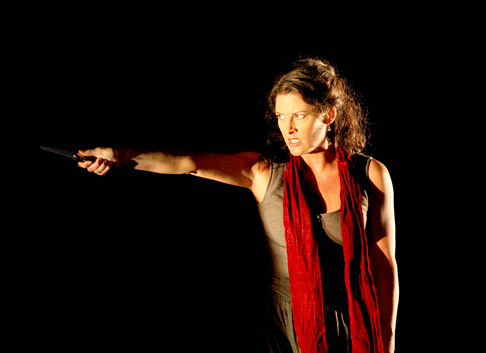 Kate Aldrich as Zelmira
The first spine tingling scenic revelation was the slow erosion of the sand partially covering three monumental sculptures lying on the stage floor. This while Zelmira, sung by American mezzo-soprano Kate Aldridge cradled her father Polidoro, sung by Italian bass Alex Esposito who, suckling her breast completed the trio with Zelmira’s nurse Emma, sung by Italian mezzo-soprano Marianna Pizzolato. And then the supine monumental sculptures took flight, becoming huge, suspended, twirling figures.
A huge, full stage mirror reflected Mo. Abbado and his orchestra, with the inclusion of the audience, vertically slashed by the three blood-red electric stripes that marked the aisles of the tiered seating at the rear of the auditorium. This mirror then tilted forward to reflect a giant sand box that covered floor of the arena, visible through the mesh floor of the raised stage platform in which a multitude of mothers suckled their babies. In another scene a bloody soldier was gently washed by his wife, and later wounded and dead soldiers were dragged from a battlefield, etc.
Other times the mirror reflected the action on the stage as well, doubling the presences of the characters, a visually impressive staging technique that attained the Baroque ideal of the scenic meraviglioso. This simple trick (well, hardly simple to achieve) wove notions of the real and irreale with the concept of theater (opera) itself, and immersed us into a metaphysical world, here the hyper-world of music, Rossini’s music.
Brilliant too was the punctuation created by the minutes we sat in darkness and silence taking us from one illusionary world, that of babies and battles, to another, that of politics and intrigue — a flat gold wall and a coterie of ancient priests.
The complications of the staging, the juxtaposition of a single stage image with the changing poetic images of the arias, and the technical brilliance of the vocal displays of the arias finally merged. Sig. Corsetti had the confidence to pit vocal artistry against theatrical meaning, insisting that singing meant to impress could leave deeper and broader impressions, and they did. We soon learned that the complex scenic backgrounds for the arias were not distraction.
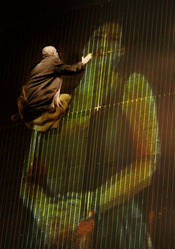 Alex Exposito as Polidoro
The first Zelmira was Mme. Colbran-Rossini, well past her prime, thus Rossini gave her only one small aria near the end of the opera. Kate Aldridge, a formidable artists distinctly in her prime, almost eliminated our frustration at Zelmira’s vocal banishment (after all she is the title role) by delivering the brief aria, finally, with virtuoistic bite and finesse. Though Mme. Aldridge leaves the impression that she may not be a genuine Rossini singer she brought a forceful tonality to Zelmira of filial, maternal, uxorial warmth that firmly anchored the Corsetti entanglement of conflicting masculine bellicose, political and dynastic urges into this sentimental, feminine world.
Rossini’s ensembles embodied these archetypal conflicts, Mo. Abbado sculpting the multiple perspectives into statements that soared above time and place into the sublime. And for extended periods. Meanwhile Sig. Corsetti knew to remain scenically silent during these intense moments. Of spectacular beauty was the first act Zelmira and Emma lament duet with solo harp and english horn, as was Rossini’s recall of this scene by restating this music in the tragic moments of the last act.
Opera casting is infamously difficult as reconciling vocal attributes with physical and dramatic presence is a precarious business. This ROF production achieved the near miraculous with top level Rossini artists who could embody their characters. The attributes of Juan Diego Flórez are well-known, Alex Exposito possesses an unusually beautiful bass voice well adapted to Rossini demands, mezzo-soprano Marianna Pizzolato delivered the fervent roulades of her second act invocation to the gods to guard Zerlmira’s infant son with such conviction that it earned the evening’s second biggest ovation. Gregory Kunde is a unique artist, now well into mid-career who can bring the heft, brilliance and presence — vocally and dramatically — to make a Rossini villain real. Baritone Marco Palazzi completed the cast of six principals as Leucippo, henchman of the scheming Antenore.
The Rossini Opera Festival typically offers three productions. This summer in addition to Zelmira was the early comedy La Scala di Seta and his last comedy Le Comte Ory, both mounted in the small, early nineteenth century Teatro Rossini. La Scala di Seta was a new production staged by Damiano Michieletto and conducted by Claudio Scimone. Sig. Michieletto, a young Venetian, allowed expediency to triumph over art in this prosaic TV sit com style production that fulfilled the Rossini Opera Festival’s obligation to expose the complete Rossini. Seventy-five year old conductor Claudio Scimone, founder of I Solisti Veneti, brought the famous first act quartet to a very modest Rossini boil, but did not succeed otherwise in resuscitating this minor, flawed Rossini.
Le Comte Ory was a revival of the ROF 2003 production by Catalan director Lluis Pasqual, conducted this time by Paolo Carignani, the former head of Frankfurt Opera. The Pasqual production makes Rossini’s French comedy into a parlor game, a concept this masterpiece wears passably but a bit uncomfortably. Mr. Pasqual’s staging is conventional, as are his designs, costumes and lighting. On the other hand conductor Carignani gave us dynamic, vintage Rossini, working with the excellent orchestra of Bologna’s Teatro Comunale, and a fine cast, notably soprano María José Moreno as Adèle, Natalia Gavrilan as Ragonde and Laura Polverelli in the pants role, Isolier. Roberto de Candia ably delivered Raimbaud. In the 2003 production Juan Diego Flórez was the Count Ory, a tough act for young tenor Vlhe Shi to follow. Mr. Shi proved himself a musical Count, and succeeded well enough in accomplishing his antics.
Michael Milenski