06 Sep 2009
Aspen stages a Don to die for
“Can it be?”
“It can’t!”
“But it is; he looks just like him…”
English Touring Opera are delighted to announce a season of lyric monodramas to tour nationally from October to December. The season features music for solo singer and piano by Argento, Britten, Tippett and Shostakovich with a bold and inventive approach to making opera during social distancing.
This tenth of ten Live from London concerts was in fact a recorded live performance from California. It was no less enjoyable for that, and it was also uplifting to learn that this wasn’t in fact the ‘last’ LfL event that we will be able to enjoy, courtesy of VOCES8 and their fellow vocal ensembles (more below …).
Ever since Wigmore Hall announced their superb series of autumn concerts, all streamed live and available free of charge, I’d been looking forward to this song recital by Ian Bostridge and Imogen Cooper.
The Sixteen continues its exploration of Henry Purcell’s Welcome Songs for Charles II. As with Robert King’s pioneering Purcell series begun over thirty years ago for Hyperion, Harry Christophers is recording two Welcome Songs per disc.
Although Stile Antico’s programme article for their Live from London recital introduced their selection from the many treasures of the English Renaissance in the context of the theological debates and upheavals of the Tudor and Elizabethan years, their performance was more evocative of private chamber music than of public liturgy.
In February this year, Albanian soprano Ermonela Jaho made a highly lauded debut recital at Wigmore Hall - a concert which both celebrated Opera Rara’s 50th anniversary and honoured the career of the Italian soprano Rosina Storchio (1872-1945), the star of verismo who created the title roles in Leoncavallo’s La bohème and Zazà, Mascagni’s Lodoletta and Puccini’s Madama Butterfly.
Evidently, face masks don’t stifle appreciative “Bravo!”s. And, reducing audience numbers doesn’t lower the volume of such acclamations. For, the audience at Wigmore Hall gave soprano Elizabeth Llewellyn and pianist Simon Lepper a greatly deserved warm reception and hearty response following this lunchtime recital of late-Romantic song.
Collapsology. Or, perhaps we should use the French word ‘Collapsologie’ because this is a transdisciplinary idea pretty much advocated by a series of French theorists - and apparently, mostly French theorists. It in essence focuses on the imminent collapse of modern society and all its layers - a series of escalating crises on a global scale: environmental, economic, geopolitical, governmental; the list is extensive.
For this week’s Live from London vocal recital we moved from the home of VOCES8, St Anne and St Agnes in the City of London, to Kings Place, where The Sixteen - who have been associate artists at the venue for some time - presented a programme of music and words bound together by the theme of ‘reflection’.
'Such is your divine Disposation that both you excellently understand, and royally entertaine the Exercise of Musicke.’
Amongst an avalanche of new Mahler recordings appearing at the moment (Das Lied von der Erde seems to be the most favoured, with three) this 1991 Mahler Second from the 2nd Kassel MahlerFest is one of the more interesting releases.
‘And there was war in heaven: Michael and his angels fought against the dragon; and the dragon fought and his angels, And prevailed not; neither was their place found any more in heaven … that old serpent … Satan, which deceiveth the whole world: he was cast out into the earth, and his angels were cast out with him.’
If there is one myth, it seems believed by some people today, that probably needs shattering it is that post-war recordings or performances of Wagner operas were always of exceptional quality. This 1949 Hamburg Tristan und Isolde is one of those recordings - though quite who is to blame for its many problems takes quite some unearthing.
There was never any doubt that the fifth of the twelve Met Stars Live in Concert broadcasts was going to be a palpably intense and vivid event, as well as a musically stunning and theatrically enervating experience.
‘Love’ was the theme for this Live from London performance by Apollo5. Given the complexity and diversity of that human emotion, and Apollo5’s reputation for versatility and diverse repertoire, ranging from Renaissance choral music to jazz, from contemporary classical works to popular song, it was no surprise that their programme spanned 500 years and several musical styles.
The Academy of St Martin in the Fields have titled their autumn series of eight concerts - which are taking place at 5pm and 7.30pm on two Saturdays each month at their home venue in Trafalgar Square, and being filmed for streaming the following Thursday - ‘re:connect’.
The London Symphony Orchestra opened their Autumn 2020 season with a homage to Oliver Knussen, who died at the age of 66 in July 2018. The programme traced a national musical lineage through the twentieth century, from Britten to Knussen, on to Mark-Anthony Turnage, and entwining the LSO and Rattle too.
With the Live from London digital vocal festival entering the second half of the series, the festival’s host, VOCES8, returned to their home at St Annes and St Agnes in the City of London to present a sequence of ‘Choral Dances’ - vocal music inspired by dance, embracing diverse genres from the Renaissance madrigal to swing jazz.
Just a few unison string wriggles from the opening of Mozart’s overture to Le nozze di Figaro are enough to make any opera-lover perch on the edge of their seat, in excited anticipation of the drama in music to come, so there could be no other curtain-raiser for this Gala Concert at the Royal Opera House, the latest instalment from ‘their House’ to ‘our houses’.
"Before the ending of the day, creator of all things, we pray that, with your accustomed mercy, you may watch over us."
“Can it be?”
“It can’t!”
“But it is; he looks just like him…”
A gasp went up when the curtain rose on Mozart‘s Don Giovanni in Aspen’s intimate Wheeler Opera House on August 21. Even at close range the Don — tall, lean, handsome and black — was a dead ringer for Barack Obama. It was, of course, not the president of the United States doubling as the legendary lover, but Donavan Singletary, a current member of the Lindemann Young Artist Development Program at the Metropolitan Opera, who played the Don. Although there is no knowing how adeptly Singletary, already the winner of numerous awards and competitions, might deal with health care, he is — it seems safe to say — the greatest Giovanni to come along since Italy’s Cesare Siepi brought new dimensions of sensuality to the character in the 1950’s.
In erudite notes for this final Aspen Opera Theater production of the 2009 60th anniversary season of the Aspen Music Festival, Edward Berkeley, director both of the program and of this production, discussed Giovanni as the Greek god Dionysus returned to earth. “He’s life force,” Berkeley wrote. “His sensuality and his sex drive has such energy that the rest of this society feels it doesn’t have it’s own energy without Giovanni.” Unable to equal him, however, the others, who are what they are only through their relationship with him, must destroy the Don in order to continue their own trivial lives. Even if he is hauled off to Hell at the end of the opera, there’s clearly more to the story that librettist Lorenzo Da Ponte assembled for Mozart than the Sunday-school tale of a destructive wrong-doer justly punished.
For in Giovanni the audience confronts what Robert A. Johnson in his book Ecstasy called “the irrational wisdom of the senses.” It’s heady stuff, and Berkeley staged one of the best Giovannis ever seen anywhere. To do so, he answered a question open to debate since the opera was new in Prague in 1788: just what had happened in Donna Anna’s room before the drama begins on stage? She was raped, the director says, and that leaves her with feelings of guilt for her father’s death at the Don’s hands and yet irrevocably attracted to the rapist. Anna, in short, knows a good thing when she has experienced it and she knows that Don Ottavio, the aristocratic Milquetoast whom she is to marry, is no match for the Don.
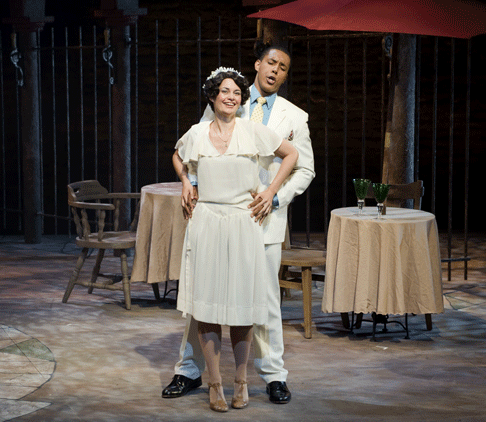 A scene from Don Giovanni
This view brings a tension to the opera lacking in less perceptive stagings, and in Aspen Berkeley had a cast of talented young singers to make his production exceptional. Singletary, equally fluent in voice and body language; moved and sang with an elegance that made him carnality incarnate — a force the equal of a hurricane before which everyday mortals bow their heads.
Yet even more perfect in Aspen was his servant Leporello, portrayed with breathtaking immediacy by Adam Paul Lau, now a graduate student at Rice University. Too often reduced to a merely comic character, Lau understood the serious side of Leporello, his disgust with his master’s devious way and — at the same time — the desire to be like him. He really is the Don’s double.
Yoosun Park and Rachel Sliker were ideally paired as Anna and Elvira, two women unable to turn their backs totally on the attraction of the Don. Sliker played an Elvira ever willing to forgive with a nervous edge that hinted of hysteria, while as Anna Park had her heart set on revenge. Her account of what happened in that crucial night — incomplete as it might have been in detail — was not mere narrative; it was a flesh-and-blood reliving of that fateful hour.
In appearance Aspen’s Ottavio Samuel Read Levine recalled the youthful Jussi Bjoerling; however, his voice, still badly in need of refining discipline, was far more robust than that of the late Swede. As the Commandatore, bass Paul An struck cosmic fear in the hearts of everyone in the Cemetery and final Banquet scenes. Adrian Rosas was a delightfully boyish Mazetto, and it was only Debra Stanley, his Zerlina, who fell below the across-the-board excellence of the cast. Already vocally too mature to be a peasant girl convincing in her innocence, as an actress Stanley took no cues from her colleagues.
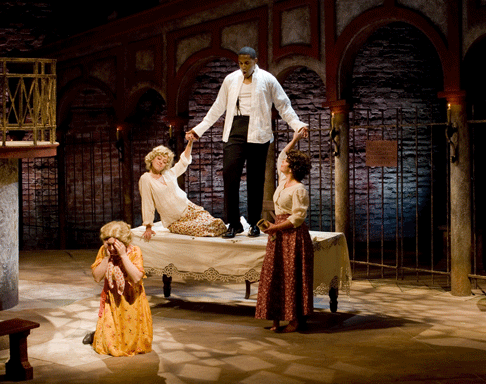 A scene from Don Giovanni
As conductor, James Gaffigan, since 2006 associate conductor of the San Francisco Symphony, showed all the markings of a major Mozartean, working with an ensemble that richly displayed the gifts of many Aspen student instrumentalists. Sets by John Kasarda and largely non-descript modern costumes by Marina Reti were functional and, staying out of the way of the music, allowed an interrupted flow of Giovanni’s many scenes. Most significant, however, was Berkeley’s telling of the story of this opera. Rather than answering all the questions about Giovanni, he confronted the audience with the fact that great art dwells in that abyss that lies between human aspiration and achievement. For Giovanni — not unlike his brothers Faust and Tristan — is a man out to know life to its fullest — usually, alas, at the expense of women. As ever-hungry and never-sated Dionysian man, the Don is shattered by the wall of limitations placed in his way by this thing called “reality.” Giovanni pays the price demanded by his many acts of hubris — and one regrets that that is the way things are in this world.
While the Aspen Opera Theater might be regarded primarily as a training program, it is much more than that. Indeed, this production exceeded by far the expectations that one brings to the country’s regional companies and, this — in turn — should prompt them to rethink the role they are too often content to play with yet another run-of-the-mill Carmen or Butterfly.
Finally, as the world this summer celebrates Marian Anderson’s historic 1939 concert at Lincoln Memorial one cheers the Aspen performance in which the first four people to appear on stage were one black and three Asians.
Wes Blomster