Recently in Reviews
English Touring Opera are delighted to announce a season of lyric monodramas to tour nationally from October to December. The season features music for solo singer and piano by Argento, Britten, Tippett and Shostakovich with a bold and inventive approach to making opera during social distancing.
This tenth of ten Live from London concerts was in fact a recorded live performance from California. It was no less enjoyable for that, and it was also uplifting to learn that this wasn’t in fact the ‘last’ LfL event that we will be able to enjoy, courtesy of VOCES8 and their fellow vocal ensembles (more below …).
Ever since Wigmore Hall announced their superb series of autumn concerts, all streamed live and available free of charge, I’d been looking forward to this song recital by Ian Bostridge and Imogen Cooper.
The Sixteen continues its exploration of Henry Purcell’s Welcome Songs for Charles II. As with Robert King’s pioneering Purcell series begun over thirty years ago for Hyperion, Harry Christophers is recording two Welcome Songs per disc.
Although Stile Antico’s programme article for their Live from London recital introduced their selection from the many treasures of the English Renaissance in the context of the theological debates and upheavals of the Tudor and Elizabethan years, their performance was more evocative of private chamber music than of public liturgy.
In February this year, Albanian soprano Ermonela Jaho made a highly lauded debut recital at Wigmore Hall - a concert which both celebrated Opera Rara’s 50th anniversary and honoured the career of the Italian soprano Rosina Storchio (1872-1945), the star of verismo who created the title roles in Leoncavallo’s La bohème and Zazà, Mascagni’s Lodoletta and Puccini’s Madama Butterfly.
Evidently, face masks don’t stifle appreciative “Bravo!”s. And, reducing audience numbers doesn’t lower the volume of such acclamations. For, the audience at Wigmore Hall gave soprano Elizabeth Llewellyn and pianist Simon Lepper a greatly deserved warm reception and hearty response following this lunchtime recital of late-Romantic song.
Collapsology. Or, perhaps we should use the French word ‘Collapsologie’ because this is a transdisciplinary idea pretty much advocated by a series of French theorists - and apparently, mostly French theorists. It in essence focuses on the imminent collapse of modern society and all its layers - a series of escalating crises on a global scale: environmental, economic, geopolitical, governmental; the list is extensive.
For this week’s Live from London vocal recital we moved from the home of VOCES8, St Anne and St Agnes in the City of London, to Kings Place, where The Sixteen - who have been associate artists at the venue for some time - presented a programme of music and words bound together by the theme of ‘reflection’.
'Such is your divine Disposation that both you excellently understand, and royally entertaine the Exercise of Musicke.’
Amongst an avalanche of new Mahler recordings appearing at the moment (Das Lied von der Erde seems to be the most favoured, with three) this 1991 Mahler Second from the 2nd Kassel MahlerFest is one of the more interesting releases.
‘And there was war in heaven: Michael and his angels fought against the dragon; and the dragon fought and his angels, And prevailed not; neither was their place found any more in heaven … that old serpent … Satan, which deceiveth the whole world: he was cast out into the earth, and his angels were cast out with him.’
If there is one myth, it seems believed by some people today, that probably needs shattering it is that post-war recordings or performances of Wagner operas were always of exceptional quality. This 1949 Hamburg Tristan und Isolde is one of those recordings - though quite who is to blame for its many problems takes quite some unearthing.
There was never any doubt that the fifth of the twelve Met Stars Live in Concert broadcasts was going to be a palpably intense and vivid event, as well as a musically stunning and theatrically enervating experience.
‘Love’ was the theme for this Live from London performance by Apollo5. Given the complexity and diversity of that human emotion, and Apollo5’s reputation for versatility and diverse repertoire, ranging from Renaissance choral music to jazz, from contemporary classical works to popular song, it was no surprise that their programme spanned 500 years and several musical styles.
The Academy of St Martin in the Fields have titled their autumn series of eight concerts - which are taking place at 5pm and 7.30pm on two Saturdays each month at their home venue in Trafalgar Square, and being filmed for streaming the following Thursday - ‘re:connect’.
The London Symphony Orchestra opened their Autumn 2020 season with a homage to Oliver Knussen, who died at the age of 66 in July 2018. The programme traced a national musical lineage through the twentieth century, from Britten to Knussen, on to Mark-Anthony Turnage, and entwining the LSO and Rattle too.
With the Live from London digital vocal festival entering the second half of the series, the festival’s host, VOCES8, returned to their home at St Annes and St Agnes in the City of London to present a sequence of ‘Choral Dances’ - vocal music inspired by dance, embracing diverse genres from the Renaissance madrigal to swing jazz.
Just a few unison string wriggles from the opening of Mozart’s overture to Le nozze di Figaro are enough to make any opera-lover perch on the edge of their seat, in excited anticipation of the drama in music to come, so there could be no other curtain-raiser for this Gala Concert at the Royal Opera House, the latest instalment from ‘their House’ to ‘our houses’.
"Before the ending of the day, creator of all things, we pray that, with your accustomed mercy, you may watch over us."
Reviews
09 Sep 2009
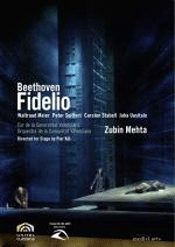
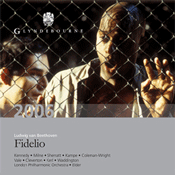
Fidelio from Glyndebourne and Medici Arts
Beethoven’s Fidelio is actually several works combined — a rescue opera in the grand style of the French revolution, a sentimental comedy focusing on mistaken identity, and a tragédie bourgeoise involving a husband, a wife, and their efforts to re-unite despite the actions of a relentless and implacable foe.
As if this were not enough, the opera is
also Beethoven’s political testament, an attack on tyranny and injustice
initiated (quite literally) with a trumpeted call to arms for the forces of
truth and fraternity. Fortunately, this confused (and some might argue,
irreconcilable) juxtaposition of genres contains some of the composer’s
most beautiful music, and lovers of the work will undoubtedly welcome these two
recently released recordings of Beethoven’s only completed opera. Both
performances date from 2006: an audio recording of a Glyndebourne production
featuring Anja Kampe, Torsten Kerl, and the London Philharmonic conducted by
Mark Elder, and a filmed performance (celebrating the opening of the new Palau
de les Arts of Valencia) with Waltraud Meier and Peter Seiffert accompanied by
the Community Orchestra of Valencia under Zubin Metha.
A comparison of these two productions — one a two CD set, and the
other a DVD — while inherently unfair, is revealing. From the first notes
of the overture it is obvious that the Gyndebourne production features the
better orchestra and more inspired conductor: throughout the performance
Elder’s direction of the LPO is a heavenly delight. This is not meant as
a criticism of Maestro Mehta, however, who still manages to create some
powerful moments while working with a much younger and less accomplished
orchestral ensemble. It is particularly regrettable that, unlike the Valencia
version, the Glyndebourne production does not include a performance of the
third Leonore overture before the second act finale (a tradition,
begun by Mahler in Vienna, which Metha wisely follows). The Gyndebourne
recording also features the better chorus (prepared by Thomas Blunt) —
“O welche Lust” is sung with excellent diction, wonderful dynamic
contrast, and superior balance by the British troupe. Elder’s direction
of the LPO in the performance of the Haydenesque introduction to the chorus is
unforgettable.
Waltraud Meier is a dynamic and powerful presence as Leonore, and her
considerable talents are fully utilized in the Valencia production. The
contrast between the vocal styles of Meier and Kampe is nowhere more evident
than in “Mir ist so wunderbar” — Meier’s tone is
commanding and mature, whereas Kampe’s seems less so. This comparison
holds throughout the performances: Meier is simply more convincing and at ease
in the showcase arias and duets. Her performance of “O namenlose
Freude!” with Seiffert is remarkable, and is undoubtedly the happy result
of their frequent collaboration together in other roles (most recently in the
Met production of Tristan). Seiffert is less compelling when Meier is
not on stage, however. Torsten Kerl’s Florestan is more endearing: the
youthful tenor’s rendition of “Gott, Welch Dunkel hier” is
athletic and impassioned, and made all the more enjoyable by the special
touches added by the London Philharmonic’s wonderful accompaniment.
In the secondary roles each performance offers some special moments. Matti
Salminen is surpisingly comfortable in his role as Rocco, and even pulls off
the notoriously awkward “Hat man nicht auch Gold beineben” aria
beautifully. While the voice is at times strained and raspy, his expressive
presence, particularly in ensemble numbers, elevates the performances of his
fellow cast members. Brindley Sherratt’s Rocco is adequate in the
Glydnebourne version, but little more. Lisa Milne is impressive as Marzelline,
and displays an enthusiasm for her role which Ildikó Raimondi seems not to. The
rising Finnish star, Juha Uusitalo is an impressive and menacing Don Pizarro
(seeing him interact on stage with fellow-Finn Salminen in the “Es
schlägt der Rache Stunde” is a real treat), and Rainer Trost is a far
more convincing and lyric Jaquino than Andrew Kennedy, whose voice seems forced
and pinched throughout much of the performance.
Pierluigi Pier’Alli’s direction of the Valencia version features
some fascinating video effects. His creative use of the motif of chains and
prison bars (projected onto the screen on stage) which leads to
Florestan’s aria to open Act II is highly effective. Despite this, some
may find his otherwise rather conservative approach to much of the rest of the
work a trifle dull, and it is unfortunate that Deborah Warner’s edgy
Glyndebourne production can only be seen in a few photos in the album notes.
One welcomes Pier’Alli’s willingness to allow Meier an opportunity
to explore the full range of her dramatic abilities, particularly during the
prisoner’s chorus, where the soprano wanders the stage in a futile search
for Florestan — an unforgettable effect which she brings off
beautifully.
Because of the merits of each performance it is difficult to choose between
these two recordings. The Glyndebourne version is dynamic and more aurally
pleasing, but the added visual dimension of the Valencia recording is quite
powerful. Certainly, newcomers to Fidelio will appreciate the DVD
version more than a sound recording, even a relatively good one. I suspect that
those who already know the opera well will enjoy both of these new issues
— each performance brings out different facets of the work, an opera
which, despite its many flaws, remains one of the most enjoyable products of
Beethoven’s genius.
Donald R. Boomgaarden
Dean of the College of Music and Fine Arts
Loyola University New Orleans