![Renée Fleming as Marschallin [Photo by Ken Howard courtesy of The Metropolitan Opera]](http://www.operatoday.com/Fleming_Marschalin.png)
26 Oct 2009
Der Rosenkavalier at the MET
The Met’s production of Der Rosenkavalier still arouses gasps from audience members as the curtain rises on each set — and laughter at appropriate moments — and tears at others.
English Touring Opera are delighted to announce a season of lyric monodramas to tour nationally from October to December. The season features music for solo singer and piano by Argento, Britten, Tippett and Shostakovich with a bold and inventive approach to making opera during social distancing.
This tenth of ten Live from London concerts was in fact a recorded live performance from California. It was no less enjoyable for that, and it was also uplifting to learn that this wasn’t in fact the ‘last’ LfL event that we will be able to enjoy, courtesy of VOCES8 and their fellow vocal ensembles (more below …).
Ever since Wigmore Hall announced their superb series of autumn concerts, all streamed live and available free of charge, I’d been looking forward to this song recital by Ian Bostridge and Imogen Cooper.
The Sixteen continues its exploration of Henry Purcell’s Welcome Songs for Charles II. As with Robert King’s pioneering Purcell series begun over thirty years ago for Hyperion, Harry Christophers is recording two Welcome Songs per disc.
Although Stile Antico’s programme article for their Live from London recital introduced their selection from the many treasures of the English Renaissance in the context of the theological debates and upheavals of the Tudor and Elizabethan years, their performance was more evocative of private chamber music than of public liturgy.
In February this year, Albanian soprano Ermonela Jaho made a highly lauded debut recital at Wigmore Hall - a concert which both celebrated Opera Rara’s 50th anniversary and honoured the career of the Italian soprano Rosina Storchio (1872-1945), the star of verismo who created the title roles in Leoncavallo’s La bohème and Zazà, Mascagni’s Lodoletta and Puccini’s Madama Butterfly.
Evidently, face masks don’t stifle appreciative “Bravo!”s. And, reducing audience numbers doesn’t lower the volume of such acclamations. For, the audience at Wigmore Hall gave soprano Elizabeth Llewellyn and pianist Simon Lepper a greatly deserved warm reception and hearty response following this lunchtime recital of late-Romantic song.
Collapsology. Or, perhaps we should use the French word ‘Collapsologie’ because this is a transdisciplinary idea pretty much advocated by a series of French theorists - and apparently, mostly French theorists. It in essence focuses on the imminent collapse of modern society and all its layers - a series of escalating crises on a global scale: environmental, economic, geopolitical, governmental; the list is extensive.
For this week’s Live from London vocal recital we moved from the home of VOCES8, St Anne and St Agnes in the City of London, to Kings Place, where The Sixteen - who have been associate artists at the venue for some time - presented a programme of music and words bound together by the theme of ‘reflection’.
'Such is your divine Disposation that both you excellently understand, and royally entertaine the Exercise of Musicke.’
Amongst an avalanche of new Mahler recordings appearing at the moment (Das Lied von der Erde seems to be the most favoured, with three) this 1991 Mahler Second from the 2nd Kassel MahlerFest is one of the more interesting releases.
‘And there was war in heaven: Michael and his angels fought against the dragon; and the dragon fought and his angels, And prevailed not; neither was their place found any more in heaven … that old serpent … Satan, which deceiveth the whole world: he was cast out into the earth, and his angels were cast out with him.’
If there is one myth, it seems believed by some people today, that probably needs shattering it is that post-war recordings or performances of Wagner operas were always of exceptional quality. This 1949 Hamburg Tristan und Isolde is one of those recordings - though quite who is to blame for its many problems takes quite some unearthing.
There was never any doubt that the fifth of the twelve Met Stars Live in Concert broadcasts was going to be a palpably intense and vivid event, as well as a musically stunning and theatrically enervating experience.
‘Love’ was the theme for this Live from London performance by Apollo5. Given the complexity and diversity of that human emotion, and Apollo5’s reputation for versatility and diverse repertoire, ranging from Renaissance choral music to jazz, from contemporary classical works to popular song, it was no surprise that their programme spanned 500 years and several musical styles.
The Academy of St Martin in the Fields have titled their autumn series of eight concerts - which are taking place at 5pm and 7.30pm on two Saturdays each month at their home venue in Trafalgar Square, and being filmed for streaming the following Thursday - ‘re:connect’.
The London Symphony Orchestra opened their Autumn 2020 season with a homage to Oliver Knussen, who died at the age of 66 in July 2018. The programme traced a national musical lineage through the twentieth century, from Britten to Knussen, on to Mark-Anthony Turnage, and entwining the LSO and Rattle too.
With the Live from London digital vocal festival entering the second half of the series, the festival’s host, VOCES8, returned to their home at St Annes and St Agnes in the City of London to present a sequence of ‘Choral Dances’ - vocal music inspired by dance, embracing diverse genres from the Renaissance madrigal to swing jazz.
Just a few unison string wriggles from the opening of Mozart’s overture to Le nozze di Figaro are enough to make any opera-lover perch on the edge of their seat, in excited anticipation of the drama in music to come, so there could be no other curtain-raiser for this Gala Concert at the Royal Opera House, the latest instalment from ‘their House’ to ‘our houses’.
"Before the ending of the day, creator of all things, we pray that, with your accustomed mercy, you may watch over us."
The Met’s production of Der Rosenkavalier still arouses gasps from audience members as the curtain rises on each set — and laughter at appropriate moments — and tears at others.
If it had been redesigned and restaged by Luc Bondy of this season’s Tosca, the rising curtain would not show us a splendid rococo bedroom with St. Stephen’s Cathedral subtly phallic in the distance but would be placed in an underground dormitory where three strapping stablehands would service the Marschallin whenever Octavian took a breather. No doubt we will live to see such a Rosenkavalier. For the moment, happily, we’ve still got the forty-year-old Nathaniel Merrill production on Robert O’Hearn’s sets, in which pretty much every action seems to take place synchronically with descriptions of or references to that action in Strauss’s score. How very Old Hat! (The hats — and gowns and wigs and uniforms — are probably less old, actually, though still in the proper style.)
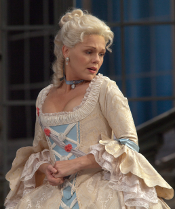 Miah Persson as Sophie
Last Monday, the production looked spiffy — how much of it is original
and not rebuilt and repainted, I wonder? — and Edo de Waart led a
sparkling performance of this most graciously autumnal of chestnuts. The comic
business may be familiar, but it went off without a hitch, from the
well-behaved lapdog and the wheezing lawyer in Act I to the dozen sword-waving
hussars in Act II to the raucous children in Act III. Stage direction is
credited to Robin Guarino, and there are some touches I don’t remember:
Did the children always mistake Valzacchi and Faninal for their Papa and have
to be rerouted? (That was funny.) Did the egotistical Singer (Barry Banks, in
full satirical glory) always trample his music in disgust when leaving the
levee? (So was that.) Did Baron Ochs always try to make out with another, more
willing maid of the Marschallin when Mariandel proved elusive? Most interesting
of all, maybe, did the Marschallin always totter about on an imaginary crutch
when daydreaming of her future, aged self? Or has Renée Fleming come up with
that bit in the years since she sang it last? She possesses comic chops she has
scarcely used in her prima donna career — as has been true of
many great stars.
What all this shows is the novelty that can be added, as casts change and work out new business, even in the most traditional stagings of thrice-familiar operas.
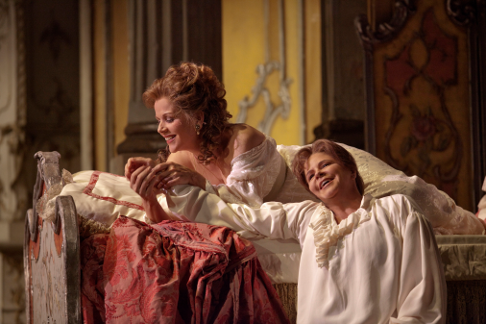 Susan Graham as Octavian and Renée Fleming as Marschallin
As she has approached the Marschallin’s years (allowing for inflation of the youthful stage from the 1760s to our era), Fleming’s voice has grown thinner, less penetrating on top but fuller, more satisfying in the lower reaches, with less of the famous velvet cream that thrills her fans but annoys those of us who have found her phrasing inexact. These sins were always less noticeable in German roles anyway — Strauss keeps her on her mettle. She was humorous here, as suits a Viennese, and maintained hauteur without the goddess-like dimension Kiri Te Kanawa used to bring, perhaps inappropriately, to the final scene.
Susan Graham makes a more convincing bumptious boy than she does a graceful lady in certain other roles. While Fleming’s voice has lost some luster on top, Graham’s I find thinner, ungraceful, in the lower reaches, more inclined to the blundering quality of “Mariandel,” even when she is singing Octavian’s lines. Her acting is appealing in both the amorous scenes with Fleming and the “flirtatious” punches she gives the Baron whenever he grabs “Mariandel” inappropriately — but the dramatic peak of the night came when Graham and Miah Persson’s Sophie stopped dead, half bowing, eye to eye, infatuated at first glance at the presentation of the rose and seemed almost unable to continue in their aristocratic ritual.
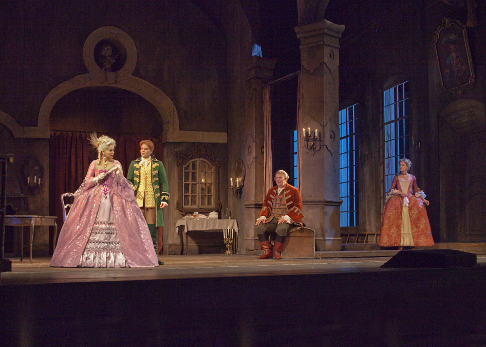 Susan Graham as Octavian, Renée Fleming as Marschallin, Miah Persson as Sophie and Kristin Sigmundsson as Baron Ochs
Miah Persson has a lively, energetic, easy high soprano, vocally lacking nothing called for by the part, but she lacked for me certain ideal Sophic qualities: there was less girlishness, less poutiness than with most. She was a woman, not a child — but Sophie is specifically a naïve fifteen. Her chatter on being introduced to the Marschallin was too calm for chatter, her breasts seemed awfully prominent and exposed for a girl fresh from a convent, and her grin is too wide; too, she is the tallest Sophie ever to grace this production — she has all the goods for Sophie, but she isn’t Sophie, at least not in this production. Perhaps they play the part more maturely in her native Sweden, a country sadly lacking in aristocratic convents.
Kristin Sigmundsson, tall even beside Susan Graham, made a grabby, sleazy, stingy, you-love-him-because-you-loathe-him Baron Ochs. His grainy voice is not what one would want in a lover in any case, and both his topmost and bottom notes were weak to inaudibility, but he inhabited the role to perfection. Hans-Joachim Ketelsen sang a fine Faninal, less dignified than some — but then, the man is a ridiculous snob, redeemed only because the piece is a comedy with Mozartean aspirations. Wendy White, as Annina, and Jennifer Check, as Sophie’s governess had the loudest voices on stage, though Jeremy Galyon’s policeman came close.
Some of the less well-judged cutenesses that afflicted recent revivals are gone, and the entire presentation is snappier. Either Robin Guarino or Edo de Waart should have most of the credit, but all hands win applause.
John Yohalem