Subscribe to
Opera Today

Receive articles and news via RSS feeds or email subscription.


twitter_logo[1].gif


UCP_9780226043425.gif

Recently in Reviews

Domingo Conducts Holdridge’s New Opera Dulce Rosa

Dulce Rosa, a brand new opera, had its world premiere Friday night, May 17, 2013 at the Broad Stage in Santa Monica, California. It was produced by Los Angeles Opera, but staged in the smaller theater.

Verdi’s Falstaff at Glyndebourne

Richard Jones’ 2009 production of Verdi’s Falstaff translates the action from the first Elizabethan age to the start of the second.

Gareth John, Wigmore Hall

Baritone Gareth John is rapidly accumulating a war-chest of honours. Winner of the 2013 Kathleen Ferrier Award, he recently won the Royal Academy of Music Patrons’ Award and was presented the Silver Medal by the Worshipful Company of Musicians.

La bohème at ENO

This second revival of Jonathan Miller’s La bohème was the first time I had caught the production.

Rolando Villazón: Verdi (International Opera Stars Series 2013)

It’s Verdi’s bicentenary year and Rolando Villazón has two new CDs to plug — titled somewhat confusingly, ‘Villazón: Verdi’ and ‘Villazón’s Verdi’, the latter a ‘personal selection’ of favourite numbers performed by stars of the past and present.

Brahms Third in San Francisco

Nicola Luisotti and the San Francisco Opera Orchestra climbed out of the War Memorial pit, braved the wind whipped bay and held spellbound an audience at Cal Performances’ Zellerbach Auditorium at UC Berkeley.

Ariane et Barbe-Bleue on Blu-Ray

Paul Dukas’ Ariane et Barbe-Bleue, first heard in 1907, once seemed important. Arturo Toscanini conducted the Met premiere in 1911 with Farrar and later arranged some of its music for a 1947 recording with his NBC Symphony.

Glyndebourne: Ariadne auf Naxos

Utterly mad but absolutely right — Richard Strauss’s Ariadne auf Naxos started the Glyndebourne 2013 season with an explosion. Strauss could hardly have made his intentions more clear. Ariadne auf Naxos is not “about” Greek myth so much as a satire on art and the way art is made.

Wozzeck at ENO

“Man is an abyss. It makes one dizzy to look into it.” So utters Georg Büchner’s Woyzeck, repeating what was also a recurring motif in the playwright’s own letters.

Mulhouse: Rare Britten Well Done

National Opera Company of the Rhine has marked this year’s Benjamin Britten celebration with a remarkably compelling, often gripping new production of the seldom-seen Owen Wingrave.

Frankfurt's Intriguing Idomeneo

Once upon a time, Frankfurt Opera had the baddest ass reputation in Germany as “the” cutting edge producer of must-see opera.

Rigoletto at Lyric Opera of Chicago

Productions of Giuseppe Verdi’s Rigoletto can serve as a vehicle for individual singers to make a strong impression and become afterward associated with specific roles in the opera.

Britten Sinfonia with Ian Bostridge

Just in case we were not aware that the evening’s programme was ‘themed’, the Britten Sinfonia designed a visual accompaniment to their musical exploration of night, sleep and dreams.

Aida, Manitoba Opera

Poor Aida! She never seems to have anything go her way.

Superlative singing: Don Carlo, Royal Opera House

Is it possible to upstage Jonas Kaufmann? Kaufmann was brilliant in this Verdi Don Carlo at the Royal Opera House, London, but the rest of the cast was so good that he was but first among equals. Don Carlo is a vehicle for stars, but this time the stars were everyone on stage and in the pit. Even the solo arias, glorious as they are, grow organically out of perfect ensemble. This was a performance that brought out the true beauty of Verdi's music.

Sarah Connolly: French Song at Wigmore Hall

The big names were absent: Duparc, D’Indy, Debussy, Ravel … and while Fauré, Chausson, Roussel and several members of Les Six put in an appearance, in less than familiar guises, this survey of French song of the early 20th century and interwar years deliberately took us on a journey through infrequently travelled terrain.

Rare restoration: Handel’s Esther 1720

Composed between 1718 and 1720, Handel’s Esther is sometimes described as the ‘first English Oratorio’, but is in fact a hybrid form, mixing elements of oratorio, masque, pastoral and opera.

The Damnation of Faust, London

Hector Berlioz's légende dramatique, La Damnation de Faust, exists somewhere between cantata and opera. Berlioz's flexible attitude to dramatic form made the piece unworkable on the stages of early 19th century Paris and his music is so vivid that you wonder whether the piece needs staging at all.

Elizabeth Connell Memorial Concert, St John's Smith Square

St. John’s Smith Square was the site of Elizabeth Connell’s final London concert, intended as a farewell to London on her moving to Australia. It was rendered ultimately final by her unexpected death.

Aida with all the Trimmings, Even a Blue Silk Elephant!

With the building of the Suez Canal, Egypt became more interesting to Western Europeans. Khedive Ismail Pasha wanted a hymn by Verdi for the opening of a new opera house in Cairo, but the composer said he did not write occasional pieces.

OPERA TODAY ARCHIVES »

Reviews

Above: Joyce DiDonato as Rosina [Photo by Ken Howard courtesy of Metropolitan Opera]
13 Oct 2009

Il Barbiere di Siviglia at the MET

Bartlett Sher’s production of Il Barbiere di Siviglia has proved one of the more admired stagings of the Peter Gelb regime, but I’ve avoided it due to a surfeit of Barbieres and to fond memories of the John Cox production on Robin Wagner’s delicious turntable set, about as ideal a Barbiere as could be imagined.

Gioachino Rossini: Il Barbiere di Siviglia

Rosina: Joyce Di Donato; Almaviva: Barry Banks; Figaro: Rodion Pogossov; Dr. Bartolo: John Del Carlo; Don Basilio: Orlin Anastassov; Berta: Claudia Waite. Conducted by Maurizio Benini. Metropolitan Opera, performance of October 8.

Above: Joyce DiDonato as Rosina

All photos by Ken Howard courtesy of Metropolitan Opera]


The complicated story was told clearly, the stage pictures were handsome and the set changes elegant, the funny business funny and to the point, the movement rapid. Even Rossini’s thunderstorm got laughs, as a projected starry sky was gradually effaced by clouds and real rain while the set spun around below. I wasn’t crazy about the barber’s updated costume and I could have done without the donkey — the donkey is the one item Mr. Sher retained. Figaro’s costume is back to tradition.

The Sher production does not get in the way of the storytelling (a major point! especially in a comic opera), does not introduce new sub-plots the composer never delineated (a defect of the recent stagings of Tosca, Sonnambula and Fidelio, among others), the stage pictures are attractive and will endure repeated viewing (unlike Tosca), the funny business is sometimes funny — and gives scope, as a comedy staging should, for funny performers to make it more so; there are inexplicable touches (what is that giant anvil in the sky, aside from a sign of Mr. Sher out of ideas? Why does Bartolo’s china closet explode?), and the movement is constant if not always logical. Seville, indicated in the previous production by the city’s famous white walls and a splendid conservatory in the courtyard of Bartolo’s mansion, is now implied by many, many doors and an orangery. At one point, the Count, playing a drunken soldier, makes a swipe at an orange tree with his saber — and appeared to slice it through — the best laugh of the night. I’d give the production a solid B, maybe a B-plus.

The most distinctive part of the Sher staging — aside from the moveable doors that comprise most of the set, and which are often used to delightful farcical advantage — is the platform around the orchestra pit that allows singers to leave the action and come warble to us intimately, duck out of busy action entirely, complain about how badly they are being used by other characters — or hand out business cards to the audience, as Figaro does during the curtain calls. This parade in front of the apron also allows a solid but underpowered cast to make a more powerful effect than they would if they remained center stage. There was certainly an improvement in sound quality when they stepped forward.

Among the singers last Thursday night, the smoothest, most elegant, most satisfying performance came from Bulgarian newcomer Orlin Anastassov, who possesses the requisite size, depth and legato for Don Basilio and is an amusing comic actor to boot. It is no surprise to see in the program that he is singing Boito’s Mefistofele elsewhere this year — that’s an opera that the Met could certainly use back in its repertory, and he’s a likely candidate to put over a role that calls for an agile actor as well as a remarkable voice.
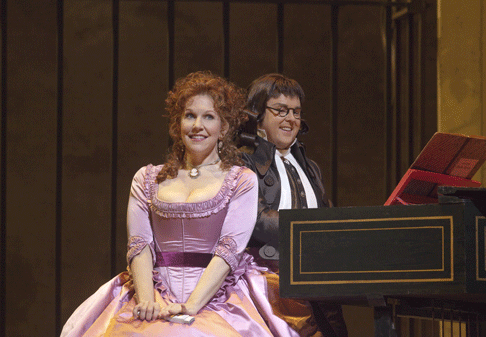
BARBIERE_DiDonato_and_Banks.gifJoyce DiDonato as Rosina and Barry Banks as Count Almaviva

Rodion Pogossov, a showman of great charm and comic energy — you may well remember his Papageno — sang a most entertaining Figaro, with a seductive and self-seductive way of phrasing. John Del Carlo, a familiar and excellent buffo quantity, fudged the racing patter of “A un dottore del mio sorte,” as so many Doctor Bartolos do, but proved an effective foil for the antics of all the others throughout the evening. You can’t have a farce if the villain isn’t convincingly alarming — if he’s not, nobody else’s antics make sense. Del Carlo, tall as a Wagnerian giant, can be alarming while full of self-pity, which is just what we want.

Barry Banks is a comic actor the equal of any bel canto tenor going — his smarmy smiles as the feigned “Don Alfonso” were especial joys — and his coloratura technique is remarkable, but the quality of the voice itself was dry in “Ecco ridente” and rather hollow the rest of the night. Dramatic intensity (as Oreste in Rossini’s Ermione) and delirious self-parody (as Thisbe in Britten’s Midsummer Night’s Dream) are his fortes; romantic heroes are not.
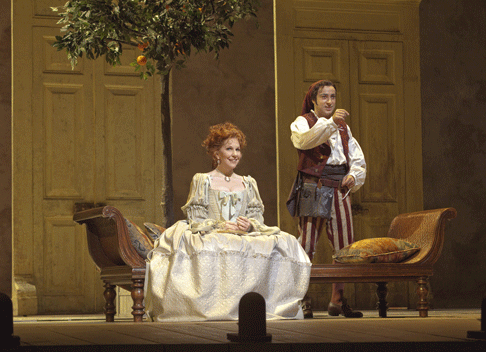
BARBIERE_DiDonato_and_Pogos.gifJoyce DiDonato as Rosina and Rodion Pogossov as Figaro

Joyce Di Donato is a few years into an important career. She is an excellent comic actress — you listen to her, yes, but you also watch, just to see what madcap business she’ll come up with next. She works the manic fireworks of “Contro un cor” in the Lesson Scene into a simultaneous show of brilliant vocalism and stage hilarity like no other Rosina I’ve seen. When she dashes out on that walkway to deliver the evening’s few big phrases, her strong line suggests that many of the grander bel canto roles (Adalgisa, Elisabetta Tudor, La Favorite) would suit her nicely, but in some of her rapid-fire phrases in “Una voce poco fa” and elsewhere, she seemed too anxious to race up and down the scale to bother with the note-perfect ideal flow of a Horne, a Berganza or a Swenson. She seems to love to play this role and to be on stage with these other singers, but a little more technical focus (and you just know she could do it) would make hers an extraordinary Rosina instead of merely a very good one. Claudia Waite, the Berta, sang her “sherbet aria” with the shrill, ungrateful tone one expects of, well, Berta the laundress.

Maurizio Benini in the all but invisible orchestra pit kept the wheels turning precisely without calling attention to himself — it was not a Mozartean reading of the score but a reliable base for the farcical doings on stage. The whole evening seemed calculated in that direction, and it was gracious of him to be so self-effacing, but sometimes Rossini works well as a partnership.

John Yohalem

Send to a friend

Send a link to this article to a friend with an optional message.

Friend's Email Address: (required)

Your Email Address: (required)

Message (optional):