Both light-weight works remained on the fringe of the Puccini repertory for
most of the twentieth century, though in recent years they have been exploited
in opera’s attempt at repertory expansion.
In San Francisco La rondine reappeared in 2007 in a lackluster
production made splendid by the magnetic Rondine of Angela Gheorghiu.
Il trittico was in the 1923 and 1952 SFO seasons (though parts of it
have appeared in many other years), and just now it has dared the War Memorial
stage once again, and succeeded as one of its truer artistic ventures!
The by-now enormous vocal resources of SFO triumphed, led by Merola and
Adler Fellow alumna Patricia Racette as all three heroines — Giorgetta,
Suor Angelica, Lauretta, supported by fifteen other past and present Merolini
and Adler Fellows, notably mezzo Catherine Cook as Frugola, Monitor and La
Ciesca. And not the least of whom was conductor Patrick Summers, a most
distinguished Merola alumnus. Three singers only, of the thirty two singers who
performed the myriad of roles across the three operas, validated the
company’s international pretensions, Italian baritone Paolo Gavanelli as
Michele and Gianni Schicchi, Polish contralto Ewa Podles as the Princess, and
Italian bass Andrea Silvestrelli as Il Talpa and Simone, thus delicately
spicing the otherwise all American brew.
Verismo as an operatic term is applied to the Puccini
oeuvre though verismo per se is much purer than any Puccini
opera ever wanted to be. Puccini was far more entralled by horror theater, the
infamous Grand Guignol, like the blood bath that concludes Madama
Butterfly, her two-year-old son looking on, and particularly in the
revelation of Luigi’s mutilated body in the triptych’s Il
tabarro. Not to mention Suor Angelica’s on-stage suicide
under the gaze of the Virgin Mary, and the Gianni Schicchi
heirs’ horror that their arms be reduced to stumps.
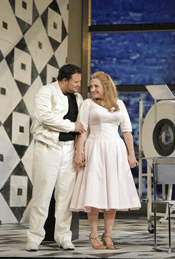 David Lomelí (Rinuccio) and Patricia Racette (Lauretta) in Gianni Schicchi
Paris’ Theatre du Grand Guignol, the world’s original horror
theater (20 rue Chaptal), finally petered out in 1962, the public no longer
titillated by the contemplation of the gruesome. But it was going strong during
and after the first world war, and fashionable for the fashionable. Puccini was
a man of his times, a true Italian with his finger on the pulse of style, and
all style was Parisian just then. Voilà Il trittico.
Nowhere on earth do opera audiences seem partial to high style. Thus when
West Virginia born stage director James Robinson conceived this fairly high
concept production for New York City Opera in 2002 he was careful to imbue its
original cutting edge style with adorable, witty images. The first was even a
caricature, a super-endowed and sexually overripe female alone on the empty
stage slinking alongside a mostly submerged hut. Puccini’s Seine flowed
as bored time and there was little hint of a Parisian dockside, it could have
been near a coal mine as well, but where was not the point as long as it was
dark and low.
Robinson stripped la Frugola of her usual pathos, instead we saw a happy,
giddy floozy with her homey fantasies. Luigi was a lanky American boy, not
smart enough to keep his hands off the boss’s wife, Giorgetta, who was
aching to be touched in her little girl, Butterfly voice, and strangely
dismissive of her baby’s death. At last Michele blew-up in nearly buffo
terms leaving Luigi dead, hanging from his arms like a Michelangelo Pietà.
Robinson rendered Suor Angelica’s seventeenth century convent as a
twentieth century children’s hospital adorable in its sterile detail. Its
diseased and maimed occupants were quietly eating lunch while its custodians
chattered about trivial spiritual concerns. The maiden aunt arrived in
supercilious Protestant outrage and the resulting suicide was somehow rendered
by all this clutter into terms that were softly personal, and heart wrenchingly
tender. The final, blurred vision of an Asian-American boy (Trouble, now seven
years old?) was super witty, hardly maudlin at all.
Robinson made Buoso Donati’s home with a view a shiny white high rise
hospital room, so shiny that its patterned black and white marble floor was
perfectly reflected on the walls and ceiling, the heirs attired in oh-so
impeccably fashionable black and white. Lauretta was a daddy’s valley
girl who got finally everything she wanted, save a good view of Florence as set
designer Alan Moyer’s Duomo dome ruthlessly blocked most of it.
Nothing’s perfect.
And so the more delicate sensibilities of twenty-first century audiences
were titillated by wit rather than horror. And greatly so by the superb
individual performances of the entire cast. Patricia Racette, without doubt the
world’s reigning Butterfly, was in magnificent voice (9/30). She applied
the wiles of the complex Butterfly role to Puccini’s quickly drawn
triptych heroines with contagious gusto. Though Il trittico had its
world premiere at the Met in 1918 (with three different sopranos), the Met
jumped the anniversary gun by introducing a new production by Jack
O’Brien in 2004. Odds are that even the new, enlightened Met with its
reprise next year (with la Racette) cannot one-up this low budget NYCO
production as it was incarnated just now at SFO.
Notable among many fine performances was American tenor Brandon Jovanovich,
already an SFO Pinkerton (2007), whose rendering of Luigi as a down-and-out
itinerant worker willing enough to appease Giorgetta’s animal needs was
down-right real. Mexican tenor David Lomelí, an Adler Fellow, brought solid
voice, stolid presence and just about enough stature to fill the shoes of
Lauretta’s fiance Rinuccio. Impressive indeed was the contralto voice and
performance of Merola alumna Meredith Arwady as the Abbess and Zita.
And finally Paolo Gavanelli stepped off the stage onto the apron to have the
last word, and beg applause for his vivid performances of two of opera’s
most sympathetic villains, Michele and Schicchi, and for Puccini’s kitsch
operatic novellas of heaven and hell, and purgatory too. There was a mighty
roar, particularly for the responsive, hyper-sensitive conducting of Patrick
Summers who got Puccini just right for this heady concoction.
Michael Milenski
![Patricia Racette (Sister Angelica) in Suor Angelica [Photo by Cory Weaver courtesy of San Francisco Opera]](http://www.operatoday.com/Suor_Rac1.gif)