Subscribe to
Opera Today

Receive articles and news via RSS feeds or email subscription.


twitter_logo[1].gif


9780521746472.png

Recently in Reviews

James Melton: The Tenor of His Times

Those of us of a certain age have fond memories of James Melton, who entertained our parents starting in the 1930s and the rest of us in the 1940s and beyond on recordings, the radio, and films.

The Importance of Being Earnest, Covent Garden

The Importance of Being Earnest , Gerald Barry’s fifth opera, was commissioned by the Los Angeles Philharmonic Orchestra and the Barbican, and was first performed in concert, Thomas Adès conducting the London premiere.

Death in Venice by ENO

‘Beauty is the one form of spirituality that we experience through the senses.’ In Thomas Mann’s, Death in Venice, Plato’s axiom stirs the hopes of the aging, intellectually stale poet, Gustav von Aschenbach, that he may rekindle his creativity.

Adding Movie Magic to The Magic Flute

What better way for Masonic brothers, Wolfgang Amadeus Mozart and Emmanuel Shikaneder to disseminate Masonic virtues, than through the most popular musical entertainment of their age, a happy ending folktale that features a dragon, enchanting flutes and bells, mixed-up parentage, and a beautiful young princess in distress?

Madama Butterfly, Opera Holland Park

There is a sense in which it all began in London, Puccini having been seized in 1900 with the idea of an opera on this subject after watching David Belasco’s play here.

An Evening of Zarzuela and Latin American Music at Los Angeles Opera

The tenor that the audience most wanted to hear, Plácido Domingo, opened the vocal program with “Junto al puente de la peña” (Next to the rock bridge) from La Canción del Olvido (The song of Oblivion) by José Serrano. He sounded rested and his voice soared majestically over the orchestra.

Così fan tutte in San Francisco

Tucked away somewhere in the San Francisco Opera warehouse was an old John Cox production of Così fan tutte from Monte Carlo. Well, not that old by current standards at San Francisco Opera.

Rossini Maometto Secondo Garsington Opera at Wormsley

Rossini's Maometto Secondo is a major coup for Garsington Opera at Wormsley, confirming its status as the leading specialist Rossini house in Britain. Maometto Secondo is a masterpiece, yet rarely performed because it's formidably difficult to sing. It's a saga with some of the most intense music Rossini ever wrote, expressing a drama so powerful that one can understand why early audiences needed "happy endings" to water down its impact

Peter Grimes in Concert

I suppose it was inevitable that, in this Britten Centenary year, the 66th Aldeburgh Festival would open with Peter Grimes.

Die Entführung aus dem Serail, Garsington Opera at Wormsley

Die Entführung aus dem Serail at Garsington Opera at Wormsley isn’t Mozart as you’d expect but it’s true to the spirit of Mozart who loved witty, madcap japes.

Le nozze di Figaro, Glyndebourne

What a pity! On a glorious — well, by recent English standards — summer’s day, there can be few more beautiful English countryside settings than Glyndebourne, with the added bonus, as alas much of the audience appears to understand it, of an opera house attached.

Queens, Heroines and Ladykillers

Described by one critic as “cosmically gifted”, during her tragically short career, American mezzo-soprano Lorraine Hunt Lieberson amazed and delighted audiences with the spellbinding beauty of her singing and the astonishing honesty of her performances.

L’Incoronazione di Poppea from Virgin Classics

Since its first performance at the Teatro Santi Giovanni e Paolo during Venice’s 1643 Carnevale, Monteverdi’s L’Incoronazione di Poppea has been one of the most important milestones in the genesis of modern opera despite its 250 years of unmerited obscurity. 

Alzira by Chelsea Opera Group

“I wrote it almost without noticing.” So Verdi declared when reminded of his eighth — and perhaps least frequently performed, opera, Alzira. One might say that, since he composed the work, no-one else has much noticed either.

Les Contes d’Hoffmann in San Francisco

Just when you thought the protagonist was Hoffmann! Who, rather what stole the show?

La Tosca in Los Angeles

When is verismo verily veristic? Or what is a virginal girl dressed in communion white doing in the two murderous acts of the Los Angeles Opera’s current production of Tosca? And why does she sing the shepherd's song?

Saverio Mercadante: I due Figaro

Though 2013 is the bicentennial of the births of Giuseppe Verdi and Richard Wagner, the releases of Cecilia Bartoli’s recording of Bellini’s Norma on DECCA, a new studio recording of Donizetti’s Caterina Cornaro from Opera Rara, and this première recording of Saverio Mercadante’s forgotten I due Figaro, suggest that this is the start of a summer of bel canto.

Lohengrin, Welsh National Opera

Wagner’s Lohengrin is not an unfamiliar visitor to the UK thanks, in the main, to Elijah Moshinsky’s perennial production at Covent Garden.

Philip Glass: The Perfect American

Philip Glass's The Perfect American at the ENO in London is a visual treat, but the libretto is mind-numbingly anodyne.

Christian Thielemann’s Der Ring des Nibelungen

Recording Richard Wagner’s Der Ring des Nibelungen is for a record label equivalent to a climber reaching the summit of Mount Everest: it is the zenith from which a label surveys its position among its rivals and appreciates an achievement that can define its reputation for a generation. 

OPERA TODAY ARCHIVES »

Reviews

Imogen Cooper [Photo by Sussie Ahlburg courtesy of Askonas Holt]
06 Oct 2009

Imogen Cooper's Birthday at the Wigmore Hall

This wasn't an ordinary concert but something very special. The Wigmore Hall was honouring Imogen Cooper on her 60th birthday. She is greatly loved here, both as soloist and as partner in song recitals. The atmosphere was electric. The house was packed, with many famous pianists and singers in the audience. It was a historic occasion, but it felt like a party among friends.

Imogen Cooper 60th Birthday Concert

Imogen Cooper (piano), Wolfgang Holzmair (baritone), Mark Padmore (tenor), Sophie Wieder-Atherton (cello), Paul Lewis (piano). Wigmore Hall, London 28th September 2009.

Above: Imogen Cooper [Photo by Sussie Ahlburg courtesy of Askonas Holt]


Imogen Cooper is a superlative artist, so it might seem unfair to comment on her appearance, but she looked truly radiant, her face lit up with heartfelt happiness. Few deserve a tribute like this more than she, for she’s formidably dedicated. She could easily have chosen a programme to showcase her skills as soloist, with a special gift for Schubert, Schumann, and Mendelssohn. Instead, she chose to highlight others with whom she’s worked with. “I didn’t feel like working too hard”, she joked, in typical self effacing manner.

Imogen Cooper was a child prodigy sent to Germany, France and Austria, where she developed her formidable technique. Being isolated, she turned to Romantic poetry and song. Her affinity for Lieder was formed at an early age and is highly intuitive. Wolfgang Holzmair used to say he couldn’t imagine working with a pianist who didn’t instinctively live the texts as well as the music. Then he met Cooper and the rest is history. Theirs is one of the most enduring partnerships in the Lieder world.

It would be almost impossible to imagine an Imogen Cooper tribute without involving Holzmair in some way.Together, they’ve pioneered the songs of another great Lieder relationship, Robert and Clara Schumann and have mnade a notable recording. The two sets of songs by Robert Schumann chosen here date from 1840, the year Robert and Clara were finally able to marry, which inspired an explosion of song. Lieder aus dem Schenkenbuch Im Divan I and II (op 26 nos 5 and 6) are droll songs about getting drunk and louche, performed with folksy humour. In Venezianisches Lied I and II *(op 25 nos. 17 and 18), Cooper’s playing evoked the gentle rocking of oars steadily pacing through lagoons, as Holzmair sings of gondoliers and serenades on moonlit balconies. Clara’s songs *O Lust, O Lust *op 23 no 6) and *Die stille Lotosblume (op 13 no 6) have less obvious character, surprisingly as Clara was the first great female pianist to have an international career. Nonetheless, Holzmair and Cooper presented her songs with conviction.

As a treat, suitable for the party atmosphere, Holzmair and Cooper did a playful encore - a song from an operetta of the 1930’s by Robert Stolz. It’s a joyful ditty about dancing and happiness. Stolz was a lavishly lucky man who made and lost and remade several fortunes. At the age of 60, bald, broke and exiled, he was arrested in Paris when the Germans occupied. A few weeks before, he’d met a beautiful 19 year old heiress, who promptly sprung him from prison and married him. She still lives in Vienna, keeping his flame. Another reason to celebrate !
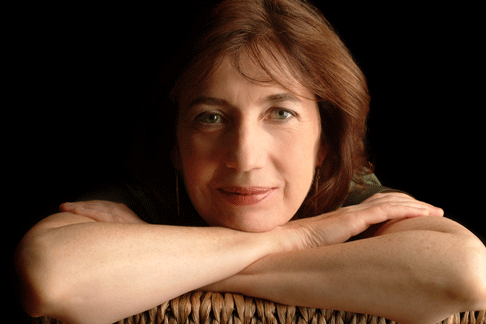
imogen-cooper.gifImogen Cooper [Photo by Benjamin Ealovega courtesy Askonas Holt]

Cooper’s partnership with Mark Padmore is more recent. Holzmair and Padmore sang Mendelssohn duets for tenor and baritone (op 52, nos 1,2 amnd 3) followed by Wasserfärht (op 50 no 4), where the voices bob up and down, like waves on the open sea while the piano melody surges forth like the ship in the poem. Padmore followed the set with four songs from Schubert. I’m very fond of Padmore’s work in baroque repertoire, but in Lieder he’s rather understated, though on an evening as genial as this it didn’t matter. Cooper provided plenty of vigour and personality. In *Die Sterne *(D939) she played the twinkling “starlight” motifs vividly, and the song came to life.

Imogen Cooper and Sophie Wieder-Atherton played a group of Janáček and Schumann pieces for piano and cello. The combination brought out the folk tunes both used, but in very different ways. Most of these pieces favoured the cello, so Wieder-Atherton took the lead, Cooper provided sensitive support.

Getting together a group of musicans like this was a wonderful opportunity to present repertoire normally beyond the scope of a song or conventional piano recital. This was a rare chance to hear Schubert’s Auf dem Strom (D 943). Voice, piano and cello weave together in counterpoise. Imogen Cooper and Paul Lewis then played the four hand Fantasy in F minor (D940). Both works arevery late Schubert, both performed in the composer’s presence. Schubertiades were intimate, friendly affairs, where people got together to enjoy good music in a convivila mood : perfect for a celebration like this.

Appropriately the encore brought everyone together. It was Brahm’s Liebesliederwalzer no 3,. “I wonder they we thought of that?”, quipped Cooper with a cheerful smile. Then Holzmair and Padmore began to sing. “O die Frauen ! O die frauen ! wie sie Wonne tauen. Wäre lang ein Mönch geworden, wäre nicht die Frauen !” (Women are bliss, if not for them, we’d be monks)

Anne Ozorio

Program:

Mendelssohn : Ich wollt’, meine Liebe ergösse sich, Abschiedslied der Zugvögel, Gruß, Wasserfärht
Schubert : An die Laute, Abendstern, Daß sie hier gewesen, Die Sterne
Clara Schumann : O Lust, O Lust, Die stille Lotosblume
Robert Schumann : Lieder aus dem Schenkenbuch im Divan i and II, Venezianische Lieder I and II
Janáček : Pohádka no 1, 2 and 3
Robert Schumann : Stücke im Volkston 2 and 3
Schubert : Auf dem Strom, Fantasy in F minor for piano duet

Send to a friend

Send a link to this article to a friend with an optional message.

Friend's Email Address: (required)

Your Email Address: (required)

Message (optional):