![Ruxandra Donose as Concepcion [Photo by Johan Persson courtesy of the Royal Opera House]](http://www.operatoday.com/HEURE-370-DONOSE%20AS%20CONCEPCION-%28C%29PERSSON.png)
26 Oct 2009
Ravel and L’Heure Espagnole at Covent Garden
Greed, lust and folly … Richard Jones’ comic double bill, first seen in 2007 and faithfully revived here by Elaine Kidd, certainly sharpens the spotlight on those eternal human foibles.
English Touring Opera are delighted to announce a season of lyric monodramas to tour nationally from October to December. The season features music for solo singer and piano by Argento, Britten, Tippett and Shostakovich with a bold and inventive approach to making opera during social distancing.
This tenth of ten Live from London concerts was in fact a recorded live performance from California. It was no less enjoyable for that, and it was also uplifting to learn that this wasn’t in fact the ‘last’ LfL event that we will be able to enjoy, courtesy of VOCES8 and their fellow vocal ensembles (more below …).
Ever since Wigmore Hall announced their superb series of autumn concerts, all streamed live and available free of charge, I’d been looking forward to this song recital by Ian Bostridge and Imogen Cooper.
The Sixteen continues its exploration of Henry Purcell’s Welcome Songs for Charles II. As with Robert King’s pioneering Purcell series begun over thirty years ago for Hyperion, Harry Christophers is recording two Welcome Songs per disc.
Although Stile Antico’s programme article for their Live from London recital introduced their selection from the many treasures of the English Renaissance in the context of the theological debates and upheavals of the Tudor and Elizabethan years, their performance was more evocative of private chamber music than of public liturgy.
In February this year, Albanian soprano Ermonela Jaho made a highly lauded debut recital at Wigmore Hall - a concert which both celebrated Opera Rara’s 50th anniversary and honoured the career of the Italian soprano Rosina Storchio (1872-1945), the star of verismo who created the title roles in Leoncavallo’s La bohème and Zazà, Mascagni’s Lodoletta and Puccini’s Madama Butterfly.
Evidently, face masks don’t stifle appreciative “Bravo!”s. And, reducing audience numbers doesn’t lower the volume of such acclamations. For, the audience at Wigmore Hall gave soprano Elizabeth Llewellyn and pianist Simon Lepper a greatly deserved warm reception and hearty response following this lunchtime recital of late-Romantic song.
Collapsology. Or, perhaps we should use the French word ‘Collapsologie’ because this is a transdisciplinary idea pretty much advocated by a series of French theorists - and apparently, mostly French theorists. It in essence focuses on the imminent collapse of modern society and all its layers - a series of escalating crises on a global scale: environmental, economic, geopolitical, governmental; the list is extensive.
For this week’s Live from London vocal recital we moved from the home of VOCES8, St Anne and St Agnes in the City of London, to Kings Place, where The Sixteen - who have been associate artists at the venue for some time - presented a programme of music and words bound together by the theme of ‘reflection’.
'Such is your divine Disposation that both you excellently understand, and royally entertaine the Exercise of Musicke.’
Amongst an avalanche of new Mahler recordings appearing at the moment (Das Lied von der Erde seems to be the most favoured, with three) this 1991 Mahler Second from the 2nd Kassel MahlerFest is one of the more interesting releases.
‘And there was war in heaven: Michael and his angels fought against the dragon; and the dragon fought and his angels, And prevailed not; neither was their place found any more in heaven … that old serpent … Satan, which deceiveth the whole world: he was cast out into the earth, and his angels were cast out with him.’
If there is one myth, it seems believed by some people today, that probably needs shattering it is that post-war recordings or performances of Wagner operas were always of exceptional quality. This 1949 Hamburg Tristan und Isolde is one of those recordings - though quite who is to blame for its many problems takes quite some unearthing.
There was never any doubt that the fifth of the twelve Met Stars Live in Concert broadcasts was going to be a palpably intense and vivid event, as well as a musically stunning and theatrically enervating experience.
‘Love’ was the theme for this Live from London performance by Apollo5. Given the complexity and diversity of that human emotion, and Apollo5’s reputation for versatility and diverse repertoire, ranging from Renaissance choral music to jazz, from contemporary classical works to popular song, it was no surprise that their programme spanned 500 years and several musical styles.
The Academy of St Martin in the Fields have titled their autumn series of eight concerts - which are taking place at 5pm and 7.30pm on two Saturdays each month at their home venue in Trafalgar Square, and being filmed for streaming the following Thursday - ‘re:connect’.
The London Symphony Orchestra opened their Autumn 2020 season with a homage to Oliver Knussen, who died at the age of 66 in July 2018. The programme traced a national musical lineage through the twentieth century, from Britten to Knussen, on to Mark-Anthony Turnage, and entwining the LSO and Rattle too.
With the Live from London digital vocal festival entering the second half of the series, the festival’s host, VOCES8, returned to their home at St Annes and St Agnes in the City of London to present a sequence of ‘Choral Dances’ - vocal music inspired by dance, embracing diverse genres from the Renaissance madrigal to swing jazz.
Just a few unison string wriggles from the opening of Mozart’s overture to Le nozze di Figaro are enough to make any opera-lover perch on the edge of their seat, in excited anticipation of the drama in music to come, so there could be no other curtain-raiser for this Gala Concert at the Royal Opera House, the latest instalment from ‘their House’ to ‘our houses’.
"Before the ending of the day, creator of all things, we pray that, with your accustomed mercy, you may watch over us."
Greed, lust and folly … Richard Jones’ comic double bill, first seen in 2007 and faithfully revived here by Elaine Kidd, certainly sharpens the spotlight on those eternal human foibles.
Yet this is not an evening of dark cynicism: John MacFarlane’s front cloths for Ravel’s L'Heure Espagnole and Puccini’s Gianni Schicchi for — a glimpse of busty cleavage, enticing coils of pasta — signal that it’s earthly pleasure and not divine punishment which is centre stage in these witty, delightful productions.
Macfarlane’s set for Ravel’s one-act gem is inspired. Frustrated by her husband’s prim devotion to his business affairs, and longing for more action in the boudoir, Concepcion, the frisky wife of the town clockmaker, Torquemada, is literally confined in the false proscenium. There are many clever touches; as when the embossed rose wallpaper and rich curtains are slyly transformed by Mimi Jordan Sherin’s slick lighting from shop décor to bedroom draperies. Torquemada’s weekly maintenance tour of the civic clocks offers Concepcion her sole hour of freedom, and the passionate poet, Gonzalve, is quick to take advantage. But, on this occasion, Torquemada has ordered Ramiro, a muleteer, to wait in the shop. The overwhelming number of ticking clock faces reminds us of just how little time Concepcion has to enact her plan, adding a tinge of hysteria to the frantic mood. And, there is plenty of opportunity for farce and slapstick, as first Gonzalve and then a second admirer, the banker Don Inigo Gomez, hide in the clocks, while Concepcion decides to spurn both, in favour of the brawny Ramiro.
The characters are parodies worthy of commedia dell’arte — the bloated banker, the idealist poet, the gullible youth, the frustrated housewife — and they are clothed in suitably garish costumes by Nicky Gillibrand. The Romanian soprano, Ruxandra Donose, is impressive as the aptly named Concepcion, fully convincing as she grows ever-more frustrated and desperate, and singing with superb projection. As the muscular muleteer, Ramiro, Christopher Maltman’s bright, golden sound is perfect. Maltman bounds with puppyish energy, happily heaving and twirling grandfather clocks at Concepcion’s whim, and showing both heft and lyricism in this detailed interpretation of the role. The hapless poet, Gonzalve, is sung by the French tenor, Yann Beuron, whose warm, passionate tone conjures a suitably dreamy air; Andrew Shore delivers a typically witty and well-timed cameo as the blustering Gomez.
Ravel’s score is rich and ravishing, almost too sophisticated for the ribald tale it illuminates. Pappano paced it perfectly, allowing us to appreciate how deftly Ravel eases between genres — here the lilt of a pasodoble, now a jazzy syncopation, next a pulsing habanera. Ravel is just as capable of musical irony as Les Six, and just as adept at pastiche and parody as Stravinsky. This is a dense, detailed score, with castanets, tambour de basque and sarrusophone supplementing just a few of the sounds supplementing the large orchestral forces. Drawing exquisitely refined playing from the ROH orchestra, Pappano reined in the forces at his disposal, never overwhelming his singers, while allowing the details to serve the stage incident.
A chorus of show-girls joins the cast for the final number on lust and love, the dazzling glitz and glamour both darkly ironic and lushly entertaining: we heed the moral, while relishing the rollick.
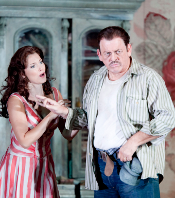 Maria Bengtsson as Lauretta and Thomas Allen as Gianni Schicchi
Long overshadowed by its tragic partners in Puccini’s triptych Il
Trittico, Gianni Schicci is a delicious satire on avarice. Buoso
Donati’s death prompts an anxious search by his presumptuous but
down-at-heel family for his will: locating it, Rinuccio demands permission to
marry the peasant girl, Lauretta, in exchange for handing it to his aunt, Zita.
All are distraught to discover that Buoso has left his fortune to a monastery,
but Rinuccio assures them that there is someone who can help — Gianni
Schicchi, Lauretta’s father. Impersonating first a doctor who declares
Buoso revived, and then Buoso himself, Schicci conjures a plan to ensure his
and the lovers’ future wealth and happiness, while the Donatis make
greedy grabs for their inheritance, torn between their avarice and their social
pretensions.
Jones gives us quite a dark reading of this score: the grimy, drab 1950s décor, complete with peeling wallpaper, broken television set and rusting radiators, certainly enhances the Donatis’ mood of desperation. The large cast, including children and farceurs, are expertly choreographed throughout, in an astoundingly detailed, meticulous staging which demonstrates both imagination and an intelligent responsiveness to Puccini’s score. Not a movement, gesture or facial expression is misplaced: manic it certainly is, but never messy.
The cast are uniformly superb — a convincing portrait of collective greed. Yet each character is fully individualised through gesture. This revival featured many of the original cast, and they clearly enjoyed themselves, musically and dramatically. Mezzo-soprano Elena Zilio was outstanding in the role of Aunt Zita, confident and controlled; while Gwynne Howell made for a distinguished Simone, the head of the grasping clan. They were matched by fine performances from Marie McLaughlin (La Ciesca), Jeremy White (Betto di Signa), Robert Poulton (Marco), Alan Oke (Gherardo) and Janis Kelly (a hand-bag swinging Nella).
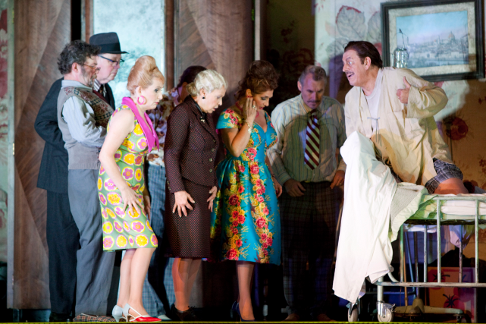 From left to right: Jeremy White as Betto di Signa, Gwynne Howell as Simone, Janis Kelly as Nella, Elena Zilio as Zita, Marie McLaughlin as La Ciesca, Robert Poulton as Marco, Thomas Allen as Gianni Schicchi
The celebrated aria, ‘O mio babbino caro’, is probably the only number from this dazzling score which is familiar to many in the audience. Here, rather than stopping the show, it was expertly incorporated into the dramatic fabric. Maria Bengtsson charmed and delighted as Lauretta; her powerful, affecting rendition was aptly supported by Pappano, who shaped the phrases sensitively and eloquently. Bengtsson was ably partnered by the American tenor, Stephen Costello who, as the dashing, aspiring young lover, both looked and sounded the part, his ardent tenor ringing out warm and true. In the title role, Thomas Allen gave a typically consummate musical and dramatic performance.
These two stylish, clever stagings offer an evening of light mischief, musical charm and dramatic froth. Delicious — not to be missed.
Claire Seymour