![Anthony Michael-Moore (Rigoletto) and Michael Fabiano (Duke of Mantua) [Photo by Chris Christodoulou courtesy of English National Opera]](http://www.operatoday.com/rigoletto_002.jpg)
11 Oct 2009
Rigoletto at ENO
There is something quote refreshing about the fact that a staging as characterful as Jonathan Miller's 27-year-old “New York Mafia” Rigoletto is the nearest thing to a warhorse that ENO has in its repertoire.
English Touring Opera are delighted to announce a season of lyric monodramas to tour nationally from October to December. The season features music for solo singer and piano by Argento, Britten, Tippett and Shostakovich with a bold and inventive approach to making opera during social distancing.
This tenth of ten Live from London concerts was in fact a recorded live performance from California. It was no less enjoyable for that, and it was also uplifting to learn that this wasn’t in fact the ‘last’ LfL event that we will be able to enjoy, courtesy of VOCES8 and their fellow vocal ensembles (more below …).
Ever since Wigmore Hall announced their superb series of autumn concerts, all streamed live and available free of charge, I’d been looking forward to this song recital by Ian Bostridge and Imogen Cooper.
The Sixteen continues its exploration of Henry Purcell’s Welcome Songs for Charles II. As with Robert King’s pioneering Purcell series begun over thirty years ago for Hyperion, Harry Christophers is recording two Welcome Songs per disc.
Although Stile Antico’s programme article for their Live from London recital introduced their selection from the many treasures of the English Renaissance in the context of the theological debates and upheavals of the Tudor and Elizabethan years, their performance was more evocative of private chamber music than of public liturgy.
In February this year, Albanian soprano Ermonela Jaho made a highly lauded debut recital at Wigmore Hall - a concert which both celebrated Opera Rara’s 50th anniversary and honoured the career of the Italian soprano Rosina Storchio (1872-1945), the star of verismo who created the title roles in Leoncavallo’s La bohème and Zazà, Mascagni’s Lodoletta and Puccini’s Madama Butterfly.
Evidently, face masks don’t stifle appreciative “Bravo!”s. And, reducing audience numbers doesn’t lower the volume of such acclamations. For, the audience at Wigmore Hall gave soprano Elizabeth Llewellyn and pianist Simon Lepper a greatly deserved warm reception and hearty response following this lunchtime recital of late-Romantic song.
Collapsology. Or, perhaps we should use the French word ‘Collapsologie’ because this is a transdisciplinary idea pretty much advocated by a series of French theorists - and apparently, mostly French theorists. It in essence focuses on the imminent collapse of modern society and all its layers - a series of escalating crises on a global scale: environmental, economic, geopolitical, governmental; the list is extensive.
For this week’s Live from London vocal recital we moved from the home of VOCES8, St Anne and St Agnes in the City of London, to Kings Place, where The Sixteen - who have been associate artists at the venue for some time - presented a programme of music and words bound together by the theme of ‘reflection’.
'Such is your divine Disposation that both you excellently understand, and royally entertaine the Exercise of Musicke.’
Amongst an avalanche of new Mahler recordings appearing at the moment (Das Lied von der Erde seems to be the most favoured, with three) this 1991 Mahler Second from the 2nd Kassel MahlerFest is one of the more interesting releases.
‘And there was war in heaven: Michael and his angels fought against the dragon; and the dragon fought and his angels, And prevailed not; neither was their place found any more in heaven … that old serpent … Satan, which deceiveth the whole world: he was cast out into the earth, and his angels were cast out with him.’
If there is one myth, it seems believed by some people today, that probably needs shattering it is that post-war recordings or performances of Wagner operas were always of exceptional quality. This 1949 Hamburg Tristan und Isolde is one of those recordings - though quite who is to blame for its many problems takes quite some unearthing.
There was never any doubt that the fifth of the twelve Met Stars Live in Concert broadcasts was going to be a palpably intense and vivid event, as well as a musically stunning and theatrically enervating experience.
‘Love’ was the theme for this Live from London performance by Apollo5. Given the complexity and diversity of that human emotion, and Apollo5’s reputation for versatility and diverse repertoire, ranging from Renaissance choral music to jazz, from contemporary classical works to popular song, it was no surprise that their programme spanned 500 years and several musical styles.
The Academy of St Martin in the Fields have titled their autumn series of eight concerts - which are taking place at 5pm and 7.30pm on two Saturdays each month at their home venue in Trafalgar Square, and being filmed for streaming the following Thursday - ‘re:connect’.
The London Symphony Orchestra opened their Autumn 2020 season with a homage to Oliver Knussen, who died at the age of 66 in July 2018. The programme traced a national musical lineage through the twentieth century, from Britten to Knussen, on to Mark-Anthony Turnage, and entwining the LSO and Rattle too.
With the Live from London digital vocal festival entering the second half of the series, the festival’s host, VOCES8, returned to their home at St Annes and St Agnes in the City of London to present a sequence of ‘Choral Dances’ - vocal music inspired by dance, embracing diverse genres from the Renaissance madrigal to swing jazz.
Just a few unison string wriggles from the opening of Mozart’s overture to Le nozze di Figaro are enough to make any opera-lover perch on the edge of their seat, in excited anticipation of the drama in music to come, so there could be no other curtain-raiser for this Gala Concert at the Royal Opera House, the latest instalment from ‘their House’ to ‘our houses’.
"Before the ending of the day, creator of all things, we pray that, with your accustomed mercy, you may watch over us."
There is something quote refreshing about the fact that a staging as characterful as Jonathan Miller's 27-year-old “New York Mafia” Rigoletto is the nearest thing to a warhorse that ENO has in its repertoire.
It’s doubly refreshing this season to have Miller himself back to direct the revival, as he did last season with his Barber of Seville. It is in the detail that his influence is visible; the character inter-relationships are complex and clearly drawn, and for the first time I can recall, James Fenton’s classic translation is delivered in authentically-accented New York-ese instead of generic English RP. It all makes a difference.
The sets are looking a little dated (recreating the shapes and colours of the 1950s through 1982-tinted spectacles) and the lighting could do with a revamp. Both the backstreet outside Rigoletto's tenement block and the seedy riverside bar where Sparafucile makes his nefarious living are reliant upon lighting for their atmosphere, and at the moment it's all looking a bit dull and disinterested. But it remains a strong, tightly conceived show, with seemingly plenty of life left in it.
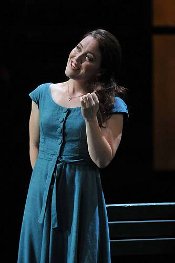 Katherine Whyte (Gilda)
In the title role was the evening's real star turn: Anthony Michaels-Moore,
too long absent from London’s stages and far, far too long absent from
the Coliseum. Compared with some of his predecessors in this production whose
physical presence have enabled them to dominate the stage overtly,
Michaels-Moore is much more subtle; his Rigoletto is a grubby little man with
an undercurrent of spite, embodying everything that is wrong with the world in
which he lives. And his singing is just spectacular — a masterclass in
Verdian line and phrasing.
In a trend becoming increasingly prevalent in ENO’s casting, the conductor and two of the key principals were imported from the other side of the Atlantic. (Don’t British singers have few enough home-grown opportunities as it is?) As Gilda, the young Canadian Katherine Whyte is a charming performer with a lovely limpid soprano and the ideal physique du role, but her voice is a good couple of sizes too small for this house and these colleagues, and instead of soaring over the top of ‘Si, vendetta’ (‘Yes, revenge’) and ‘Bella figlia dell’amore’ (‘If you want a faithful lover’) she was lost in the orchestral texture. I would very much like to hear her in this role again (well, really for the first time!) with one of the UK’s medium-sized companies, or perhaps here at the Coliseum again in a more sparsely scored opera — I see that most of her forthcoming work is in baroque and early classical repertoire.
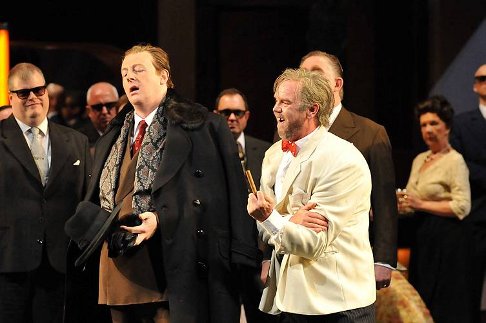 Ian Paterson (Monterone) and Anthony Michaels-Moore (Rigoletto)
As the Duke, 25-year-old Michael Fabiano (from the USA) was a great deal more successful; a bright, brash, virile tenor with confidence and macho swagger in abundance. Only his very top notes had a tendency to be too bright, almost detached from the rest of his voice.
Company regulars took the other roles, with Brindley Sherratt’s darkly malevolent Sparafucile particularly outstanding. ENO Young Artist Madeleine Shaw was a credible Maddalena. Bass-baritone Iain Paterson (perhaps the brightest star to have emerged from the Young Artists’ Programme) is a little on the high side for Monterone and he didn’t quite manage the strength and firmness of tone which we are used to hearing from him.
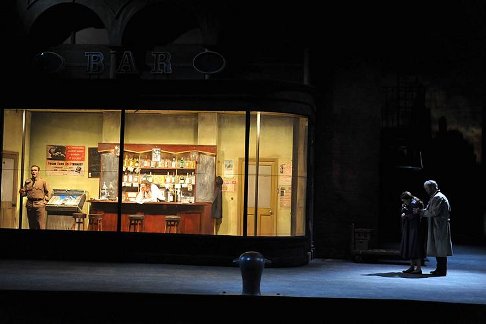 Anthony Michaels-Moore (Rigoletto) and Katherine Whyte (Gilda)
Stephen Lord, another American, conducted tautly and with brisk tempi for the most part; the only misjudgement was allowing Fabiano plenty of rubato in ‘La donna e mobile’ (‘Women abandon us’) — not an issue in itself, but inconsistent with Miller’s famous take on it whereby the Duke calls the song up on Sparafucile’s jukebox.
Ruth Elleson © 2009