![Karita Mattila as Tosca [Photo by Ken Howard courtesy of Metropolitan Opera]](http://www.operatoday.com/TOSCA_Mattila_0156a.gif)
09 Oct 2009
Tosca at the MET
In the end the performance does not rescue the dreary new production — still, the reason to visit the Met’s new Tosca is Karita Mattila’s bravura if wrongheaded interpretation of the title role.
English Touring Opera are delighted to announce a season of lyric monodramas to tour nationally from October to December. The season features music for solo singer and piano by Argento, Britten, Tippett and Shostakovich with a bold and inventive approach to making opera during social distancing.
This tenth of ten Live from London concerts was in fact a recorded live performance from California. It was no less enjoyable for that, and it was also uplifting to learn that this wasn’t in fact the ‘last’ LfL event that we will be able to enjoy, courtesy of VOCES8 and their fellow vocal ensembles (more below …).
Ever since Wigmore Hall announced their superb series of autumn concerts, all streamed live and available free of charge, I’d been looking forward to this song recital by Ian Bostridge and Imogen Cooper.
The Sixteen continues its exploration of Henry Purcell’s Welcome Songs for Charles II. As with Robert King’s pioneering Purcell series begun over thirty years ago for Hyperion, Harry Christophers is recording two Welcome Songs per disc.
Although Stile Antico’s programme article for their Live from London recital introduced their selection from the many treasures of the English Renaissance in the context of the theological debates and upheavals of the Tudor and Elizabethan years, their performance was more evocative of private chamber music than of public liturgy.
In February this year, Albanian soprano Ermonela Jaho made a highly lauded debut recital at Wigmore Hall - a concert which both celebrated Opera Rara’s 50th anniversary and honoured the career of the Italian soprano Rosina Storchio (1872-1945), the star of verismo who created the title roles in Leoncavallo’s La bohème and Zazà, Mascagni’s Lodoletta and Puccini’s Madama Butterfly.
Evidently, face masks don’t stifle appreciative “Bravo!”s. And, reducing audience numbers doesn’t lower the volume of such acclamations. For, the audience at Wigmore Hall gave soprano Elizabeth Llewellyn and pianist Simon Lepper a greatly deserved warm reception and hearty response following this lunchtime recital of late-Romantic song.
Collapsology. Or, perhaps we should use the French word ‘Collapsologie’ because this is a transdisciplinary idea pretty much advocated by a series of French theorists - and apparently, mostly French theorists. It in essence focuses on the imminent collapse of modern society and all its layers - a series of escalating crises on a global scale: environmental, economic, geopolitical, governmental; the list is extensive.
For this week’s Live from London vocal recital we moved from the home of VOCES8, St Anne and St Agnes in the City of London, to Kings Place, where The Sixteen - who have been associate artists at the venue for some time - presented a programme of music and words bound together by the theme of ‘reflection’.
'Such is your divine Disposation that both you excellently understand, and royally entertaine the Exercise of Musicke.’
Amongst an avalanche of new Mahler recordings appearing at the moment (Das Lied von der Erde seems to be the most favoured, with three) this 1991 Mahler Second from the 2nd Kassel MahlerFest is one of the more interesting releases.
‘And there was war in heaven: Michael and his angels fought against the dragon; and the dragon fought and his angels, And prevailed not; neither was their place found any more in heaven … that old serpent … Satan, which deceiveth the whole world: he was cast out into the earth, and his angels were cast out with him.’
If there is one myth, it seems believed by some people today, that probably needs shattering it is that post-war recordings or performances of Wagner operas were always of exceptional quality. This 1949 Hamburg Tristan und Isolde is one of those recordings - though quite who is to blame for its many problems takes quite some unearthing.
There was never any doubt that the fifth of the twelve Met Stars Live in Concert broadcasts was going to be a palpably intense and vivid event, as well as a musically stunning and theatrically enervating experience.
‘Love’ was the theme for this Live from London performance by Apollo5. Given the complexity and diversity of that human emotion, and Apollo5’s reputation for versatility and diverse repertoire, ranging from Renaissance choral music to jazz, from contemporary classical works to popular song, it was no surprise that their programme spanned 500 years and several musical styles.
The Academy of St Martin in the Fields have titled their autumn series of eight concerts - which are taking place at 5pm and 7.30pm on two Saturdays each month at their home venue in Trafalgar Square, and being filmed for streaming the following Thursday - ‘re:connect’.
The London Symphony Orchestra opened their Autumn 2020 season with a homage to Oliver Knussen, who died at the age of 66 in July 2018. The programme traced a national musical lineage through the twentieth century, from Britten to Knussen, on to Mark-Anthony Turnage, and entwining the LSO and Rattle too.
With the Live from London digital vocal festival entering the second half of the series, the festival’s host, VOCES8, returned to their home at St Annes and St Agnes in the City of London to present a sequence of ‘Choral Dances’ - vocal music inspired by dance, embracing diverse genres from the Renaissance madrigal to swing jazz.
Just a few unison string wriggles from the opening of Mozart’s overture to Le nozze di Figaro are enough to make any opera-lover perch on the edge of their seat, in excited anticipation of the drama in music to come, so there could be no other curtain-raiser for this Gala Concert at the Royal Opera House, the latest instalment from ‘their House’ to ‘our houses’.
"Before the ending of the day, creator of all things, we pray that, with your accustomed mercy, you may watch over us."
In the end the performance does not rescue the dreary new production — still, the reason to visit the Met’s new Tosca is Karita Mattila’s bravura if wrongheaded interpretation of the title role.
Mattila plays the prima donna Floria Tosca as an over-the-top old-school diva, all self-dramatizing nervous energy. This is dangerous, as the events of the last day of Tosca’s life would excite a buried Samuel Beckett heroine from torpor into frenetic activity: Tosca endures jealous frenzies, first soothed and then confirmed, a command performance before the queen, the torture of her lover, then betraying him, a brutal seduction, a hot-blooded murder, her lover’s apparent salvation, his actual death, and a desperate leap to her own.
If none of this penetrates her self-involvement, perhaps the business with Scarpia isn’t really so bad — she just gets carried away. You know: divas! Certainly the final scene of Act II in the Luc Bondy production is a tasteless mistake — Mattila’s Tosca seems neither stunned nor shocked by having been driven to murder. She plots it beforehand, hides the dagger, arranges her dress so as to incite him, kicks him off the sofa afterward to present a better “stage picture,” and in describing the event to Cavaradossi later, she acts it all out — clearly enjoying every moment spent in the limelight of her imagination. If Tosca is too self-involved to be touched by murder, if she looks upon it as just another chance to seize center stage, why should we care about her? why credit her with any genuine feelings?
While Mattila is performing, though, such thoughts seldom intrude. She whirls about the ugly barn of a church like a Roman dervish, she seizes her lover’s paintbrush to alter the Magdalen’s eyes; she exposes her legs for Scarpia’s rape; and she insists that Cavaradossi rehearse his “fake” execution with her. She cannot be still for a moment — and the payback is her “Vissi d’arte,” when, drained by Scarpia’s brutality, she goes pale and empty, lets her voice float stunned into the theater. She does not remain crushed — nothing but death will stop this woman’s playacting — but the moment itself is riveting, and the rest of Mattila’s Tosca seems designed to draw our attention to it. Since this is not the heart of the opera — Puccini reportedly found the aria a bit dull — her focus highlights Mattila’s errors elsewhere. Tosca must grow from the flibbertigibbet of Act I to the desperate adventuress of Act III, and Mattila’s Tosca does not make such a change. Her reaction to getting blood on her hands? She puts on purple gloves.
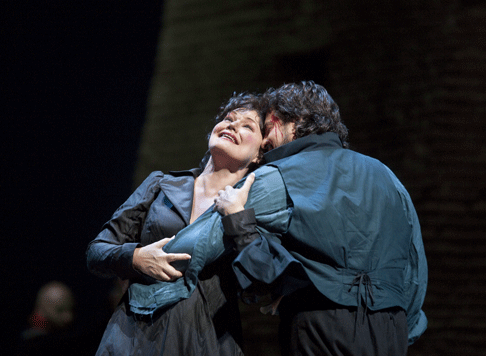 Karita Mattila in the title role and Marcelo Alvarez as Cavaradossi [Photo by Ken Howard courtesy of Metropolitan Opera]
Mattila’s voice is not Italianate — as everyone has been saying since she took up Manon Lescaut a few years back. Her Manon Lescaut indeed lacked the opulent young sound of that teenage sensualist — but Tosca is a mature woman, and Mattila sings her with full-throated sensuality, passion without wilt or waver. I’ve seen Toscas of a dozen nationalities, and her sound is more idiomatic, and more beautiful, than many others of the “Nordic” school — Behrens, Nilsson and Vishnevskaya come to mind. More important is that she feels, and lives, the notes of this extreme character.
Marcelo Álvarez (an Argentinian) sings a very Italian Cavaradossi, suave and romantic in “Recondita armonia” and the love duets. He lacked vocal finesse only in “E lucevan le stelle,” which was not the honeyed reverie many tenors give us. Álvarez seemed so involved in acting the words — each one clear — that the anguish of his situation choked him up. The elegiac scene that followed, however, found him Mattila’s match for power and expressive beauty.
Carlo Guelfi sang a gruff, barking Scarpia, brutally effective in Act I, but the nuanced slime of Act II was missing — and was missed. Part of the problem may have been the intrusion of three prostitutes fooling with him at the opening of Act II, and this is typical of the director’s initiatives in adding nothing to the show but unanswerable questions. Scarpia is explaining the trap he plans to set for Tosca — and why: he enjoys sex when the lady resists — and these women don’t take the hint — not at all. Are they the sort of persons in whom Scarpia would confide? No — he’s not the type to confide in anyone, least of all a woman — he’s an egotist who opens himself in soliloquy. So why are the dames here? If we’re not supposed to think about it, or to wonder why they’re hanging around, why their presence and those questions being shoved in our faces? Does Mr. Bondy not understand the words Scarpia is singing? Similarly, if the enormous church is built of unpainted brick — this is Rome? — why is Cavaradossi painting his Magdalen in it?
Tosca is a finely-crafted machine, every effect calculated to a hair; set it in motion with the proper fuel (voices and orchestra) and it will run smooth as a Lamborghini. Each entrance gives us the character: Tosca’s sensuous piety (in a theme that will come back in “Vissi d’arte”), Cavaradossi’s romantic idealism, Angelotti’s desperation. The first appearance of Scarpia is the most terrifying entrance in all opera — because Puccini set it up to be, thrusting it into the midst of a rollicking (but thirty-second-long) children’s scene. We are never supposed to relax after that, whenever Scarpia is around — and that tension pays dividends as Tosca takes her time suspecting what we feel in our skin: this man is setting his trap for her. Why are those whores getting in the way of our focus on a monomaniac evil?
Then there’s dawn amid the bells of Rome, gentle precisely so that it can be interrupted by the grim preliminaries of an execution. To rehearse the firing squad during this serene music does not bring us to the proper frame of mind for a jolt — on the contrary, it gives us a preliminary jolt that undercuts Puccini’s. We should relax until the jailor summons Cavaradossi — but try resting with all that pointless activity on Mr. Bondy’s stage.
To this ugly and irritating concept, the familiar Met forces under Joseph Colaneri brought a symphonic grandeur: the pounding strings rising to climax in Tosca’s scream as Scarpia corners her, the surge of life around the organ processional that ends Act I, the subtle flicks of this instrument or that to comment on character or story or the very real world in which the opera was set — all reminded us of how fine a contraption of interacting parts Puccini devised, even as Mr. Bondy was tearing them apart and flinging them to the winds. I liked Mattila’s abruptly blank face during “Vissi d’arte,” and Joel Sorenson’s (Spoletta’s) look of frustrated, “You’re going to let her get away with that?” during Scarpia’s interrogation, and the way Álvarez was always gazing at, and admiring, his lover — but these touches were probably invisible to most of the house.
The problem with this school of direction is that its practitioners seem to regard the score like music in a film, as an afterthought, mere accompaniment to action. It is not. In opera, the music is the main event — or as much of it as the action is. Action need not be invented to fill up spaces where there is merely music — the spaces of mere music are there for dramatic reasons. To change things without justification is not very good theater.
John Yohalem